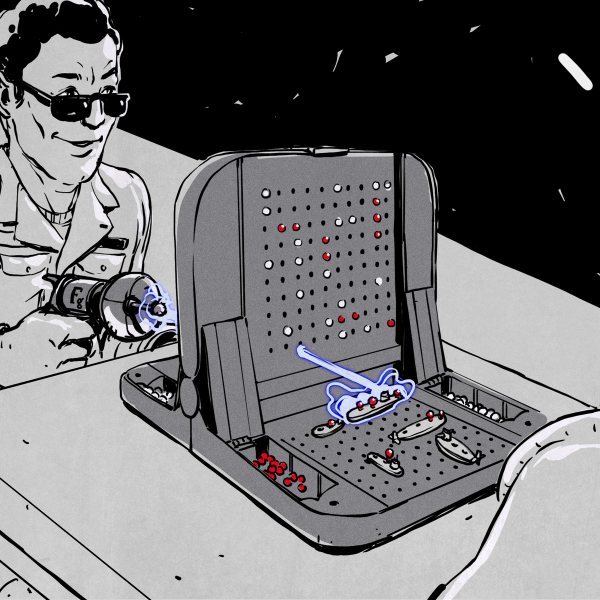
The Singularity Isn’t Here… Yet

So, GPT-4 is out, and it’s all over for us meatbags. Hype has reached fever pitch, here in the latest and greatest of AI chatbots we finally have something that can surpass us. The singularity has happened, and personally I welcome our new AI overlords.

Hang on a minute though, I smell a rat, and it comes in defining just what intelligence is. In my time I’ve hung out with a lot of very bright people, as well as a lot of not-so-bright people who nonetheless think they’re very clever simply because they have a bunch of qualifications and diplomas. Sadly the experience hasn’t bestowed God-like intelligence on me, but it has given me a handle on the difference between intelligence and knowledge.

My premise is that we humans are conditioned by our education system to equate learning with intelligence, mostly because we have flaky CPUs and worse memory, and that makes learning something a bit of an effort. Thus when we see an AI, a machine that can learn everything because it has a decent CPU and memory, we’re conditioned to think of it as intelligent because that’s what our schools train us to do. In fact it seems intelligent to us not because it’s thinking of new stuff, but merely through knowing stuff we don’t because we haven’t had the time or capacity to learn it.

Growing up and making my earlier career around a major university I’ve seen this in action so many times, people who master one skill, rote-learning the school textbook or the university tutor’s pet views and theories, and barfing them up all over the exam paper to get their amazing qualifications. On paper they’re the cream of the crop, and while it’s true they’re not thick, they’re rarely the special clever people they think they are. People with truly above-average intelligence exist, but in smaller numbers, and their occurrence is not a 1:1 mapping with holders of advanced university degrees.

Even the examples touted of GPT’s brilliance tend to reinforce this. It can do the bar exam or the SAT test, thus we’re told it’s as intelligent as a school-age kid or a lawyer. Both of those qualifications follow our educational system’s flawed premise that education equates to intelligence, so as a machine that’s learned all the facts it follows my point above about learning by rote. The machine has simply barfed up what it has learned the answers are onto the exam paper. Is that intelligence? Is a search engine intelligent?

This is not to say that tools such as GPT-4 are not amazing creations that have a lot of potential to do good things aside from filling up the internet with superficially readable spam. Everyone should have a play with them and investigate their potential, and from that will no doubt come some very interesting things. Just don’t confuse them with real people, because sometimes meatbags can surprise you.
Review: XHDATA D-219 Short Wave Radio Receiver

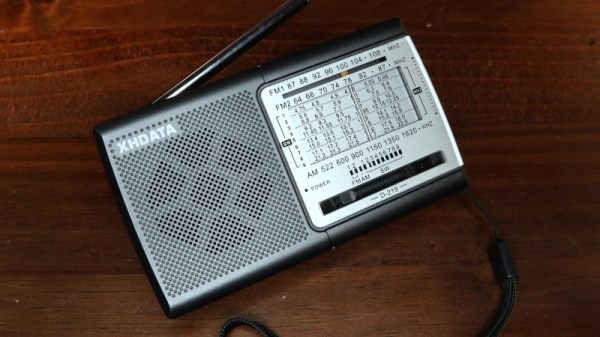
As any radio amateur will tell you, the world of radio abounds with exciting possibilities. Probably the simplest pursuit of them all is that of the SWL, or short wave listener, who scours the airwaves in search of interesting stations. SWLs will often have fully-featured setups with high-end general-coverage communications receivers and tuned antenna arrays, but it can start with the cheapest of radios at its bottom end. Such a radio is the subject of this review, the XHDATA D-219 is a miniature portable receiver that costs under ten dollars, yet is currently the talk of the town in SWL circles. This interest is in no small amount due to its being an especially low-price way to get your hands on a shortwave radio using one of the SIlicon Labs integrated software-defind radio receiver chips. We don’t often review a consumer radio here at Hackaday, but with an avid eye for unexpected gems at the cheaper end of the market this one’s worth a second look.

What Do You Get For Your Tenner?

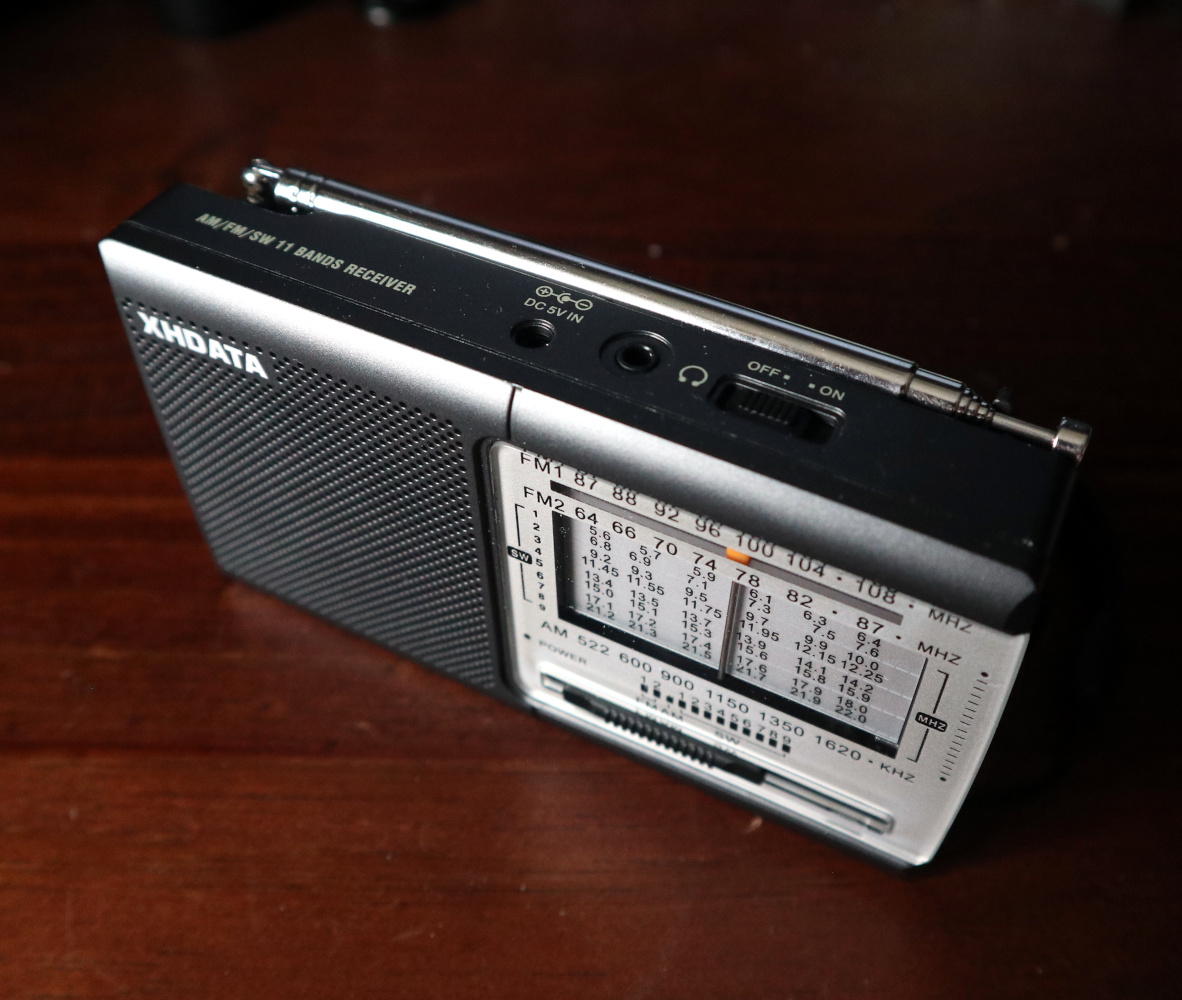
A picture of the radio on my bench
This form factor is very typical for cheap “world band” radios.

I ordered my D-219 from the XHDATA website, spending about £10 including the postage from China. The usual wait ensued before the package landed on my doormat, and inside was the radio in its box with an instruction leaflet. It’s a small unit about 135 mm x 75 mm x 30 mm, and it follows closely the form factor of other similar radios.

On the top is the extensible antenna with an on-off switch and sockets for headphone and 5 V power, on the side are side-on knobs for tuning and volume, while on the front is the speaker and old-style multi-band tuning display.

On the back is a flip-up stand and a hatch for a pair of AA cells. There’s a band switch covering AM, nine different shortwave bands from 4.75 MHz to 22 MHz, the east Asian FM band from 64 MHz to 87 MHz, and the international FM band from 87 MHz to 108 MHz. The tuning indicator is very old-school, a vertical bar that moves across a frequency scale with the tuning knob. Continue reading “Review: XHDATA D-219 Short Wave Radio Receiver”

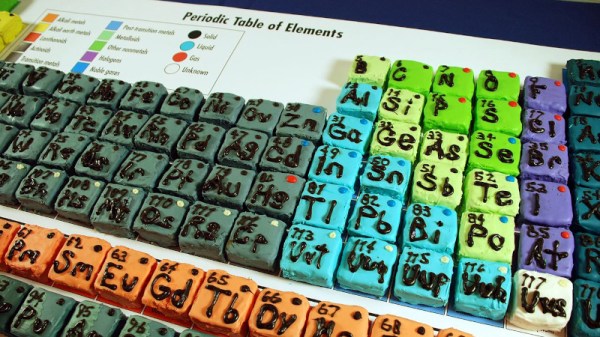
The Curious Etymology Of The Elements

It’s not often that the worlds of lexicography and technology collide, but in a video by the etymologist [RobWords] we may have found a rare example. In a fascinating 16-minute video he takes us through the origins of the names you’ll find in the periodic table. Here’s a word video you don’t have to be on the staff of a dictionary to appreciate!

Etymology is a fascinating study, in which the scholar must disentangle folk etymologies and mistaken homophones to find the true root of a word. Fortunately in the case of most elements they bear a name bestowed on them by the scientists who discovered them, so their etymologies are rarely in dispute.

The etymologies split neatly into categories, with among them such distinctions as Latin or Greek descriptions, places including the Swedish village of Ytterby which has more elements named after it than anywhere else, elements named for mythological figures, and those named for people.

He artfully skates over the distinction between aluminium and a curiously similar metal the Americans call aluminum, because etymologists are used to deflecting controversy when language differences colour, or even color, people’s emotions. Thank you, Noah Webster!

It’s an entertaining diversion for anyone with a love of both science and of language, and should remind us that the study of language has just as much scientific rigour in its research as any of those elements.

Continue reading “The Curious Etymology Of The Elements”

A Fancy Connected Caliper For Not A Lot

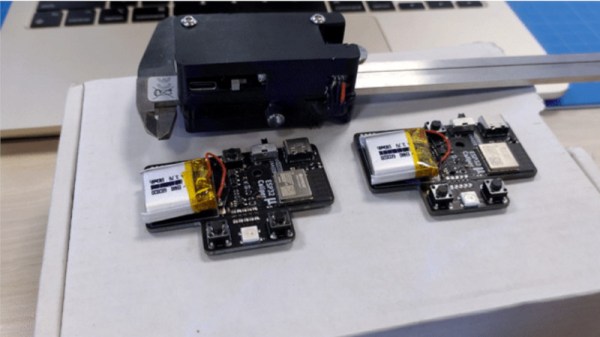
An essential for the engineer is a decent caliper, to measure dimensions with reasonable accuracy. Some of us have old-fashioned Vernier scales, while many up-to-date versions are electronic. When entering large numbers of dimensions into a CAD package matters can become a little tedious, so the fancier versions have connectivity for automatic reading transfer. [Mew463] didn’t want to shell out the cash for one of those, so modified a cheaper caliper with an ESP32-C3 microcontroller to provide a Bluetooth interface.

Many cheaper calipers have a handy hidden serial port, and it’s to this interface the mod is connected via a simple level shifter. The ESP and associated circuitry is mounted on a custom PCB on the back of the caliper body, with a very neatly designed case also holding a small Li-Po cell. It adds a little bulk to the instrument, but not enough to render it unusable. Whether the work required to design and build it is worth the cost saving over an off-the-shelf connected caliper is left to the reader to decide.

We’ve covered similar hacks in the past, but this one’s to a very high standard. Meanwhile if calipers are of interest to you then they’re a subject we’ve examined in some significant detail.

27 Litres And 12 Cylinders, With A Practical Station Wagon Body

If you were to name one of the most famous individual road cars in the world, what would it be? If you’re British and of a Certain Age, then it’s possible your nomination is for sale, because “The Beast”, the one-off creation of [John Dodd] using a 27-litre Rolls-Royce Merlin aero engine, is up for auction. The Late Brake Show’s [Jonny Smith] has given it a drive, and we’ve pasted the resulting video below the break.

A second-hand motor isn’t usual Hackaday fare, but it’s the manner of this car’s building which we think will draw you in. [John] originally acquired somebody’s failed project featuring not a Merlin but its de-tuned derivative intended for tanks. He solved the problem of finding a transmission able to handle the immense power, and built it up with a pretty 1970s coupe body. After a fire a few years later he commissioned a new body from a dragster manufacturer, which is the wildly period estate car you’ll see in the video. It famously originally had a Rolls-Royce Cars grille, for which he ended up in court in the 1980s as the carmaker sought successfully to have it removed.

The tale of this car is one of epic scale hackery, as there is quite simply nothing else like it. It was once the world’s most powerful road car, and remains capable of well over 200 miles per hour. Sadly we couldn’t afford to buy it even if we could fit its immense length in our parking space.

Hungry for more epic British car hackery? Have we got the roadster for you!

Continue reading “27 Litres And 12 Cylinders, With A Practical Station Wagon Body”

Hacker Hotel 2023 Had A Very Cool Badge

One effect of the global pandemic was that there were relatively few events in our sphere for a couple of years. This and that other by-product of COVID-19, the chip shortage, meant that over the past year we’ve been treated to several event badges that should have appeared in 2020 or 2021, but didn’t due to those cancelled events. We were lucky enough to receive probably the last of these delayed badges in mid February, as we made the journey to the central part of the Netherlands to Hacker Hotel 2023.

A Puzzle, A 4-Bit Computer, And An Artwork

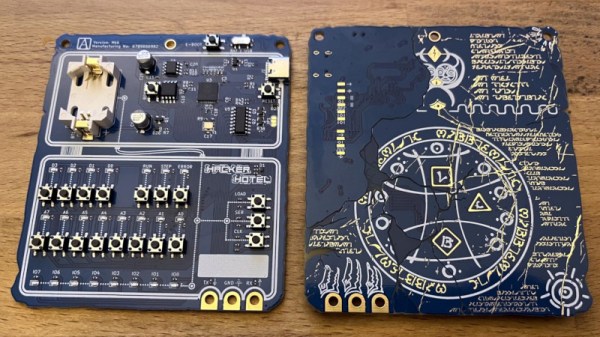
The badge takes the form of a rectangular PCB with all parts on the top side. The brains of the operation is an RP2040, and it’s powered by a CR2032 coin cell in a holder.  It’s divided into two parts, the top third which carries the circuitry and the lower two thirds of which as a row of buttons and LEDs. It’s pretty obvious from the start that it has data and address lines of a 4-bit computer, and as well as these there is an evident serial port and a USB socket. The artwork comes form the same artist whose work graced both the previous Hacker Hotel badge and the MCH2022 badge, and the rear of the PCB makes full use of all layers to create a mystical puzzle. The sum is to create a puzzle game intended to entertain the visitor, take them round the venue, and find clues to an eventual solution. I love the design both from an artistic and technical viewpoint, but have to admit that the puzzle aspect isn’t really my thing. Thus here we’ll concentrate on the badge hardware and production, and mention the puzzles only in passing. Continue reading “Hacker Hotel 2023 Had A Very Cool Badge”

A Tape Loop Echo You Can Build

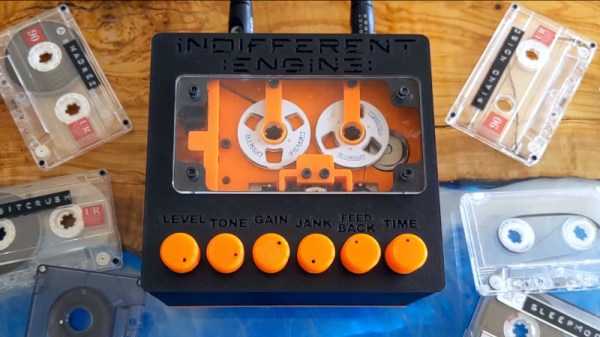
Echo and reverb are now electronic audio effects done in a computer or an integrated circuit, but originally they were achieved through mechanical means. Reverb units used springs, and echo units used loops of magnetic tape. As a musician hankering after a mechanical tape echo unit, [Adam Paul] was left with no choice but to build his own. We featured an early prototype, but now he’s back with a finished version that’s intended to be replicated by other musicians.

The unit takes a cassette mechanism from one of the last still-manufactured players available through the usual sources. It splits record and play heads, with the normal cassette replaced with a tape loop made from extra-thick computer tape. A custom PCB replaces most of the electronics, and the auto-reverse system is disabled.

The result is a functional tape echo system, as can be seen in the video below the break. This is ready to build yourself, with everything on a GitHub repository and an extremely comprehensive build guide, so do any of you fancy a go?

Read about the device’s earlier incarnation here.

Continue reading “A Tape Loop Echo You Can Build”