Hackaday Prize 2022: A Plasma Tweeter For Ultimate Clarity

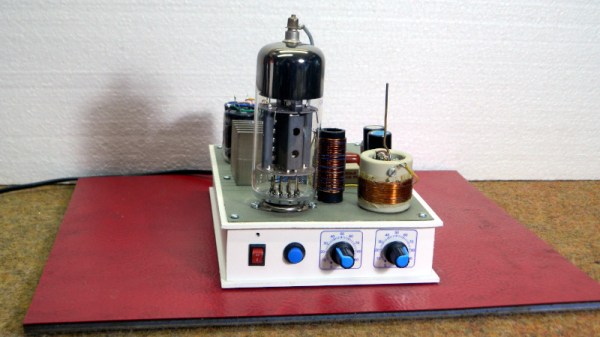
In the world of audio there are a huge variety of esoteric technologies which are rarely seen. One such is the plasma tweeter, a type of loudspeaker which generates sound by modulating a small electrical discharge. The benefit of this design comes in its delivering the closest possible to a point audio source, in effect the theoretical ideal speaker for treble frequencies. They’re a little hazardous due to the voltage but aren’t too difficult to make, as demonstrated by [Mircemk] whose version uses a recycled power pentode tube — which is how it showed up in the Hack it Back round of the Hackaday Prize.

It can be thought of as a cousin of the Tesla coil, with the same resonant oscillator but no capacity hat. Instead the top of the coil ends in a point, from which in the perfect speaker a ball of plasma replaces the Tesla’s impressive sparks. In this case the pentode is joined by a high-voltage TV line output transistor as a bias supply, which is in turn modulated with the audio through a small amplifier. It sometimes needs the plasma teasing out of it through discharge to a screwdriver, but the result is a very effective and clear plasma tweeter.

If plasma tweeters interest you, we’ve featured them before.

Was There A Programmable PONG Chip?

Students of game console history will reach back into the 1970s for the primordial machines, tracing from the Magnavox Odyssey onwards, and thence via the Fairchild Channel F into the world of microprocessors and the chain of machines that lead us to those we enjoy today. In the early days there was a parallel evolution for a few years of dedicated video game consoles with no interchangeable cartridges or microprocessors, these took their inspiration from the legendary PONG arcade game and used dedicated non-programmable hardware in custom chips to create their video. But was there a programmable PONG chip lurking among all the others? [Old VCR] takes a look.

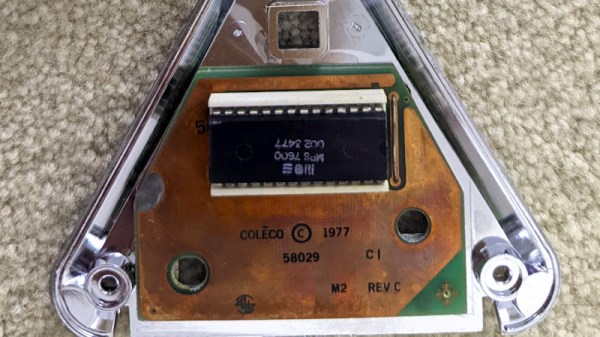
Many readers will be familiar with MOS Technology as the originator of the 6502 processor used in so many 8-bit home computers. But perhaps many of our attention spans will have passed over another of their products, the MOS 7600 and 7601. These were the chip company’s entry into the surprisingly congested mid-70s PONG-in-a-chip market, and the article investigates the question of whether they might in fact be mask-programmed microcontrollers masquerading as dedicated chips.

It’s a fascinating tour through the mid-70s in terms of games consoles, MOS, and through their eventual takeover, Commodore. The possibility of a mask-programmed PONG chip is explored in detail and discounted, though like [Old VCR], we’d love to see one decapped and reverse engineered. For us a stronger line of evidence comes in asking why MOS would stop at PONG if they had a mask-programmed microcontroller in their catalogue, and that our not having seen MOS microcontrollers appearing all over Commodore’s subsequent products suggests that it may be simply another dedicated PONG chip like all the others.

We’ve seen quite a few variants of this iconic game over the years, but few as impressive as one made from discrete components.

Hackaday Prize 2022: DIY Brushless Hand Cranked Generator

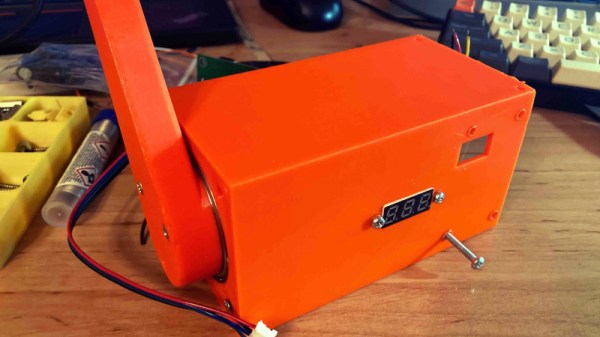
A standard part of travel kit for the 2020s is now a battery pack — a hefty lithium-ion cell with onboard electronics for USB charging, that ensures all of our devices stay topped up while we’re out of range of a socket. But what happens when there is no handy mains supply to recharge it from? Step in [Chleba], with a hand cranked generator.

There are plenty of hand cranked generators to be found online, from tiny devices intended to top up a single phone to sturdy metal boxes intended for battery charging. This one differs from those in that most use a brushed DC motor as a cheap generator, while here that function comes from a stepper motor feeding a rectifier pack and thence a DC-to-DC converter. A step-up gearbox provides the necessary shaft speed, and a neat 3D-printed case rounds everything off.

The result is about as neat a generator as you could imagine, and would certainly be of use shoved into any off-grid backpack. Meanwhile it’s not the first we’ve shown you, we’ve even see one that could start a car.

Buzzword Bingo Bitcoin Burial Burrowing Blueprint Balked At By Bureaucracy

Many of you will at some time have heard the unfortunate tale of [James Howells], a Welsh IT worker who threw away a hard drive containing 8,000 Bitcoin back in 2013. Over the years he’s hatched various schemes to persuade his local council to let him dig up the landfill where it’s reputed to be buried, and every time he’s been rebuffed. Despite the fall in the price of cryptocurrencies he’s back with another. With the added spice of AI and robot dogs alongside the cryptocurrency angle, it reads like a buzzword bingo card and adds a whole new meaning to “Bitcoin mining”. Seemingly despite generous offers the local council are still not keen on letting him dig for the drive.

We can’t help feeling sorry for the guy — after all, in the early days of cryptocurrency the coins were a worthless curiosity so it’s not impossible there are readers with similar stories. But we’re curious how well the drive will have survived its 9-year interment even if the AI robot arm and robot dog security would ensure its recovery. With that much cash at stake the best in the data recovery business will no doubt be unleashed on whatever remains they might recover, but in the unfriendly environment of a festering landfill we’d be curious as to whether chemical action might have corroded the platters to the point at which nothing might remain. Wales has a high rainfall unlike the American southwest, so we doubt it would survive as well as an Atari cartridge.

Meanwhile, tell us your cryptocurrency might-have-beens in the comments.

Landfill Site sign by Geographer, CC BY-SA 2.0.

The Hackaday Summer Camp Survival Guide

It’s a feature of summer for us, the round of hacker camps in which members of our community gather in fields and spend a few days relaxing and doing what we do best. This summer I’ll have been to four of them by September, one of which was unexpected because a last-minute ticket came my way. For Hackaday they’re a chance to connect with our readers and maybe see come of the coolest stuff in person.

If you consult the wiki for your hacker camp of choice then you’ll usually find a page of tips about what to bring. Starting with a tent and a sleeping bag and probably going on to sunscreen, a hat, and maybe how to avoid dehydration. I’d probably add spare toilet paper and disinfectant spray in case the toilets are nightmarish. All very practical stuff, but expressed in a dry list format that doesn’t really tell you what to expect. A hacker camp can be overwhelming if you’ve not been to one before, so how do you get the best out of it? Here are a few tips based on our experience. Continue reading “The Hackaday Summer Camp Survival Guide”

Self-Hosted Pi Pico Development

Older readers and those with an interest in retrocomputing may remember the days when a computer might well have booted into a BASIC interpreter. It was simultaneously a general purpose device that could run any software it would load, and also a development environment. Not something that can be said for today’s development boards which typically require a host computer on which to write code. Have we lost something along the way? Perhaps an answer to that question can be found in [lurk101]’s self-hosted development environment for the Raspberry Pi Pico.

It presents itself as a shell, with a flash file system, a port of the vi editor, and a C compiler. We might think of vi as being more at home on a UNIX-derived system, but in this case it’s a port of the vi included in BusyBox. Meanwhile the compiler comes from amacc project.

Of course, this still requires a terminal of some type which in practice will mean a host computer. But the feat is nevertheless an interesting one, and we can see that it might not be impossible given the Pico’s surprising versatility to being some of the terminal features onto the chip itself.

It’s worth noting that this isn’t the first attempt we’ve seen to put a command line interface on a development board.

Electrolytes, They’re What Dehydrated Hackaday Writers Crave!

The oddly prophetic 2006 comedy film Idiocracy features an isotonic drink called Brawndo, whose marketing continuously refers to its electrolytes as a miraculous property. Brawndo is revealed in the film to be useless for agricultural irrigation, but yesterday perhaps a couple of Hackaday writers could have used a bottle or two. At the MCH hacker camp, the record heat of a Dutch summer under the influence of global warming caused us to become dehydrated, and thus necessitated a trip to the first aid post for some treatment. We’d done all the right things, staying in the shade, keeping as cool as we could, eating salty foods like crisps, and drinking plenty of liquids, so what had gone wrong?

Perhaps Club-Mate Should Have An Isotonic Version

The answer will probably be obvious to trained observers, we’d become deficient in those electrolytes. Our bodily stocks of sodium and potassium salts had become exhausted by sweat and all that extra water requiring trips to the toilet, so while we weren’t dehydrated in liquid terms we had exhausted some of the essentials to our cellular function.

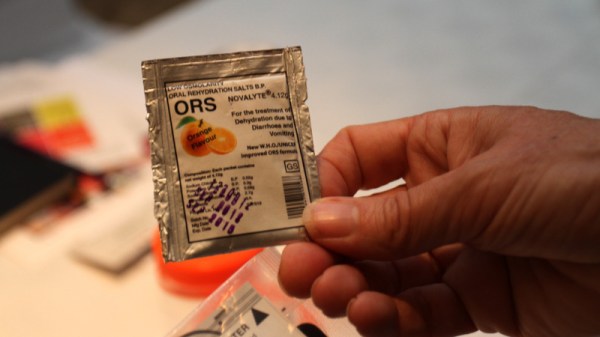
The symptoms would have been easy to spot given the right training, but at a hacker camp it was too easy to attribute a headache and tiredness to a late night. For me the point at which it became obvious something was significantly wrong came when my thought processes started to slow down and my movement became a lot less easy. I’m a long-distance walker and cyclist, yet here I was walking like an octogenarian. If I’d know what to spot I might also have noticed that I had stopped sweating despite the heat. I found a friend (Thanks Gasman!), and together we made our way to the first aid post. MCH2022 first aiders were very efficient, and I was given a cup of oral rehydration salts which restored me to health in a matter of minutes. Continue reading “Electrolytes, They’re What Dehydrated Hackaday Writers Crave!”