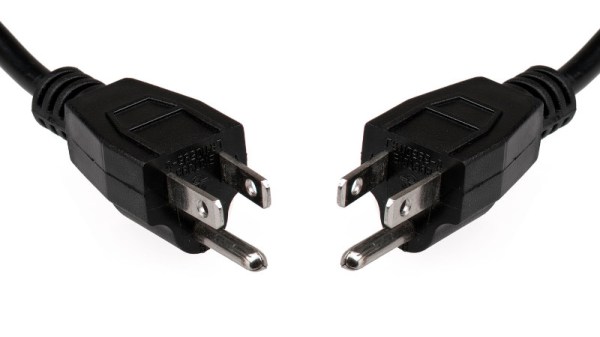
The CPSC Says Plug To Socket, Not Plug To Plug, Please

When the power goes out, it goes without saying that all the lights and sockets in a house stop working. Savvy rural homeowners stock up with candles, batteries, LED lights, and inverters.  More foolhardy folks simply hook up their home electrical system to a generator using a mains lead with a plug on one end between the generator and a wall socket. This should be so obviously dangerous as to be unnecessary, but it’s become widespread enough that the US Consumer Product Safety Commission has issued a warning about the practice. In particular, they’re concerned that there’s not even a need to wire up a lead, as they’re readily available on Amazon.

The dangers they cite include electrocution, fire hazard from circumventing the house electrical protection measures, and even carbon monoxide poisoning because the leads are so short that the generator has to be next to the socket. Hackaday readers won’t need telling about these hazards, even if in a very few and very special cases we’ve seen people from our community doing it. Perhaps there’s a flaw in the way we wire our homes, and we should provide a means to decouple our low-power circuits when there’s a power cut.

It’s likely that over the coming decades the growth of in-home battery storage units following the likes of the Tesla Powerwall will make our homes more resilient to power cuts, and anyone tempted to use a plug-to-plug lead will instead not notice as their house switches to stored or solar power. Meanwhile, some of us have our own ways of dealing with power outages.

Plug image: Evan-Amos, Public domain.
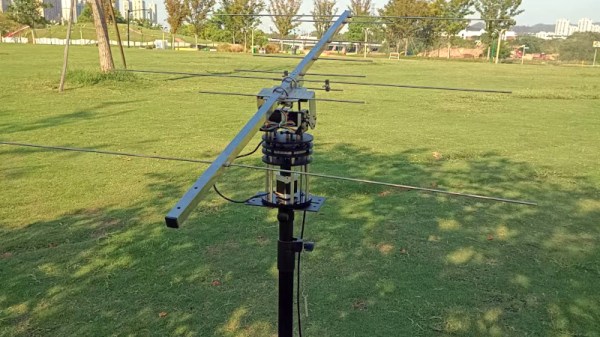
AntRunner Is The Satellite Antenna Mount You Need To Take With You

It stands to reason, that should you wish to communicate with a satellite, whatever antenna you use should point at that satellite. Some of us have done this by hand, following the bright dot of the space station in the night sky. Still, for anything more serious than trying to catch a fleeting SSTV image, a more robust solution is called for. In other words, a motorized antenna rotator, and AntRunner from [Wuxx] is just the ticket. Better still, it’s portable for those /p operating sessions off the beaten track.

The rotator itself is an az-el design with a couple of geared stepper motors. The full mechanism design has been published, but it shouldn’t be too difficult to copy. The interesting part is the controller and software, which can work with Gpredict, Hamlib, and SDR for automated satellite tracking. The controller is as straightforward as an ESP32 running the ESP port of GRBL.

So here’s a portable antenna rotator that’s accessible and widely supported, what’s not to like? As you might expect though, it’s not the first we’ve seen. In fact, the 2014 Hackaday Prize was won by SatNOGs, which includes a 3D printed antenna positioner.

Thanks [Abe Tusk] for the tip!

A Pill Dispenser For The Person With Everything

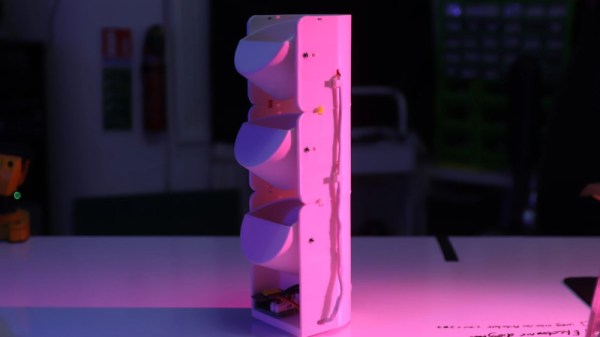
Sorting out pills is a mildly tedious task, and one that’s ripe for a bit of automation. It’s a task that [Mellow] has taken on enthusiastically, with the result of an extremely well-designed dispenser that has a stack of hoppers with servos controlled by an ESP8266 that dispense the pills required on time.

There are a series of videos of which we’ve put the latest below the break, showing the various iterations of this project. Earlier versions used multiple microcontrollers rather than the single ESP, and his sensor choice is both simple and ingenious. A single vibration sensor detects the pills falling upon it, resulting on an extremely compact electronics set-up and the base of the 3D printed stack.

We’re struck by this design, by its simplicity, ingenuity, and its pleasing aesthetics with the use of a piece of perfboard and a load of heatshrink to make an extremely tidy wiring loom. We’re not sure we’ll ever need a pill dispenser like it, but if we did we don’t think we could come up with a better design.

You might be surprised to find that pill dispensers have appeared here before.

Continue reading “A Pill Dispenser For The Person With Everything”

Billet Machining A Special Xbox

The world of console modding has delivered us some amazing projects over the years, usually rendering an original into a completely different form factor. [Modified] has done a special bit of console modding on an Xbox Series X, with the unusual result of keeping exactly the same form factor. What makes it special? His Series X has been given a new case, almost identical to the original, but instead of molded plastic it’s machined entirely from a single billet of aluminium stock.

From one perspective it’s a slightly crazy endeavor — pushing the limits of his mill to remove 90% of the stock. But from another it’s an interesting tale of how to approach such a project, of the challenges in reaching further into a workpiece than the tooling is designed for, and also of the cooling for the Xbox itself. Sure he could have made it from aluminium plate and screwed it together, but in doing so he’d have denied us the chance to follow a machining adventure.

The result is an Xbox that’s nominally the same as when it left the factory, but which looks so much cooler. Oddly the aluminum doesn’t act as a heatsink because the console is air-cooled, but particularly on the bottom there are more holes than were found in the original. On the front is an engraving of Master Chief from Halo 2‘s cover art which really puts the finishing touch on the build — though we wonder whether it might benefit from a little resin to make it stand out a bit.

Hungry for more Series X case mods? They don’t come bigger than this one!

Continue reading “Billet Machining A Special Xbox”

How The BBC (Still) Sends Audio To Transmitter Sites

Running a radio station is, on the face of it, a straightforward technical challenge. Build a studio, hook it up to a transmitter, and you’re good to go. But what happens when your station is not a single Rebel Radio-style hilltop installation, but a national chain of transmitter sites fed from a variety of city-based studios? This is the problem facing the BBC with their national UK FM transmitter chain, and since the 1980s it has been fed by a series of NICAM digital data streams. We mentioned back in 2016 how the ageing equipment had been replaced with a modern FPGA-based implementation without any listeners noticing, and now thanks to [Matt Millman], we have a chance to see a teardown of the original 1980s units. The tech is relatively easy to understand from a 2020s perspective, but it still contains a few surprises.

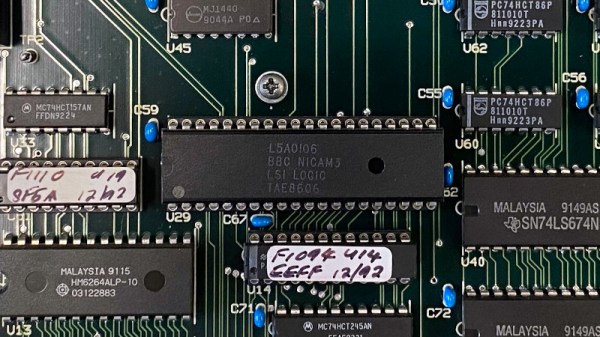
In each studio or transmitter site would have been a 19″ rack containing one of these units — a card frame with a collection of encoder or decoder cards. These are all custom-made by the BBC’s engineering department to a very high standard, and use period parts such as the familiar Z80 microprocessor and some Philips digital audio chips, which followers of high-end consumer audio may recognize. As you’d expect for a mission critical device, many of the functions are duplicated for redundancy, with their outputs compared to give warning of failures.

The surprise comes in the NICAM encoder and decoder — it’s a custom LSI chip made exclusively for the BBC. This indicates the budget available to the national broadcaster, and given that these units have in some cases been working for over 35 years, we’re guessing that the license payers got their money’s worth.

You can read about the original switch-over in 2016, and a little more about NICAM, too.

Inexpensive Reading Glasses Become Stereoscope

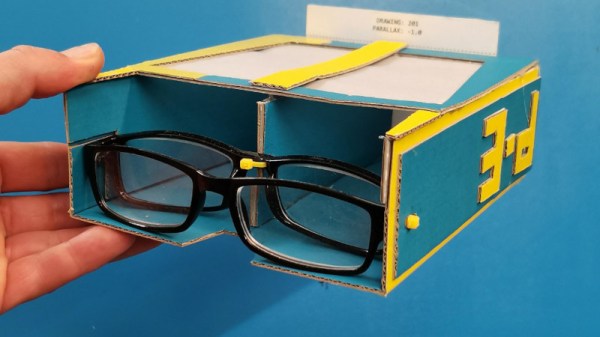
It’s an unfortunate consequence of growing older, that no longer are you able to read the print on a SOT-23 package or solder a QFN without magnification. Your eyes inexorably start to fail, and to have any hope of continuing a set of reading glasses is required. We have this in common with [Niklas Roy], who noticed while shopping for cheap reading glasses that their lenses were of surprisingly good quality. The result of this observation was a stereoscope made from card and a few euros worth of eyewear.

In the tradition of [Niklas]’ work it has a high level of attention to detail, which manifests itself here in a parametric web-based template generator to produce a result tailored to your glasses. It’s a fairly straightforward trapezoid shape, with a compound lens made from two sets of glasses drilled and held back-to-back with zip ties.

It served as a project for a group of children, and of course because stereo cameras are a relative rarity he also investigated taking his own pictures by moving a smartphone for left and right eye perspectives. It seems the youngsters had a lot of fun.

These lenses hadn’t come up on our radar until now, but like many goodies in a dollar store they’re certainly something to take a look at. Maybe not as a stereoscope for everyone though, some of us can’t see what the fuss is about.

Equalize Your Listening With HiFiScan

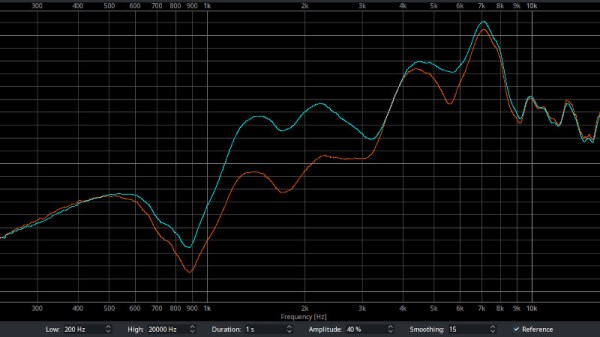
Audiophiles will go to such extents to optimize the quality of their audio chain that they sometimes defy parody. But even though the law of diminishing returns eventually becomes a factor there is something in maintaining a good set of equipment. But what if your audio gear is a little flawed, can you fix it electronically? Enter HiFiScan, a piece of Python software to analyse audio performance by emitting a range of frequencies and measuring the result with a microphone.

This is hardly a new technique, and it’s one which PA engineers have used for a long time to tune out feedback resonances, but an easy tool bringing it to the domestic arena is well worth a look. HiFiScan is a measuring tool so it won’t magically correct any imperfections in your system, however it can export data in a format suitable for digital effects packages.

Naturally its utility is dependent on the quality of the hardware it’s used with, but the decent quality USB microphone used in the examples seems to give good enough results. We see it used in a variety of situations, of which perhaps the most surprising is a set of headphones that have completely different characteristics via Bluetooth as when wired.

If audio engineering interests you, remember we have an ongoing series: Know Audio.