Iconic Yugoslavian Galaksija Computer Reborn, With A Documentary Too

One of the humbling things about writing for Hackaday is the breadth of experience among our colleagues, despite one’s own skills or achievements there is probably for all of us a level of impostor syndrome when we look at their work. This week provided a reminder of this, while taking a closer look at the crowdfunder for a documentary about the Galaksija, the Yugoslavian 8-bit computer from the 1980s designed by our colleague [Voja Antonić]. Not only will the documentary be produced, but also they are recreating the Galaksija as a kit, so you can experiment with this historic computer for yourself. The campaign has reached passed its goal a couple times over but still has a few days left, so jump in if you are interested.
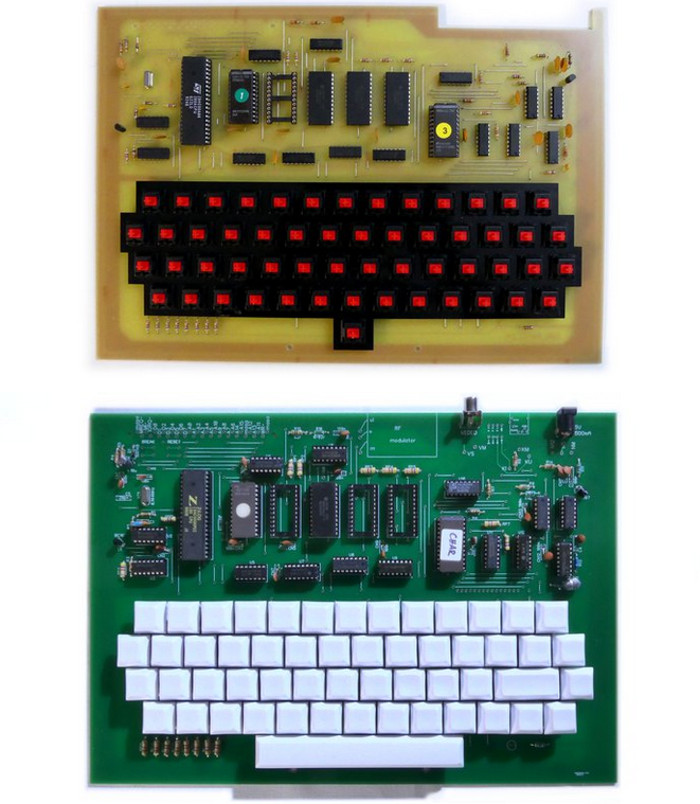
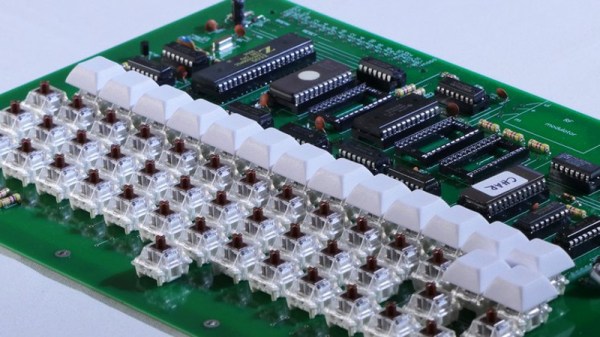
Freshly made original Galaksija (top), and new double-sided Galaksija (bottom).

With the advantage of being able to reach out to [Voja] as a colleague, it was time to secure the straight dope on the project. Though he’s not spearheading it, aside from appearing in the documentary he’s also produced the new Galaksija PCB to take advantage of double-sided manufacture and remove the wire links that were a feature of the original.

In that sense this isn’t so much a clone of the original as an updated version from the same designer, with only a few other updates such as key switches and connectors where the exact original component could no longer be sourced. A particularly fascinating side-tale comes from a reprint of the first Galaksija magazine. Photo-reproductions of the original printed pictures did not yield good results, so [Voja] built from scratch an entirely original Galaksija, carefully recreating the framing of each step shown in those original photos.

This project has faced its fair share of obstacles before launching on Crowd Supply, so it’s very good indeed to see it receive its funding with time to spare. We look forward to seeing the results, meanwhile you can see a promo video in Serbian with Youtube’s English subtitling below the break. You can read [Voja]’s writing on the machine in Hackaday articles past, but don’t miss the opportunity to meet him at a live event — he’s the mastermind behind a number of hardware badges at Hackaday events.

Continue reading “Iconic Yugoslavian Galaksija Computer Reborn, With A Documentary Too”

When Only The Tiniest Of Violins Will Do

Playing the tiniest of violins may be a phrase to encapsulate the complete lack of sympathy as someone unpleasant receives their just deserts, but have any of you ever considered how such a feat might be achieved? Unless you’re an unusually talented virtuoso with the bow, it’s difficult to believe that such a small instrument could be played with ease, even if it were to be available in the first place.

Happily a solution is at hand to all those minuscule stringed instrument woes, courtesy of [Alexandra Covor], who has created a miniature PCB violin that is after a fashion playable. It may not be a conventional instrument with a horsehair bow and traditional sounding mechanism, but its electronic voice should still deliver enough to delight.

At the heart of the violin-shaped PCB is an ATtiny85 and a piezoelectric buzzer, and just where you might expect them are a set of strings made from wire attached to the PCB. The instrument can play stored tunes, but since the strings are hooked up to an analogue input on the microcontroller, it can be played as a touch instrument. Finally a pair of LEDs behind the translucent FR4-only F-holes complete the look. It’s fair to say that Itzhak Perlman and his ilk are safe from challengers bearing this instrument, but it’s still an eye-catching piece of PCB art.

This isn’t the first tiny violin that’s been featured here, some others are much smaller.

A Transistor-less Sound Synthesizer

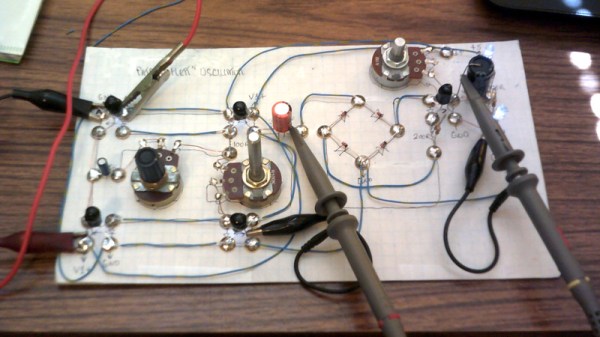
A synthesizer without transistors could almost be the basis of a trick question, surely without transistors it must be using a vacuum tube or similar. Not [Dr. Cockroach]’s synth though, instead of transistors it uses coupled pairs of LEDs and light-dependent resistors as its active components. Its oscillator circuit comes courtesy of [Patrick Flett], and uses a pair of LED/LDR combinations to alternately charge and discharge a capacitor. This feeds another LDR/LED pair that appears to act as a buffer to drive a bridge rectifier, with a final amplifier following it.

The result oscillates, though at frequencies in the low audio range with a cluster of harmonics thrown in. Its sound is best described as something akin to a small single-cylinder motorcycle engine at the lower frequencies, and is something we see could have all sorts of interesting possibilities.

This approach of using LDR-based active devices may be something of a dead end that could have had its day back in the 1930s, but it’s nevertheless an entertaining field to explore. It’s not the first time we’ve followed [Dr. Cockroach] at it, in the past we’ve seen the same technique applied to logic gates.

Have a listen to the synth in the video below the break. Continue reading “A Transistor-less Sound Synthesizer”

Proprietary Lenses Are No Problem With This USB Adaptor

There was a time when a camera lens was simply a set of shaped pieces of glass in a tube, with a mount and an aperture. But as cameras have embraced electronics ever more, technology has found its way past the lens mount to the extent that all features of a modern lens are electronically controllable. Can they be used outside the confines of the camera they were designed for? If the user is [Jana Marie] then certainly, because she’s created a nifty USB adapter and mount for Canon lenses for use with her custom streaming camera.

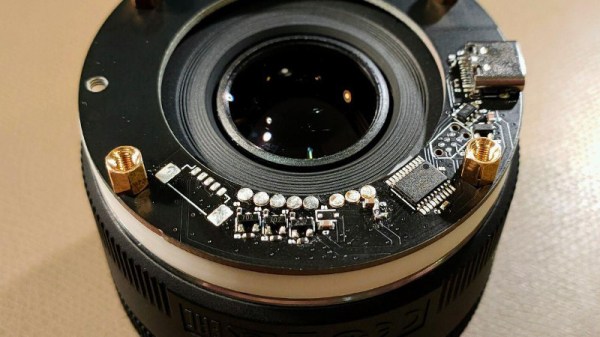
The hardware is a 3D printed lens mount with a PCB that mates with the pins on the lens. An STM32 does the hard work and talks to the outside world through a USB interface, however it’s in the software that the real effort lies. The Canon lens protocol has been extended since the 1980s, and the commands for different generations of lenses can be convoluted. All the information is in a GitHub repository, so the curious hacker can roll their own.

There are a wealth of camera projects to be found for those that don’t mind tearing apart some of their more valuable possessions, and this isn’t the first we’ve seen involving the hacking of the Canon protocol.

Raspberry Pi And Raspberry Pi Spy: This Is How Trademark SNAFUs Should Be Handled

In the eight years or so since the Raspberry Pi first landed as tangible hardware, we’ve all dealt with the Pi folks whether as customers or through their many online support and outreach activities. They’ve provided our community with the seed that led to an explosion of inexpensive Linux-capable single board computers, while their own offerings have powered so many of the projects we have featured here. Their heart lies in their educational remit, but they have also become an indispensable part of our community.

The statement from the Pi Foundation’s Philip Colligan.

Thus it was a surprise when [Raspberry Pi Spy], a long-time commentator on all things Pi, received a legal notice from the Raspberry Pi Foundation that their use of the Raspberry Pi name contravened the acceptable use guidelines and demanding that all content be removed and the domains be handed over. Some consternation ensued, before Pi foundation boss [Philip Colligan] released a statement retracting the original letter and explaining that the incident was the result of an over-zealous legal adviser and that the Foundation has no wish to undermine the Pi community.

All’s well that ends well, but what just happened? In the first instance, it’s natural for any organisation to wish to protect their brand, and there would be plenty of unscrupulous entities ready to sell fake Pi products were the Foundation not active in asserting their rights. In this case it seems that it was the use of the full Raspberry Pi trademark in a domain name that triggered the letter and not the fair-use blogging about the Pi products. We can see that however much we might wish otherwise it was not without legal merit. There have been numerous cybersquatting cases heard since the creation of the Web, and even though some of them have been on more dubious ground than others it remains a well-trodden path.

Where this story differs from so many others though is that the Pi Foundation acted with common sense in withdrawing the notice issued against a member of its community. It is inevitable that sometimes even the best of us can take regrettable paths by whatever means, and respect is earned by how such situations are resolved. We applaud the Pi folks for their swift action in this matter, we’d suggest to anyone that they take care when registering domain names, and we suspect that somewhere a legal adviser will be in the doghouse. But that all such incidents in our community could be resolved with such ease.

Where We’re Calculating, We Don’t Need No Seven Segments!

There have been many attempts at electronic numerical display technology over the decades since the first incandescent bulb or neon tube flickered into life at the command of a primordial computer, but the lowest common denominator has remained the humble seven segments. Here it might end, but for [Ken Yap] who has taken inspiration from a 1960s Sharp calculator to re-create a numerical display with only six segments.

This seemingly impossible feat is achieved by having six curved segments arranged as a figure-eight, which can render all the digits after a fashion, but which soon reveals why the extra segment made an appearance. The numbers that are made up of curves look good enough, but the straight lines in the 1, 4, and 7, are compromised by the diagonal, and the zero is curiously small at half the height.  You can read the digits, but it takes getting used to.

What made sense to reduce the complexity of 1960s electronics is only a fascinating curiosity in 2020, but we maybe won’t see these displays appearing too often. You can take a look at it in the video below the break, and if you’re curious about the Sharp calculator which inspired it then you can take a look at its page in the Vintage Calculator Museum.

Continue reading “Where We’re Calculating, We Don’t Need No Seven Segments!”

Tiny Mario Clone On A Tiny Processor

We’ve become used to seeing retro games running on commodity microcontrollers where once they would have required the bleeding-edge console hardware of their day. [Duncan]’s Mario clone takes the genre a little further, using not a processor with plenty of pins for peripherals, but instead the humble ATtiny85. Its eight pins drive two OLED displays, and accept input from the buttons of a cheap Nintendo-like controller.

The write-up is split between software and hardware sections, with all the software itself available from a GitHub repository. He’s bit-banging the i2C for the displays for an impressive turn of speed, and the ATtiny’s lack of pins is addressed by clever use of resistive dividers to present a different voltage for each button pressed. With a truth table of voltages he’s even able to detect multiple simultaneous button presses. Music is achieved with the chip’s limited resources by storing the sounds in EEPROM, and clocked it at 16 MHz for smooth gameplay.

The whole is mounted inside the shell of the controller, with its USB guts removed and replaced by a smart custom PCB. An unexpected problem with ground plane fill caused a temporary roadblock reading the buttons, but the finished product is a very Nintendo-like experience. We like it.