A Mobile Phone For The Pulse Dial Generation

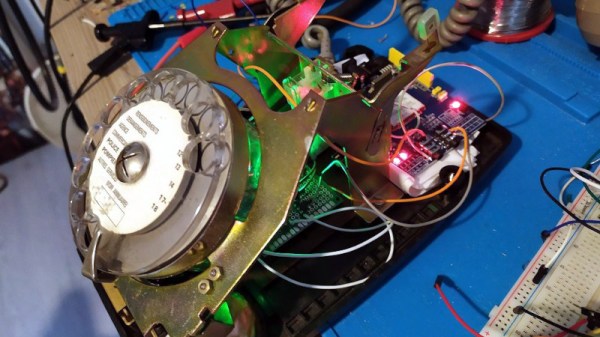
One of the useful side effects of the ubiquitous availability of cellular network data modules is that they can be used to create custom mobile phones. It’s surprising in a way that we don’t see as many of these projects as we’d expect, but by way of redressing that deficiency we’re pleased to see the work of [Proton Gamer], who has taken a vintage rotary dial phone and upgraded it with an Arduino and GSM shield to make a very unexpected mobile phone project.

It’s not entirely certain from the write-up which manufacturer produced the donor phone or for which country’s network it was produced, but it seems typical of the type you might have found the world over in the 1960s. We’re given a breakdown of the various components and how to interface to them, the ringer for example is run using a motor driver board. There are comprehensive instructions for the conversion, though sadly they involve gutting the phone and removing the original hardware. The result can be seen in the video below the break, and the finished project makes a mobile phone call from the unlikeliest of hardware.

This certainly isn’t the first rotary dial mobile phone we’ve featured, including one based on a conference badge.

Continue reading “A Mobile Phone For The Pulse Dial Generation”
What Is The Tianwen-1 Probe Saying?

A few days ago, the Chinese National Space Administration launched their Tianwen-1 mission to Mars from their launch site in the province of Hainan. It should arrive at the Red Planet in April 2021, when it will face the daunting task of launching a surface probe from its orbiting component, which will release a rover once it has reached the surface. Like all such missions it’s in constant contact with its controllers on the ground, and as with any radio transmissions floating through the aether its telemetry has been received by the radio hacker community and analaysed by [r00t].

Straight away there’s something interesting in the modulation scheme, instead of a carrier with modulation applied to it there is a main unmodulated centre carrier, and the data appears instead on a series of subcarriers. Is this a feature of its being a space probe, the unmodulated carrier making it easier to find and track in deep space?

They quickly find the telemetry carrier, and decode its frames. It carries a series of data sets, including positional and instrumentation data. From the positional data they can tell when the craft has made any course changes, and from the sensor data such as the solar sensor its movement can be deduced and graphed. It makes for a fascinating insight into the mission, and we’re grateful for the analysis.

Mars is a notoriously difficult target for space probes, somewhere that multiple missions have for various reasons failed to reach. We hope the Tianwen-1 mission is ultimately successful and that in time the Chinese space people will in due course be showing us some of the fruits of their labours. They’re not alone in launching this month, so we’ve got a plethora of Mars-related stories to look forward to next year.

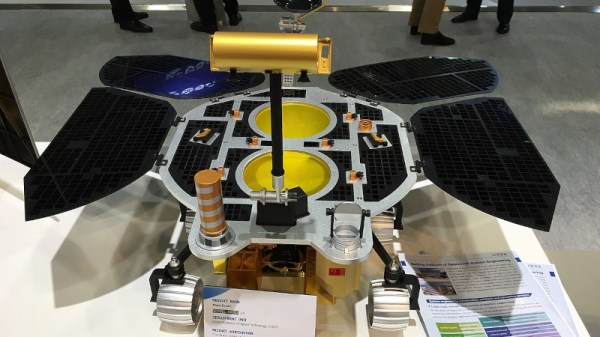
Header image: Tianwen-1 rover mockup. Pablo de León‎ / CC BY-SA 3.0

Jet Airliner Nacelle Becomes A Unique Camper

It’s possible that some of you will have thought about making a custom camper for yourselves. Some of you may even have gone as far as to build a teardrop caravan. It’s very unlikely though that you’ll have gone as far as [Steve Jones] though, who took an outer engine nacelle from a retired ex-RAF VC-10 airliner and converted it into a camper that is truly one of a kind.

On the face of it a jet engine nacelle should be an easy shell for such a project, but such a simplified view perhaps doesn’t account for the many vents, pipes, and hatches required by the engine in flight. Turning it into a waterproof housing for a camper was a significant job, which he has managed to do while leaving one set of engine access doors available as a large opening for a room with a view.


The nacelle is mounted on a narrowed former caravan chassis, and with an eye-catching window created from its former air intake and a very well executed interior fit-out it makes for a camper that many of us would relish trying for ourselves. You can see a video of it below the break, and we wish we could be lucky enough to encounter it in a campsite one summer.

We’ve shown you our share of campers over the years, but perhaps this 3D printed one has most appeal.

Continue reading “Jet Airliner Nacelle Becomes A Unique Camper”

This Tube Preamp Has A Nixie Volume Display

The pursuit of audiophile hi-fi is one upon which many superlatives and perhaps a little too much money are lavished. But it’s also a field in which the self-builder can produce their own equipment that is as good or often better than that which can be bought, so it provides plenty of interesting projects along the way. [Justin Scott]’s tube preamplifier is a great example, with its novel use of a pair of Nixie tubes to indicate the volume to which it has been set.

The audio side of the preamp comes courtesy of a four-tube kit from tubes 4 hi-fi, in which we notice another tube as power supply rectifier. The case is a beautifully made wooden affair with a professional front panel, but it’s the Nixies which make it a bit special. A high quality motorised potentiometer is used as a volume control, one of its multiple outputs is used as a simple potential divider to provide a voltage. This is read by an Arduino, which in turn drives the Nixies via a BCD-to-decimal decoder. The attention to detail in the whole project is at a very high level, and though he’s not shred any of its audio measurements with us, we’d expect it to sound as good as it looks.

If tube amplifiers interest you, we’ve delved into their design in the past, and it’s worth directing you to Justin’s matching amplifier, as well.

USB-C Where It Was Never Intended To Be

The USB-C revolution is well under way, as first your new phone, then your single-board computer, and now your laptop are likely so sport the familiar reversible round-cornered connector. We’re still in the crossover period of requiring to keep micro USB, proprietary laptop, and USB-C power supplies at hand, but the promise of a USB-C-only world is tantalisingly close. For [Purkkaviritys] that’s a little bit closer now, as he’s modified his Thinkpad T440s to take a USB charger instead of its proprietary Lenovo square-plug part. (Video, embedded below.)

At its heart is a USB-PD emulator module that does all the hard work of negotiation with the power supply, giving the laptop the DC voltage it needs. It’s not quite that simple though, because a resistor is required to reassure the laptop that it’s got a genuine power supply. The module is encased in a carefully-designed surround that neatly takes the space vacated by the original connector, and since this laptop has its internal power connector on a short cable it is made very straightforward to fit into the case. If you didn’t know it was a home-made upgrade, you could be forgiven for thinking that this laptop left the factory with a USB-C power socket.

The USB-C module used here is a versatile part. We’ve previously seen it in a soldering iron conversion.

Continue reading “USB-C Where It Was Never Intended To Be”

A Stylish Raspberry Pi Camera

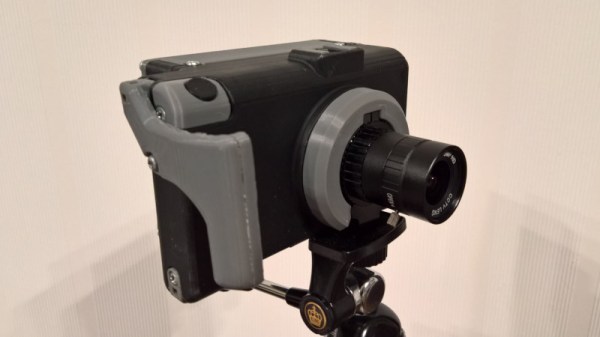
The Raspberry Pi HQ camera module is an exciting product that for the first time puts something close to a decent quality interchangeable lens camera into the hands of hardware hackers. It’s already attracted the attention of those who have a wish to explore the boundaries of camera form factors. Our latest entrant in this field comes courtesy of [BBまどーし], who has opted for a very good 3D-printed analog of a conventional compact camera.

On the front as you might expect is the module, concealed behind a smart plastic ring. Behind that is a battery compartment, concealing not the brace of 18650s or the bare LiPo pouch that you might expect, but a 10,400 mAH USB power bank. Behind that is something approaching a conventional Raspberry Pi case, designed to take a Hyperpixel screen. The battery might seem an unadventurous choice, but it serves to highlight just how much bang for your buck can now be found in compact power banks. It may not have a hacker aesthetic, but you can’t argue with its cost and simplicity.

The details are the interesting part of this design, for instance it has a standard accessory shoe printed into its top. There is also a shutter button, but they admit to not being a software wizard enough to get it working. Perhaps a quick look at this Pi Camera in a 1970s Merlin game would be in order.

There’s An Engineer In Germany I’d Like A Word With; Tale Of A Crumbling Volkswagen Lock

In common with quite a few in the hardware hacking community, I have a fondness for older vehicles. My “modern” ride is an older vehicle by today’s standards, a Volkswagen Polo 6N made in the late 1990s. It’s by my estimation a Good Car, having transported me reliably back and forth across the UK and Europe for several years.

Last week though, it let me down. Outside the church in a neighbouring village the driver’s door lock failed, leaving me with my igniton key stuck in the door, and a mildly embarrassing phone call to my dad to bring the Torx driver required to remove the assembly and release it. I am evidently not 1337 enough, I don’t carry a full set of Torx bits with me everywhere I go. The passenger side lock has never worked properly while I’ve had the car, and this is evidently my cue to sort it all out.

Continue reading “There’s An Engineer In Germany I’d Like A Word With; Tale Of A Crumbling Volkswagen Lock”