New Part Day: Bouffalo Labs BL602 RISC-V Wi-Fi/Bluetooth SoC

We should all by now be used to microcontrollers with wireless hardware on board, with Espressif or Nordic Labs dominating the hacker scene. There have been several other contenders in this arena over the years that haven’t really caught the attention of our community, usually because of the opacity of their available information.

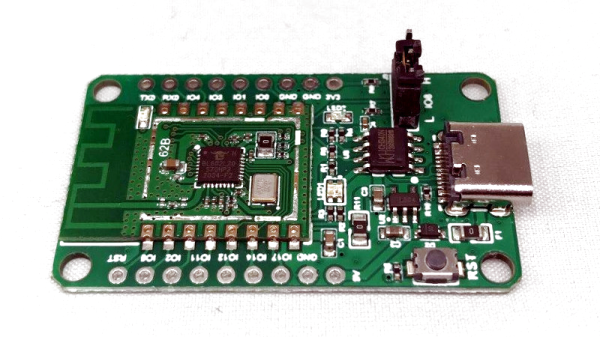
A new contender should be worth a second look though. The BL602 from Bouffalo Labs is a Wi-Fi- and Bluetooth LE-capable microcontroller with a 32-bit RISC-V derived core. If that doesn’t interest you much, perhaps news that the PINE64 folks are spearheading an effort to reverse engineer it for a fully open-source blob-free wireless implementation might sharpen your attention.

So where can you get your hands on one? Hold your horses, this chip is at an early stage in its gestation. We can see that there are some exciting possibilities in store, but we’re still figuring out the hardware interfaces and other software required to make it work. A community is hard at work reverse engineering it, which leads us back to the PINE64 story we mentioned earlier.

You can find BL602 modules from AliExpress vendors, but the PINE64 folks will offer you a free one if you join their blob reverse engineering effort. Take note though, this offer is for those prepared to show commitment to the project, so don’t spam them in the hope of free stuff if you won’t be helping deliver the goods.

We might see the BL602 gaining an open-source toolchain and internal blobs over the coming months thanks to the efforts of those working on it. Just as the ESP8266 did back in 2014, it’s starting as a black box with a relative scarcity of information. But if this hacking effort pays off, we’ll have a cheap RISC-V Wi-Fi and Bluetooth module with entirely open-source software from the silicon upwards. What a time to be alive!

Thanks [Renze] for the tip.
Easy Device Configuration For Your Pi Projects

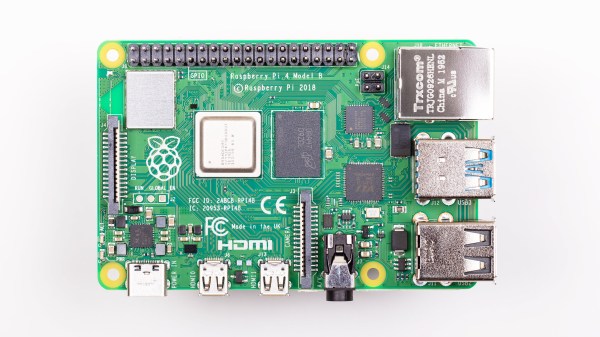
We’re all familiar with a typical configuration sequence for a new mass-market IoT device. Turn it on for the first time and it exposes a temporary Wi-Fi network, connect to that network and open a Web page for device configuration. Wouldn’t it be useful to be able to incorporate that functionality into your own projects without having to write it yourself! Happily now thanks to [Peter Walsh] you can, with his AppDaemon project for the Raspberry Pi.

At its heart is  a set of Perl scripts that run whatever your software is, then monitor a GPIO. A button press toggling the GPIO stops the application and fires up the access point and web server. Handily the code can all be found in a GitHub repository, and there is a run-through of the features in a video that we’ve placed below the break. It’s not something that will appeal to everybody, but for anyone who has to pass their work onto people who can’t dive into a config file and break out the editor, it should be a particularly useful addition to the armoury.

Continue reading “Easy Device Configuration For Your Pi Projects”

The Special Fridges Behind The COVID-19 Vaccine, Why It’s Surprisingly Difficult To Be That Cool

One of the big stories last week was the announcement of results from clinical trials that suggest a new COVID-19 vaccine developed through the joint effort of the American and German companies Pfizer and BioNTech is strongly effective in providing immunity from the virus. In the midst of what is for many countries the second spike of the global pandemic this news has been received with elation as well as becoming the subject of much political manoeuvring.

While we currently have two vaccine candidates with very positive testing results, one of the most interesting things for us is the need to keep doses of the Pfizer/BioNTech vaccine extremely cold until they are administered. Let’s dig into details of the refrigeration problem at hand.

Continue reading “The Special Fridges Behind The COVID-19 Vaccine, Why It’s Surprisingly Difficult To Be That Cool”

An EV Conversion Engineered As A Drop-in Replacement

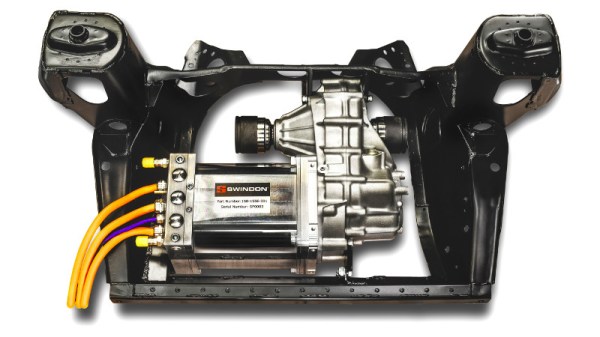
With electric vehicles such as the Tesla or the Leaf being all the rage and joined by fresh competitors seemingly every week, it seems the world is going crazy for the electric motor over their internal combustion engines. There’s another sector to electric traction that rarely hits the headlines though, that of converting existing IC cars to EVs by retrofitting a motor. The engineering involved can be considerable and differs for every car, so we’re interested to see an offering for the classic Mini from the British company Swindon Powertrain that may be the first of many affordable pre-engineered conversion kits for popular models.

Swindon Powertrain's demo Mini
Swindon Powertrain’s demo Mini

The kit takes their HPD crate EV motor that we covered earlier in the year, and mates it with a Mini front subframe. Brackets and CV joints engineered for the kit to drop straight into the Mini. The differential appears to be offset to the right rather than the central position of the original so we’re curious about the claim of using the Mini’s own driveshafts, but that’s hardly an issue that should tax anyone prepared to take on such a task. They can also supply all the rest of the parts for a turnkey conversion, making for what will probably be one of the most fun-to-drive EVs possible.

The classic Mini is now a sought-after machine long past its days of being dirt-cheap old-wreck motoring for the masses, so the price of the kit should be viewed in the light of a good example now costing more than some new cars. We expect this kit to have most appeal in the professional and semi-professional market rather than the budget end of home conversions, but it’s still noteworthy because it is a likely sign of what is to come. We look forward to pre-engineered subframes becoming a staple of EV conversions at all levels. The same has happened with other popular engine upgrades, and no doubt some conversions featuring them will make their way to the pages of Hackaday.

We like the idea of conversions forming part of the path to EV adoption, as we’ve remarked before.

Bringing An IBM Model F Into 2020

We know that the Hackaday family includes many enthusiasts for quality keyboards, and thus mention of the fabled ‘boards of yore such as the IBM Model F is sure to set a few pulses racing. Few of us are as lucky as [Brennon], who received the familial IBM PC-XT complete with its sought-after keyboard.

This Model F has a manufacture date in March 1983, and as a testament to its sturdy design was still in one piece with working electronics. It was however in an extremely grimy condition that necessitated a teardown and deep clean. Thus we are lucky enough to get a peek inside, and see just how much heavy engineering went into the construction of an IBM keyboard before the days of the feather-light membrane devices that so many of us use today. There follows a tale of deep cleaning, with a Dremel and brush, and then a liberal application of Goo Gone. The keycaps had a long bath in soapy water to remove the grime, and we’re advised to more thoroughly dry them should we ever try this as some remaining water deep inside them caused corrosion on some of the springs.

The PC-XT interface is now so ancient as to have very little readily available in the way of adapters, so at first a PS/2 adapter was used along with a USB to PS/2 converter. Finally though a dedicated PC-XT to USB converter was procured, allowing easy typing on a modern computer.

This isn’t our first look at the Model F, but if you can’t afford a mechanical keyboard don’t worry. Simply download a piece of software that emulates the sound of one.

Spacing Out: A Big Anniversary, Starlink Failures Plummet, Lunar Cellphones, And A Crewed Launch

After a couple of months away we’re returning with our periodic roundup of happenings in orbit, as we tear you away from Star Trek: Discovery and The Mandalorian, and bring you up to date with some highlights from the real world of space. We’ve got a launch to look forward to this week, as well as a significant anniversary.

Continue reading “Spacing Out: A Big Anniversary, Starlink Failures Plummet, Lunar Cellphones, And A Crewed Launch”

Help, I’m Buried Alive By Tablets!

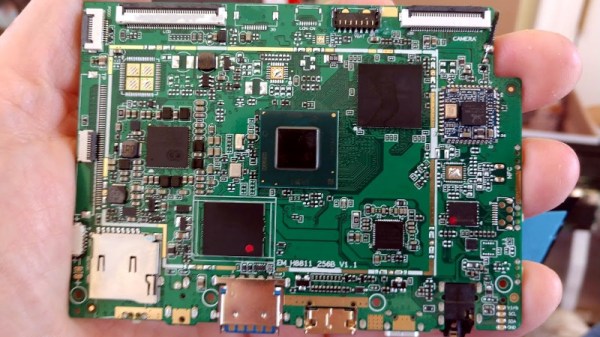
It’s fair to say that many Hackaday readers will have a propensity for hoarding electronic or tech junk. Who hasn’t hung on to something because “It might be useful someday”? Spare a thought for [Mike Drew], who in his own words is “buried alive by tablets”. In this case the tablets are Intel-based ones that look as though they ran one of those cut-down Windows versions, and they appear to be rejects from a repair shop processing customer returns that he saved from the dumpster. They are missing their backs, and not all of their screens work, but they amount to a tidy pile of Stuff That’s Too Good To Throw Away.

The exact spec is a 1.4 GHz quad-core Atom with 4 GB of RAM and 32 GB of Flash, and appear from the photos to have HDMI and USB 3 interfaces. Happily they run Linux Mint 20 so they have plenty of potential, but there is only so much that one person can do with them before running out of ideas. He tells us he’s made a Folding@Home cluster, but beyond that he’s open to suggestions. Depending on the age of the commenter no doubt he’ll be exhorted to run Beowulf or mine Bitcoin, but we’d suggest more sensible ideas.

So, what would you do with them? They lack the handy GPIO port of a Raspberry Pi, but with suitable USB peripherals could you use them in any lowish-power distributed node project where the popular SBC would be the usual choice? Perhaps something like WeeWX, or OpenEnergyMonitor. Or how about distributed mesh network nodes, after all there’s an x86 port of LibreMesh. It’s obvious that there’s plenty of potential to be found, so help [Mike] with his problematic bounty in the comments.