London Gatwick Airport Shuts Its Doors Due To Drone Sighting

If you could pick a news story you would prefer not to be woken with, it’s likely that a major airport being closed due to a drone sighting would be high on the list. But that’s the news this morning: London’s Gatwick airport has spent most of the night and into the morning closed due to repeated sightings. Police are saying that the flights appear to have been deliberate, but not terror-related.

We’ve written on reports of drone near-misses with aircraft here back in 2016, and indeed we’ve even brought news of a previous runway closure at Gatwick. But it seems that this incident is of greater severity, over a much longer period, and even potentially involving more than one machine. The effect that it could have on those in our community who are multirotor fliers could be significant, and thus it is a huge concern aside from the potential for mishap in the skies above London’s second largest airport.

It is safe to say that if there was indeed a multirotor above Gatwick last night then its operator should be brought to justice and face the appropriate penalty without delay. Responsible fliers are painfully aware of the rules involving multirotor flight, and that airports of any description are strictly off-limits. It matters not whether this was a drunken prank or a premeditated crime, we hope you’ll all join us in saying that anybody flying outside the law should be reported to the authorities.

Continue reading “London Gatwick Airport Shuts Its Doors Due To Drone Sighting”

The Hydrogen Economy May Be Coming Through Your Cooker

About an hour’s drive from where this is being written there is a car plant, and as you drive past its entrance you may notice an unobtrusive sign and an extra lane with the cryptic road marking “H2”. The factory is the Honda plant at Swindon, it produces some of Europe’s supply of Civics, and the lane on the road leads to one of the UK or indeed the world’s very few public hydrogen filling stations. Honda are one of a select group of manufacturers who have placed a bet on a future for environmentally sustainable motoring that lies with hydrogen fuel cell technologies.

The hydrogen-powered Honda Clarity FCV, a car most of us will probably never see. Lcaa9 [CC BY-SA 4.0].
The trouble for Honda and the others is that if you have seen a Honda Clarity FCV or indeed any hydrogen powered car on the road anywhere in the world then you are among a relatively small group of people. Without a comprehensive network of hydrogen filling stations such as the one in Swindon there is little incentive to buy a hydrogen car, and of course without the cars on the road there is little incentive for the fuel companies to invest in hydrogen generating infrastructure such as the ITM Power electrolysis units that seem to drive so many of the existing installations. By comparison an electric car is a much safer bet; while the charging point network doesn’t rival the gasoline filling station network there are enough to service the electric motorist and a slow charge can be found from most domestic supplies. Continue reading “The Hydrogen Economy May Be Coming Through Your Cooker”

This 6502 Made From 74-Series Logic Can Run At 20 MHz

If you always wished you could get closer to the hardware with the 6502 in your classic microcomputer you’re in luck, because [Drass] has created a beautiful implementation of a 6502 using TTL logic chips. What makes it special is that it sits on a very neat set of PCBs, and due to its use of 74AC series logic it can run at much higher speeds than the original. A 20 MHz 6502 would have been revolutionary in the mid-1970s.

Neat reworking of what looks to be a reversed bus.

Through a flying ribbon cable, it can plug directly into the 6502 socket on classic microcomputers, and the website shows it running a variety of software on a Commodore VIC20. There is also a custom SBC as part of the suite, so no need for a classic micro if you want to put the CPU through its paces. The boards are not quite perfect, the website has a picture of some very neat reworking where it appears that a bus has been applied to a chip in reverse, but it certainly has the feel of a professional design about it.

This is a very tidy 6502, but it’s not the first we’ve seen and neither is it the most dis-integrated. There is a fascinating world of 74 logic CPUs to be explored, so it’s difficult to pick only one other to show you.

Thanks [Jeff] for the tip.

Scott Swaaley On High Voltage

If you were to invent a time machine and transport a typical hardware hacker of the 1970s into 2018 and sit them at a bench alongside their modern counterpart, you’d expect them to be faced with a pile of new things, novel experiences, and exciting possibilities. The Internet for all, desktop computing fulfilling its potential, cheap single-board computers, even ubiquitous surface-mount components.

What you might not expect though is that the 2018 hacker might discover a whole field of equivalent unfamiliarity while being very relevant from their grizzled guest. It’s something Scott Swaaley touches upon in his Superconference talk:  “Lessons Learned in Designing High Power Line Voltage Circuits” in which he describes his quest for an electronic motor brake, and how his experiences had left him with a gap in his knowledge when it came to working with AC mains voltage.

When Did You Last Handle AC Line voltages?

If you think about it, the AC supply has become something we rarely encounter for several reasons. Our 1970s hacker would have been used to wiring in mains transformers, to repairing tube-driven equipment or CRT televisions with live chassis’,  and to working with lighting that was almost exclusively provided by mains-driven incandescent bulbs. A common project of the day would have been a lighting dimmer with a triac, by contrast we work in a world of microcontroller-PWM-driven LEDs and off-the-shelf switch-mode power supplies in which we have no need to see the high voltages. It may be no bad thing that we are rarely exposed to high-voltage risk, but along the way we may have lost a part of our collective skillset.

Scott’s path to gaining his mains voltage experience started in a school workshop, with a bandsaw. Inertia in the saw kept the blade moving after the power had been withdrawn, and while that might be something many of us are used to it was inappropriate in that setting as kids are better remaining attached to their fingers. He looked at brakes and electrical loads as the solution to stopping the motor, but finally settled on something far simpler. An induction motor can be stopped very quickly indeed by applying a DC voltage to it, and his quest to achieve this led along the path of working with the AC supply. Eventually he had a working prototype, which he further developed to become the MakeSafe power tool brake.

Get Your AC Switching Right First Time

The full talk is embedded below the break, and gives a very good introduction to the topic of switching AC power. If you’ve never encountered a thryristor, a triac, or even a diac, these once-ubiquitous components make an entrance. We learn about relays and contactors, and how back EMF can destroy them, and about the different strategies to protect them. Our 1970s hacker would recognise some of these, but even here there are components that have reached the market since their time that they would probably give anything to have. We see the genesis of the MakeSafe brake as a panel with a bunch of relays and an electronic fan controller with a rectifier to produce the DC, and we hear about adequate safety precautions. This is music to our ears, as it’s a subject we’ve touched on before both in terms of handling mains on your bench and inside live equipment.

So if you’ve never dealt with AC line voltages, give this talk a look. The days of wiring up transformers to power projects might be largely behind us, but the skills and principles contained within it are still valid.

Continue reading “Scott Swaaley On High Voltage”

Charge Your EV The Portable Way

[Andrew Rossignol] has a slightly unusual plug-in hybrid vehicle, a Cadillac ELR, and his latest project for the car sees him building a battery-powered portable mains charging pack for it in an attempt to increase its range. If this seems to be a rather cumbersome exercise, his write-up details the work he put in trying to hook up directly to the car’s internal battery, and how a 4 kW mains inverter and an off-the-shelf mains charging station were the most practical alternative.

His first impulse was to hook a second supply to the car’s high voltage bus from a supplementary battery pack and inverter, but in this aim he was thwarted by a protection diode and his not wanting to modify the car to bypass it. So the unlikely solution was to take his battery pack from a second-hand Toyota Prius upgrade kit and build it into a frame along with the inverter and charger. The result is something akin to a portable generator without the small gasoline engine, and while it is hardly the most efficient way to transfer energy from a wall socket into a car it does offer the ELR a significant range upgrade.

The cost involved has probably kept away many readers who would like to hack their hybrid cars, so we’ve seen surprisingly few. This home made Geo Metro supplements its forklift motor with a small gasoline generator. Meanwhile [Andrew] is no stranger to these pages, among the several times his work has appeared here are his rundown on OBD sniffing the ELR, and from a while back, displaying graphics on an oscilloscope including a Wrencher.

5G Cellphone’s Location Privacy Broken Before It’s Even Implemented

Although hard to believe in the age of cheap IMSI-catchers, “subscriber location privacy” is supposed to be protected by mobile phone protocols. The Authentication and Key Agreement (AKA) protocol provides location privacy for 3G, 4G, and 5G connections, and it’s been broken at a basic enough level that three successive generations of a technology have had some of their secrets laid bare in one fell swoop.

When 3G was developed, long ago now, spoofing cell towers was expensive and difficult enough that the phone’s International Mobile Subscriber Identity (IMSI) was transmitted unencrypted. For 5G, a more secure version based on a asymmetric encryption and a challenge-reponse protocol that uses sequential numbers (SQNs) to prevent replay attacks. This hack against the AKA protocol sidesteps the IMSI, which remains encrypted and secure under 5G, and tracks you using the SQN.

The vulnerability exploits the AKA’s use of XOR to learn something about the SQN by repeating a challenge. Since the SQNs increment by one each time you use the phone, the authors can assume that if they see an SQN higher than a previous one by a reasonable number when you re-attach to their rogue cell tower, that it’s the same phone again. Since the SQNs are 48-bit numbers, their guess is very likely to be correct. What’s more, the difference in the SQN will reveal something about your phone usage while you’re away from the evil cell.

A sign of the times, the authors propose that this exploit could be used by repressive governments to track journalists, or by advertisers to better target ads. Which of these two dystopian nightmares is worse is left as comment fodder. Either way, it looks like 5G networks aren’t going to provide the location privacy that they promise.

Via [The Register]

Header image: MOs810 [CC BY-SA 4.0].

A Raspberry Pi Has This Pool Covered

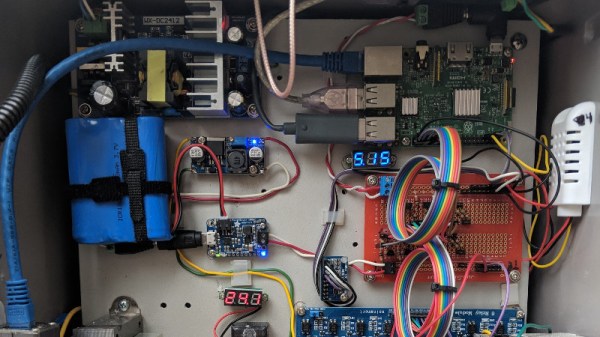
Far from being a tiled hole in the ground with a bit of water in it, a modern swimming pool boasts a complex array of subsystems designed to ensure your morning dip is as perfect as that you’d find on the sun-kissed beaches of your dream tropical isle. And as you might expect with such complex pieces of equipment in a domestic setting, they grow old, go wrong, and are expensive to fix.

[DrewBeer]’s pool had just such a problem. A decades-oldwired controller had failed, so rather than stump up a fortune for a refit, he created his own pool controller which exists under the watchful eye of a Raspberry Pi. The breadth of functionality is apparent from his write-up. In addition to the pump and heater you’d expect, he as a salt water system, environmental monitoring, and even an RTL-SDR to pull in readings from an RF floating temperature probe. It’s all exposed via a node.js API, and thus far has been running for over 6 months without mishap.

From where this is being written in the gloom of a damp November in a Northern Hemisphere maritime climate we can only envy [Drew] his pool and imagine it as perpetually deep blue and sparkling, invitingly cool against the heat of a summer’s day. If you have similar pool automation woes. perhaps you’d also like to look at this ESP8266 pool monitor, or another automation project using a Raspberry Pi.