UK To Register Multirotor Fliers

The British government has shown a surprisingly light touch towards drone fliers in the face of the strident media demands for them to be banned following a series of reports of near-misses with other aircraft. That is about to change with reports of the announcement of a registration scheme for craft weighing over 250 g (about 9 oz). Details are still a bit sketchy, but it is reported that there will be a written test and an element of geofencing around sensitive locations.

Our friendly professional multirotor flier’s reaction is that the existing laws are clear enough, and that this is likely to be no deterrent to any people who already use their drones illegally. It seems that the UK government is following the lead set by the USA in this matter, with the 250 g limit on that side of the Atlantic having already spawned an industry of smaller craft. Time will tell on whether the measures will be effective, we suspect that their success will depend on their not being overly stringent.

[Editor’s note: Following a lawsuit, the US FAA registration requirement was struck down for hobbyists because model aircraft are explicitly excluded from the FAA’s purview. The Brits are not likely to be so lucky.]

If there is a positive side to this announcement, it might be that the 250 g class of multirotor will inevitably become the focus of a lot of attention as manufacturers and engineers work to pack the most performance into the small platform. This small silver lining to the drone registration cloud might not be much, but we’ll take it.

We’ve covered the UK drone story as reported in the media in detail in the past.

Palace of Westminster image: Diliff [CC BY-SA 2.5].
Read Amiga Floppies Using An Arduino

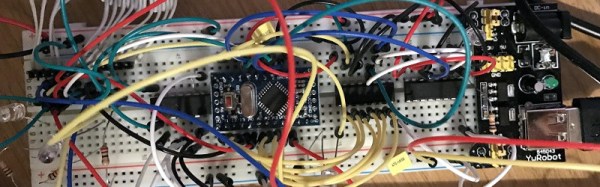
So you spent your youth learning your craft in front of an Amiga 500+, but a quarter century later all you have left is a broken computer and a pile of floppies you can’t read any more. What’s to be done? This was the position [Rob Smith] found himself in, and since some of the commercial solutions to ripping Amiga floppies were rather expensive, he decided to have a go at making his own.

His write-up makes for a fascinating read, as he delves into the physical interface of the PC floppy drive he used, and into the timing required from the Arduino that controlled it. He faced some challenges in getting his code to be fast enough for the task, and goes into some of the optimisation techniques he employed. His code for both Arduino and Windows  is open-source, and can be downloaded from his GitHub repository. Future plans involve supporting the FDI disc format as well as ADF, and adding the ability to write discs.

We’ve shown you a lot of Amigas over the years, but perhaps of most relevance here in our archive are this Raspberry Pi floppy emulator and this floppy autoloader for archiving a disc collection.

Via Hacker News.

RF Noise Floor Concerns From Both Sides Of The Atlantic

Our feed is full of stories about the RF noise floor today, and with good reason. The ARRL reports on the International Amateur Radio Union Region 1 president, [Don Beattie, G3BJ] warning that in densely populated parts of Europe there is a danger that parts of the RF spectrum have become so swamped with noise as to be rendered unusable, while on the other side of the Atlantic we have RadioWorld reporting on similar problems facing AM broadcasting in the USA.

At issue are the usual suspects, interference from poorly shielded or suppressed domestic electronic devices, VDSL broadband, power-over-Ethernet, solar and wind power systems, and a host of other RF-spewing electronics. The combined emissions from all these sources have raised the noise level at some frequencies to the point at which it conceals all but the strongest signals. Any radio amateur will tell you that a station in a rural location will be electrically much quieter than one in a city, it seems that this effect has now reached a crescendo.

In the RadioWorld article, the author [Tom F. King] and his collaborator [Jack Sellmeyer] detail a series of tests they performed on a selection of lighting products from a quality brand, bought at a local Home Depot store. They were gathering data for a submission to the FCC enquiry on the noise floor issue we reported on last year. What they found was unsurprising, significant emissions from all the products they tested. They make some stiff recommendations to the FCC and other bodies concerned with radio spectrum to get tough with offending devices, to stay on top of future developments, and for operators of AM stations to pursue sources of interference.

It could be that there is so much equipment contributing to the noise floor that this battle is lost, but it doesn’t have to be this way. Anyone who has had to prepare a product to pass a properly carried out EMC test will tell you that the requirements are stringent, and it is thus obvious that many manufacturers are shipping products unworthy of the certification they display. It is to be hoped that the authorities will begin to take it seriously before it becomes an order of magnitude worse.

Compliance label image, Moppet65535 [CC BY-SA 3.0].

Take Control Of Your Cheap Laser Cutter

The relatively inexpensive K40 laser cutter/engraver machines from China have brought laser cutting to the masses, but they are not without their faults. Sure, they’re only powerful enough for the lightest cutting tasks, but on top of that, their bundled software is inflexible and disappointing. If your workshop or hackspace has one of these machines languishing in the corner, then the release of a new piece of software, K40 Whisperer from [Scorch], is an interesting and welcome development.

He tells us that the reverse engineering process required to understand the K40’s protocol was non-trivial, given that it does not use handy decimal numbers to issue commands. A spreadsheet was used to collate data packets and spot repeating patterns to analyse the inner workings. Feature-wise, the software reads SVG and DXF files, and can split SVGs by colour. It has a halftone algorithm for rendering grey scales, and cuts from the inside of each shape first to avoid pieces of work dropping out of the piece of material. Currently it works with the stock M2 Nano controller board and is available as a Windows download, though it can also be compiled for Linux distributions, or MacOS, and he is asking owners to test it with as many machines as possible to ensure compatibility with other boards.

He has posted a video of K40 Whisperer in action, which you can see below the break.

Continue reading “Take Control Of Your Cheap Laser Cutter”

Lethal LED Lantern Leaks Lotsa ‘Leccy

When you take an item with you on a camping trip and it fails, you are not normally in a position to replace it immediately, thus you have the choice of fixing it there and then, or doing without it. When his LED camping lantern failed, [Mark Smith] was in the lucky position of camping at a friend’s compound equipped with all the tools, so of course he set about fixing it. What he found shocked him metaphorically, but anyone who handles it while it is charging can expect the more literal variation.

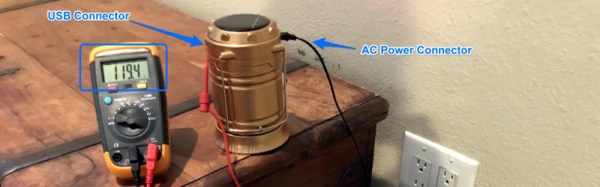
The lamp was an LED lantern with built-in mains and solar chargers for its Ni-Cd battery pack, and a USB charger circuit that provided a 5 volt output for charging phones and the like. The problem [Mark] discovered was that the mains charger circuit did not have any mains isolation, being a simple capacitive voltage dropper feeding a rectifier. These circuits are very common because they are extremely cheap, and are perfectly safe when concealed within insulated mains-powered products with no external connections. In the case of [Mark]’s lantern though the USB charging socket provided that external connection, and thus access to a potential 120 VAC shock for anyone touching it while charging.

Plainly this lamp doesn’t conform to any of the required safety standards for mains-powered equipment, and we’re guessing that its design might have come about by an existing safe lamp being manufactured with an upgrade in the form of the USB charger. The write-up gives it a full examination, and includes a modification to safely charge it from a wall-wart or similar safe power supply. Definitely one to watch out for!

If you were wondering what the fault was with Mark’s lamp, it was those cheap NiCd batteries failing. He replaced them, but there are plenty of techniques to rejuvenate old NiCds, both backyard, and refined.

Almost An Amiga For Not A Lot

If you ask someone old enough to have been a computer user in the 16-bit era what machine they had, you’ll receive a variety of answers mentioning Commodore, Atari, Apple, or even PC brands. If your informant lay in the Commodore camp though, you’ll probably have an impassioned tale about their Amiga, its capabilities, and how it was a clearly superior platform whose potential was wasted. The Amiga was for a while one of the most capable commonly available computers, and became something of a cult within its own lifetime despite the truly dismal performance of the various companies that owned it. Today it retains one of the most active retro computer scenes, has an active software community, and even sees new hardware appearing.

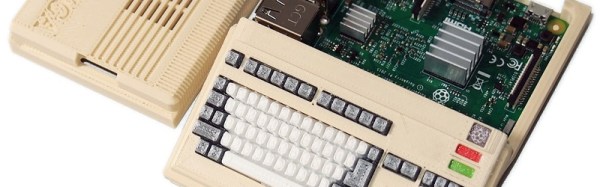
For Amiga enthusiasts without the eye-watering sums required to secure one of the new Amiga-compatible machines with a PowerPC or similar at its heart, the only option to relive the glory beside finding an original machine is to run an emulator. [Marco Chiapetta] takes us through this process using a Raspberry Pi, and produces an Amiga that’s close enough to the real thing to satisfy most misty-eyed enthusiasts.

He starts with a cutesy Amiga-themed Raspberry Pi case that while it’s not essential for the build, makes an entirely appropriate statement about his new machine, We’re taken through the set-up of the Amibian emulator distro, then locating a set of Amiga ROMs. Fortunately that last step is easier than you might think, even without trawling for an illicit copy.

The result is an Amiga. OK, it’s not an Amiga, but without the classic Commodore logo is it any more not an Amiga than some of the other non-branded Amiga-compatible boards out there? Less talking, more classic gaming!

We’ve covered quite a few Amigas on these pages. Getting an A500 online was the subject of a recent post, and we brought you news of a new graphics card for the big-box Amiga’s Zorro slot.

The Acorn Archimedes At 30

The trouble with being an incidental witness to the start of something that later becomes world-changing is that at the time you are rarely aware of what you are seeing. Take the Acorn Archimedes, the home computer for which the first ARM processor was developed, and which has just turned 30. If you were a British school pupil in 1987 who found a pair of the new machines alongside the row of BBC Micros in the school computer lab, for sure it was an exciting event, after all these were the machines everyone was talking about. But the possibility that their unique and innovative processor would go on to spawn a line of successors that would eventually power so much of the world three decades later was something that probably never occurred to spotty ’80s teens.

[Computerphile] takes a look at some of the first Archimedes machines in the video below the break. We get a little of the history and a description of the OS, plus a look at an early model still in its box and one of the last of the Archimedes line. Familiar to owners of this era of hardware is the moment when a pile of floppies is leafed through to find one that still works, then we’re shown the defining game of the platform, [David Braben]’s Lander, which became the commercial Zarch, and provided the template for his Virus and Virus 2000 games.

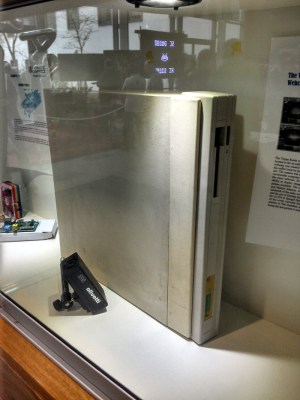
The Trojan Room Coffee Cam Archimedes, on display at the Cambridge University Computing Department.

We see the RiscOS operating system booting lightning-fast from ROM and still giving a good account of itself 20 years later even on a vintage Philips composite monitor. If you were that kid in 1987, you were in for a shock when you reached university and sat down in front of the early Windows versions, it would be quite a few years before mainstream computers matched your first GUI.

The Archimedes line and its successors continued to be available into the mid 1990s, but faded away along with Acorn through the decade. Even one being used to power the famous Trojan Room Coffee Cam couldn’t save it from extinction. We’re told they can still be found in the broadcast industry, and until fairly recently they powered much of the electronic signage on British railways, but other than that the original source of machines has gone. All is not lost though, because of course we all know about their ARM joint venture which continues to this day. If you would like to experience something close to an Archimedes you can do so with another computer from Cambridge, because RiscOS is available for the Raspberry Pi.

Sit back and enjoy the video, and if you were one of those kids in 1987, be proud that you sampled a little piece of the future before everyone else did.

Continue reading “The Acorn Archimedes At 30”