Hackaday Prize Entry: Catch The IMSI Catchers

An IMSI catcher is an illicit mobile phone base station designed to intercept the traffic from nearby mobile phones by persuading them to connect to it rather than the real phone company  tower. The IMSI in the name stands for International Mobile Subscriber Identity, a unique global identifier that all mobile phones have. IMSI catchers are typically used by government agencies to detect and track people at particular locations, and are thus the subject of some controversy.

As is so often the case when a  piece of surveillance technology is used in a controversial manner there is a counter-effort against it. The IMSI catchers have spawned the subject of this post, an IMSI catcher detector app for Android. It’s a work-in-progress at the moment with code posted in its GitHub repository, but it is still an interesting look into this rather shadowy world.

How them you might ask, does this app hope to detect the fake base stations? In the first case, it will check the identity of the station it is connected to against a database of known cell towers. Then it will try to identify any unusual behaviour from the base station by analysing its traffic and signal strength. Finally it will endeavour to spot anomalies in the implementation of the cell phone protocols that might differentiate the fake from the real tower.

They have made some progress but stress that the app is in alpha stage at the moment, and needs a lot more work. They’re thus inviting Android developers to join the project. Still, working on projects is what the Hackaday Prize is all about.

Hackaday Prize Entry: Dodo 6502 Game System

If you are a gamer of A Certain Age, it’s probable that you retain a soft spot for 8-bit computers and consoles of your youth. For a time when addictive gameplay came through the most minimal of graphics, and when gaming audio was the harshest of square waves rather than immersive soundscapes.

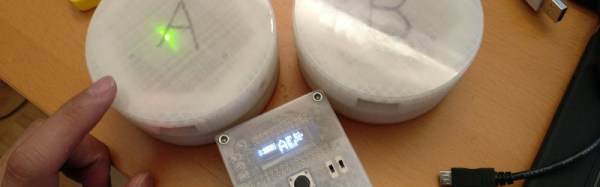
Does the previous paragraph sound familiar? Then we may just have the device for you. The Dodo is a handheld console that harks back to that era with a 6502 processor and a 128×64 pixel OLED screen. Games are loaded from plug-in EEPROM cartridges, and sounds are suitably period-digital square wave tones. It’s the brainchild of [Peter Noyes], and he says he will consider it complete when it sports a game fun enough to entertain his 4-year-old.

The prototype Dodo is a handheld form-factor made from two stacked PCBs. The upper one has the display and buttons while the lower has the classic 6502 and associated chipset in through-hole DIP format. A Game Boy Micro it ain’t, but miniaturization is not the name of the game with these consoles. Best of all though, all the console’s resources are available in a GitHub repository, so you can all have a play too.

The 6502 has featured in a huge number of projects here on Hackaday over the years. Now it’s turned up in the Hackaday Prize.

Hackaday Prize Entry: LipSync, Smartphone Access For Quadriplegic People

For most of us, our touch-screen smartphones have become an indispensable accessory. Without thinking we tap and swipe our way through our digital existence, the promise of ubiquitous truly portable computing has finally been delivered.

Smartphones present a problem though to some people with physical impairments. A touchscreen requires manual dexterity on a scale we able-bodied people take for granted, but remains a useless glass slab to someone unable to use their arms.

LipSync is a project that aims to address the problem of smartphone usage for one such group, quadriplegic people. It’s a mouth-operated joystick for the phone’s on-screen cursor, with sip-and-puff vacuum control for simulating actions such as screen taps and the back button.

To the smartphone itself, the device appears as a standard Bluetooth pointing device, while at its business end the joystick and pressure sensor both interface to a Bluetooth module through an Arduino Micro. The EAGLE board and schematic files are available on the project’s hackaday.io page linked above, and there is a GitHub repository for the code.

Technology is such a part of our lives these days, and it’s great to see projects like this bridge the usability gaps for everyone.  Needless to say, it’s a perfect candidate for the Assistive Technology round of the Hackaday Prize.


Panel Meter-To-Bluetooth Hack Hijacks The Display Segments

There are a proliferation of cheap digital meter modules available online for pocket money prices. Current, voltage, frequency, or combinations thereof can all be yours for just a few dollars and a wait for shipping. Unfortunately though these meters are all self-contained units. They do not have a serial port or other interface through which you can log their readings.

This failing was not an obstacle for [Scott Harden], though. He simply added a Bluetooth interface to his combined voltage and current meter module by using an ATmega328 microcontroller to capture the signals sent to the module’s display LEDs and interpret them into readings for his Bluetooth module. He details the process of reverse engineering the meter, and his build. The result is an intriguing mess of wires with a DIP ATmega hanging on their ends. But it performs the task requested of it admirably and when mounted in a project box you would not know what lurks within.

He has made his code for the project available in his GitHub repository, we can see that this could be a valuable technique for use with other similar displays. In the video below the break he gives us a full run-down, as if his comprehensive write-up was not enough.

Continue reading “Panel Meter-To-Bluetooth Hack Hijacks The Display Segments”

Hackspace Websites And The Great Software Trap

Part of the job of a Hackaday writer involves seeking out new stories to write for your delectation and edification. Our tips line provides a fruitful fount of interesting things to write about, but we’d miss so much if we restricted ourselves to only writing up stories from that source. Each of us writers will therefore have a list of favourite places to keep an eye on and catch new stuff as it appears. News sites, blogs, videos, forums, that kind of thing. In my case I hope I’m not giving away too much to my colleagues when I say I keep an eye on the activities of as many hackspaces as I can.

So aside from picking up the occasional gem for these pages there is something else I gain that is of great personal interest as a director of my local hackspace. I see how a lot of other spaces approach the web, and can couple it to my behind-the-scenes view of doing the same thing here in our space. Along the way due to both experiences I’ve begun to despair slightly at the way our movement approaches the dissemination of information, the web, and software in general. So here follows a highly personal treatise on the subject that probably skirts the edge of outright ranting but within which I hope you’ll see parallels in your own spaces.

Before continuing it’s worth for a moment considering why a hackspace needs a public website. What is its purpose, who are its audience, and what information does it need to have?

Continue reading “Hackspace Websites And The Great Software Trap”

Arcade Button Pressing Game

When every month brings out a fresh console blockbuster game that breaks new boundaries of cinematic immersion in its gameplay, it’s easy to forget that sometimes the simplest of game interfaces can be rewarding.

Hele Norges Knapp” (“All of Norway’s Button”), is a good example. As you might expect, it’s a button, a large arcade-style one, and the gameplay is simple. Press the button as many times as you can in 30 seconds. It’s a project from Norwegian Creations, and it was produced as a promotion that toured the country for one of Norway’s debit card payment systems.

The blog post and video is frustratingly light on hardware or software details, and their is nothing about it in their GitHub presence. But they tell us that at its heart is a Teensy 3.2 with an audio board, driving the big 7-segment displays for the scoreboard and the WS2801 LED lighting.

The button itself is Adafruit’s 100mm Massive Arcade Button, and given that it was pressed over a million times by eager Norwegians it would seem this project has proved its robustness.

The video below the break has details of construction and of the game in action, and there is another far more corporate promotional video on Facebook featuring a host of Bright Young People honing their button action in a sun-kissed Norway that looks almost tropical. The game itself does look as though it could be an amusing diversion in the same vein as those fairground strength tests.

Continue reading “Arcade Button Pressing Game”

Ask Hackaday: Help Me Choose A ‘Scope

If there is one instrument that makes an electronic engineer’s bench, it is the oscilloscope. The ability to track voltages in the time domain and measure their period and amplitude is one akin to a light in the darkness, it turns a mere tinkerer with circuits into one in command of them. Straightforward add-on circuits can transform a basic oscilloscope into a curve tracer, frequency response display, and much more, and modern oscilloscopes offer a dizzying array of useful measurement features unimaginable to engineers only a few years ago. And I need your help to pick a new one.

Continue reading “Ask Hackaday: Help Me Choose A ‘Scope”