Ask Hackaday: What Should Father Christmas Bring From Shenzhen?

Imagine this, you have a friend who grew up in Shenzhen, China. The place from whence all your really cool electronics come these days. They speak Chinese in a way only someone born there can, and given that you know them through a shared interest in hardware hacking you can assume they know their way round those famous electronics marts of their home town.

Now, imagine that in a rash move, your friend has offered to pick up a few bits for you on their next trip home. A whole city-sized electronic candy store opens up in front of you, but what do you ask for them to seek out?

Before you continue, consider this. Why has Shenzhen become the powerhouse of electronic manufacturing (and everything else) that it is? Economists will give you pages of fascinating background, but if you want a simple answer it is that those electronics are produced for export, and that its citizens are only too happy to export them to you. Therefore if you want to get your hands on electronics from Shenzhen you do not need a friend who is a native of the city, all you need is a web browser and a PayPal account.

We have all become used to seeking out the cool stuff and eagerly waiting for a padded envelope from China Post a week or two later, so there are very few items that are worth putting a friend to the extra task of finding. At which point you realize that it is the candy store rather than the candy itself which is so alluring, and you ask your friend for a video walkthrough with commentary of their travels through the electronics marts. Oh, and maybe a Chinese Raspberry Pi with red solder resist, just for the collection.

If you had a friend about to board a plane to Shenzhen, what would you ask them to find for you that you can’t just buy for yourself online? Remember, nothing that’ll land them with awkward questions at either airport, nor anything that’ll land them with a hefty customs bill. That’s a very good way to end a friendship.

Huaqiangbei skyline image: Edward Rivens (PD) via Wikimedia Commons.

Retrotechtacular: Horseless Farming With The Ford Model B

Does everyone watch a load of videos on YouTube that are somewhat on the unadmissibly geeky side? In my case I might not care to admit that I have a lot of videos featuring tractors in my timeline. The mighty Russian Kirovets hauling loads through the impossible terrain of the taiga, tiny overloaded 2WD tractors in India pulling wheelies, and JCB Fastracs tearing around the British Fenland. You can take the girl off the farm, but you can’t take the farm out of the girl.

Tractor versus Tractor; a guilty pleasure but not Retrotechtacular

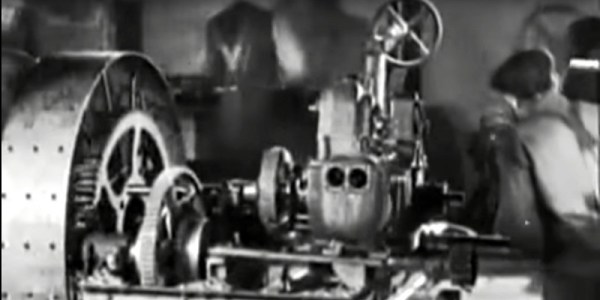
So my recommendations have something of an agricultural flavor. Like the video below the break, a 1917 silent film promoting the Ford Model B tractor. This one was eye-catching because it was a machine I’d not seen before, a rather unusual three-wheeler design with two driving wheels at the front and a single rear steering wheel.

During the early years of the twentieth century the shape of the modern tractor was beginning to evolve, this must have been a late attempt at an alternative. Speaking from the viewpoint of someone who has operated a few tractors in her time it does not look the easiest machine to control, that cloud of exhaust smoke surrounding the driver would not be pleasant, and the operating position hanging over the implement coupling at the rear does not look particularly comfortable or safe.

The film has a charming period feel, and tells the tale of a farmer’s son who tires of the drudgery of manual farm labor, and leaves for the city. He finds a job at the tractor factory and eventually becomes a tractor salesman, along the way meeting and marrying the daughter of a satisfied customer. He returns home with his bride, and a shiny new tractor to release his father from ceaseless labor. Along the way we gain a fascinating look at agriculture on the brink of mass mechanization, as well as the inside of a tractor factory of the time with an assembly sequence in which they appear to use no fasteners.

[Image Source: Tractor Industry Fraud on Farm Collector]
[Image Source: Tractor Industry Fraud on Farm Collector]
All of this is very interesting, but the real nugget in the story lies with its manufacturer. This is a Ford Model B tractor. But it’s not a Ford Model B. Confused? So, it seems were the customers. The Ford we all know is the Michigan-based motor company of Henry Ford, who were already very much a big name in 1917. This Ford however comes from the Ford Tractor Co, of South Dakota, an enterprise set up by a shady businessman to cash in on the Ford brand, manufacturing an already outdated and inferior machine backed up by dubious claims of its capabilities.

On the staff was an engineer called Ford who lent his name to the company, but he bore no relation to Henry Ford. The company didn’t last long, collapsing soon after the date of this film, and very few of its products survived. It did have one legacy though, the awful quality of one of its tractors is reputed to have been the impetus behind the founding of the Nebraska Tractor Test Laboratory, the place where if you sell a tractor in the USA, you’ll have to have it tested to ensure it performs as it should. In their museum they house one of the few surviving Ford Model B tractors.

Meanwhile the Ford in Michigan produced their own very successful line of tractors, and their Fordson Model F from the same year is a visible ancestor of today’s machines. But as the video below shows, there’s nothing new about a fake.

Continue reading “Retrotechtacular: Horseless Farming With The Ford Model B”

Soviet Portable Scopemeter Teardown

Browsing YouTube may prove to be your largest destroyer of productive time outside of Hackaday, once you have started looking at assorted Lincolnshire plumbers or young Ukrainians doing dangerous stunts it’s easy to lose an hour with very little to show for it. There is so much to divert our attention, it’s a wonder that any of us ever make anything!

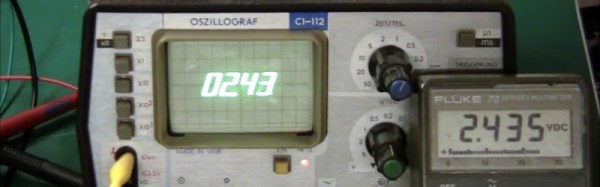
So to ensure you lose a further quarter hour today, we’d like to bring you [Jesper Broe]’s demonstration and teardown of his latest oscilloscope. This might seem unpromising when we tell you it’s a single-trace model with a bandwidth of 10MHz, but don’t give up. This is a RIMEDA C1-112, a portable instrument made in Lithuania when the country was part of the Soviet Union, and its party piece is that it contains a digital multimeter with a vector display using the oscilloscope CRT.

We’re shown the compact device being unpacked, then put through its paces as an oscilloscope. It gives useful results above 10MHz, but it is visibly losing amplitude and eventually it has trouble triggering as the frequency increases. Interestingly all the controls work in the opposite direction to the ones you will be used to, anticlockwise rotation increases rather than decreases. Then we’re shown the multimeter function, which is compared to a modern DMM and found to be still pretty accurate after nearly three decades.

The ‘scope’s lid is then removed, and we see something of the logic boards that produce the digital display. A host of Soviet K155 series logic ICs are at the heart of it, and at the end of the video we’re shown a period review in Russian with a glimpse at the waveforms they produce to vector draw the figures.

Take a look at the video below the break, we’re sure you’ll agree it’s an instrument that many of us would still find useful today.

Continue reading “Soviet Portable Scopemeter Teardown”

Daisy Kite Wind Turbine: Now You Can Buy One

The Isle of Lewis is the largest of the Scottish Outer Hebrides, sitting in the North Atlantic off the west coast of the Scottish mainland. It is the first landfall after thousands of miles of ocean for a continuous stream of Atlantic weather systems, so as you might imagine it is a place in which there is no shortage of wind.

It is thus the perfect situation for a wind power startup, and in the aptly-named Windswept and Interesting Ltd it has one that is pushing the boundaries. Their speciality is the generation of power from spinning kites, arrays of kites that transmit power to a ground-based generator through the rotation of their lines, and because they release their designs as open source they are of extra interest to us.

Of course, if you are a seasoned reader you’ll now be complaining that we’ve covered this story before when they had an entry in the 2014 Hackaday Prize, so what’s new? The answer is that the 2014 story was a much earlier iteration than their current multi-level kite array, and that they have now reached the point of bringing their products to market. You can buy one of their prototypes right now, and there is a soon-to-be-launched crowdfunding campaign for their latest model. It’s not exactly cheap, but this first product is the result of 5 years of product development, and it is pretty obvious that more is on the way. For any open hardware startup to stay afloat that long is an impressive achievement, to do so in a field in which you are not surrounded by a huge supporting industry in the way for example electronics startups are is nothing short of amazing.

If you would like to have a go at building one of their spinning kites, you can do so with full instructions released under a Creative Commons licence, but for non kite builders their website is a fascinating read in its own right. Their YouTube channel  in particular has a wealth of videos of previous tests as well as design iterations, and is one on which many readers will linger for a while. Below the break we’ve put one of their most recent, a montage showing the kite evolution over the years.

Continue reading “Daisy Kite Wind Turbine: Now You Can Buy One”

Retrotechtacular: Max Headroom Takes Chicago In Audacious TV Hack

Those of you with long memories and a compulsive TV viewing habit might remember [Max Headroom], a quirky piece of TV ephemera from the late 1980s and early 1990s. [Max] was a supposedly computer generated TV show host and VJ with a pseudomechanical stutter, a slightly blocky rendered head, and a moving background of rendered lines. He looks a little quaint for viewers with a few decades viewing experience of CGI, but in his day he was cutting-edge cypberpunk TV.

He also made unscheduled showings on two Chicago TV stations in an audacious hack that has never been explained and whose culprit has never been found.

The real [Max Headroom] (Fair use) Via Wikimedia commons.
The real [Max Headroom] (Fair use) Via Wikimedia Commons.
If you were a bored British teenager and future Hackaday writer vegging out in front of your parents’ TV on an April night in 1985, you’d have caught [Max]’s genesis. He strung upon us by rising out of a title screen full of static in the Channel 4 TV movie [Max Headroom]: 20 Minutes into the Future.

The plot is a trip in itself. An investigative journalist seeking to uncover the sinister owners of his network (they run speeded-up adverts with the unfortunate side-effect of causing overweight viewers to explode) is pursued, causing a road accident in which he is injured by a collision with a safety barrier. Hence the name: [Max Headroom]. The network try to cover it up by producing a computerized facsimilie of the reporter which turns out to be an embarassing failure. They scrap the computer and it falls into the hands of a pirate TV station operating from a decrepit campervan, the Alphabetti-eating proprietor of which turns the character it contains into a TV sensation. Meanwhile the reporter escapes, recovers, and prevails over the villains.

The [Max] character proved to be something of a hit, with a TV spin-off series, VJing, adverts, and more. But that wasn’t the whole story of his appearances, back to that unexplained hack of Chicagoland TV.

The Chicago fake [Max Headroom].
On the night of the 22nd of November 1987, viewers of WGN were watching a sports program when the screen went blank and they were treated to a few seconds of a slightly home-made [Max Headroom] dancing in front of  those trademark moving lines. A couple of hours later on WTTW a rerun of a [Doctor Who] episode was again interrupted with the same fake [Max], this time speaking for a while before, if his performance wasn’t already bizarre enough, being spanked by a woman whose face is off camera.

As a piece of television history it’s an intriguing mystery, though since so little is known about the mechanism through which it was achieved it hasn’t achieved the notoriety in the technical world that you might expect. The stations involved conducted full investigations at the time and failed to locate a culprit, perhaps they should have been looking for that old campervan with the antennae on its roof.

It is very unlikely that a similar stunt could be performed today, with entirely digital TV studios and easy access to encryption technologies for external links to transmitter sites. But in the 1980s a studio would still have been an analogue affair so there would have been more opportunities to insert an unauthorized feed. Next year sees the 30th anniversary of the event, it would be fascinating if the perpetrator would mark it by anonymously revealing how it was achieved. Of course, we’d love to hear how you would have done it in the comments below. Surely we have readers who are intimately familiar with the television broadcasting equipment of the time.

Below the break we’re showing you both fake [Max] intrusions into the Chicago airwaves. First is the short outing on EGN, below that the longer one on WTTV.

Continue reading “Retrotechtacular: Max Headroom Takes Chicago In Audacious TV Hack”

“Alexa, Make My ESP8266 Do Something”

The Amazon Echo and its diminutive Dot cousin have the handy feature of being able to control some home automation devices. If you own the right manufacturer’s hardware you can bend your home to your will using the power of your voice alone.

The trouble is, if your hardware isn’t on the list of supported devices or if you make your own, you’re out of luck.

[Xose Pérez] had been sidestepping this problem by using a server running a set of scripts emulating a Belkin WeMo device, which Echo supports. The server could issue commands to his microcontrollers, but he wanted more. Why not cut out the middle man to incorporate the WeMo emulation directly on the ESP8266 that did the work?

He took the Fauxmo Python WeMo emulator he had been using, and ported it to an ESP8266 library that can be incorporated in existing code to make it appear to the world as a WeMo device. With the code itself he has provided full instructions on its BitBucket page as well as on the page linked above.

He admits that he is not the first person to have achieved this aim, and points to this earlier project. However his requirement for a library to be incorporated in another piece of software were not satisfied by it, hence his work.

We like this project, but it’s probably worth reminding readers that Alexa does have an SDK in the form of the Alexa Skills Kit. You can use it to do all sorts of clever things with your Echo or Dot… or you can make it the brains of a Big Mouth Billy Bass novelty ornament.