Bubble Displays Make A Neat Retro Clock

In 2025 we are spoiled for choice when it comes to displays, with affordable LCDs, OLEDs, TFTs, and e-ink panels of all sizes only a few clicks away. But in decades past, such exotica were not on the menu for casual construction. Instead there were a range of LED seven segment displays which have now largely passed out of use.

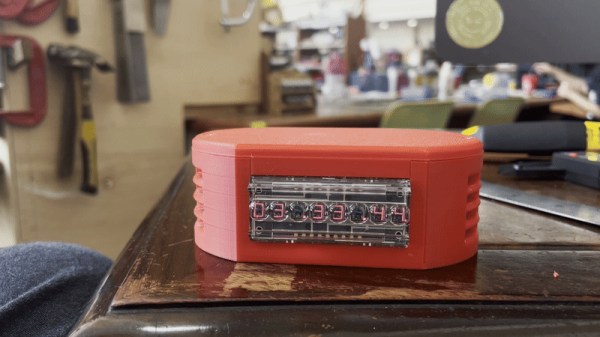
Among them were HP’s bubble displays, assemblies of miniature LEDs on a PCB, topped with plastic bubble lenses. If you had a calculator in the 1970s it probably had one, but in the present, [Joshua Coleman] has incorporated one into a pleasingly retro digital clock.

Inside the 3D printed case is an ESP32 with a pair of 74HC595 shift registers to drive the display, and an 18650 battery with all associated charging and protection circuitry. It’s a surprisingly simple circuit, and the code is provided on the page. He makes an apology to non-Americans for his use of US date formats, but we think few readers will be unable to change it to reflect the only date format which really matters.

If you find a bubble display, hang on to it. They’re certainly something we’ve seen before here a few times.
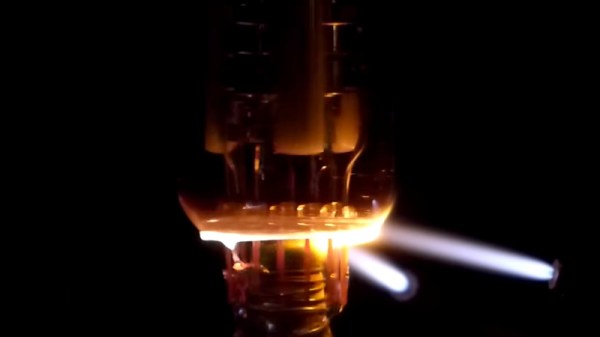

Reconditioning A Vintage CRT Tube

Plenty of readers will be familiar with CRT televisions, not least because many of us use them with retrocomputers and consoles. But perhaps fewer will have worked with CRTs themselves as components, and of those, fewer still will be familiar with the earlier generation of tubes. In the first few decades of color TV the tubes were so-called delta gun because their three electron guns were arranged in a triangular form. [Colorvac] has put up a video in which they demonstrate the reconditioning of one of these tubes from a late-1960s Nordmende TV.

The tube in question isn’t one of the earlier “roundies” you would find on an American color TV from the ’50s or early ’60s, instead it’s one of the first generation of rectangular (ish) screens. It’s got an under-performing blue gun, so they’re replacing the electron gun assembly. Cutting the neck of the tube, bonding a new neck extension, and sealing in a new gun assembly is not for the faint-hearted, and it’s clear they have both the specialist machinery and the experience required for the job. Finally we see the reconditioned tube put back into the chassis, and are treated to a demonstration of converging the three beams.

For those of us who cut our teeth on these devices, it’s fascinating.

Continue reading “Reconditioning A Vintage CRT Tube”

2025 Pet Hacks Contest: A Barrel Of Fun For Your Dog

If you ask someone for a piece of received opinion about Bernese mountain dogs, the chances are that the tale of their carrying barrels of brandy round their necks for the revival of those lost in the snow. It’s a story of uncertain provenance and may indeed be a myth, but that hasn’t stopped [Saren Tasciyan] 3D printing one for their faithful hound. In its own way it too is a saviour, for as well as a small camera, it carries a supply of dog poop bags.

It’s a two part print, held together with strong magnets. Waterproofing is achieved using liberal quantities of hot glue. There’s a protrusion on one side designed to take an action camera for a dog’s-eye-view of the world. The files are downloadable, so your pooch can have one too if you like. We are wondering whether a couple of miniatures of brandy might just fit in there as well.

It’s is part of the 2025 Pet Hacks contest, so if this has whetted your appetite, expect more. If your dog carries around something you’ve made, how about making it an entry of your own?

2025 Pet Hacks Contest: A Water Fountain For Your Cat

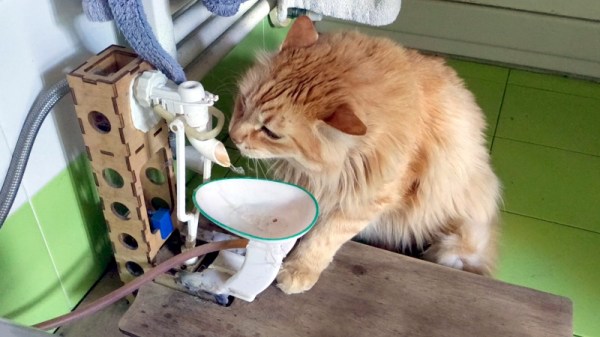
Part of the charm of having a cat in your life is that by their nature these animals are very interactive. They will tell you in no uncertain terms when something in their lives needs attention, for example when their water dish is empty. But why not give them a drinking fountain all of their own? It’s what [supermarioprof] did for their adorable ginger cat [Piki Piki], providing a cat-operated trickle of water on demand.

It’s a simple enough device in its operation, but very well constructed. There’s a small basin with a drain, and a water cistern valve operated by the cat placing a paw on a lever. This starts a trickle of water, from which they can lap as much as they like.

The physical construction comes courtesy of some laser-cut ply, and what looks like some 3D print work. It’s certainly easy to operate for the cat, and has worked reliably for a few years now.

This project is part of the 2025 Pet Hacks contest, so expect to see more in the same vein. If your cat’s life is improved by one of your projects, consider making an entry yourself!

2025 Pet Hacks Contest: Keep Your Hound Toasty Warm With This Heated Dog Bed

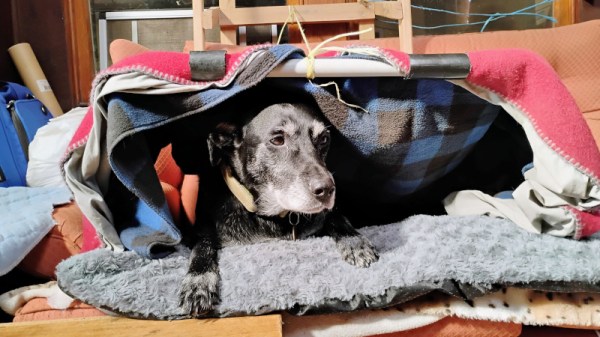
It’s been a universal trait among the different faithful Hackaday Hounds who have loped around these parts over the decades, that there is no place warm enough for their tastes. Fire up the stove and the dog is there stretched out in front of it, leaving one to wonder whether our house temperature is being cruel to the mutt, or simply that they are heat sponges with infinite capacity. There’s got to be some joy in doggy circles then at the prospect of [John.r.sheahan]’s heated dog bed, designed in particular with the comfort of an older dog in mind.

In electronics terms it’s a relatively low-tech project, using as it does a 12 volt electric lap blanket aimed at motorists. It’s none the less a hack though, because it has a frame made of PVC pipe to hold it, and a blanked clipped in place. This forms a box-like structure above the sleeping position keeping the dog very comfortable indeed over chilly nights. We’ve cared for more than one geriatric dog over the years, and can see that something like this is vital for their comfort and well-being.

This project is part of the 2025 Pet Hacks contest, so look out for more like it. Alternatively if your faithful friend uses something you made, why not enter yourself!

Hackaday Podcast Ep 322: Fake Hackaday Writers, New Retro Computers, And A Web Rant

We’re back in Europe for this week’s Hackaday podcast, as Elliot Williams is joined by Jenny List. In the news this week is the passing of Ed Smylie, the engineer who devised the famous improvised carbon dioxide filter that saved the Apollo 13 astronauts with duct tape.

Closer to home is the announcement of the call for participation for this year’s Hackaday Supercon; we know you will have some ideas and projects you’d like to share.

Interesting hacks this week include a new Mac Plus motherboard and Doom (just) running on an Atari ST, while a LoRa secure messenger and an astounding open-source Ethernet switch captivated us on the hardware front. We also take a dive into the Mouse programming language, a minimalist stack-based environment from the 1970s. Among the quick hacks are a semiconductor dopant you can safely make at home, and a beautiful Mac Mini based cyberdeck.

Finally, we wrap up with our colleague [Maya Posch] making the case for a graceful degradation of web standards, something which is now sadly missing from so much of the online world, and then with the discovery that ChatGPT can make a passable show of emulating a Hackaday scribe. Don’t worry folks, we’re still reassuringly meat-based.

Insert MP3 podcast link here.

Continue reading “Hackaday Podcast Ep 322: Fake Hackaday Writers, New Retro Computers, And A Web Rant”

Now KDE Users Will Get Easy Virtual Machine Management, Too

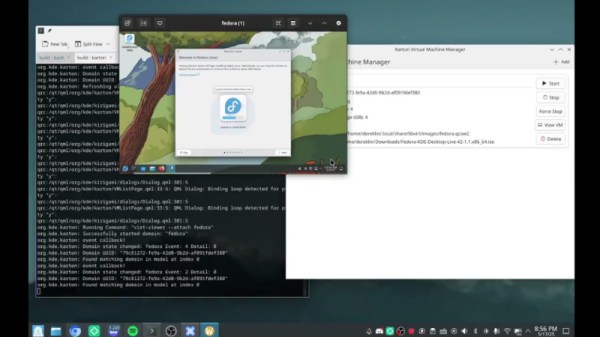
If you work with virtual machines, perhaps to spin up a clean OS install for testing, historically you have either bitten the bullet and used one of the commercial options, or spent time getting your hands dirty with something open source. Over recent years that has changed, with the arrival of open source graphical applications for effortless VM usage. We’ve used GNOME Boxes here to make our lives a lot easier.  Now KDE are also joining the party with Karton, a project which will deliver what looks very similar to Boxes in the KDE desktop.

The news comes in a post from Derek Lin, and shows us what work has already been done as well as a roadmap for future work. At the moment it’s in no way production ready and it only works with QEMU, but it can generate new VMs, run them, and capture their screens to a desktop window. Having no wish to join in any Linux desktop holy wars we look forward to seeing this piece of software progress, as it’s a Google Summer Of Code project we hope there will be plenty more to see shortly.

Still using the commercial option? You can move to open source too!