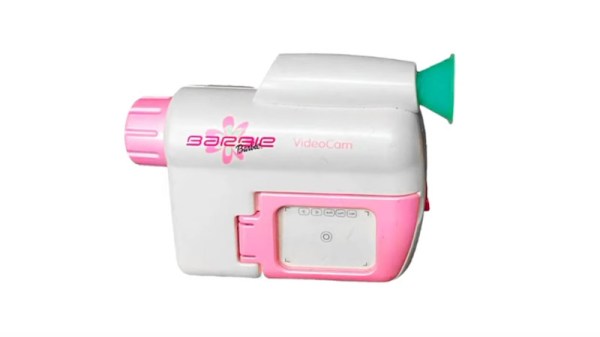
For those who missed it, there’s been something of a quiet revolution in the world of analogue video over the last year, due to the arrival of inexpensive “MiniDVR” devices. These little modules are a complete video recorder including battery, recording PAL or NTSC composite video and audio to SD card. They’ve become the box of choice for camcorder enthusiasts, but that’s not where the fun ends. [Max Vega] has taken a Barbie video camera toy from 2001 and added a MiniDVR to make it into a fully self-contained novelty camcorder. But this isn’t a simple case of duct-taping the DVR to the toy, instead it’s a comprehensive upgrade resulting in a device which could almost have been a real product.
The original toy had a small transmitter which could send over a short distance to a receiver that connected to a domestic VCR, so all that circuitry had to go. The camera itself is a small enough module in the fake lens assembly, with an easily identifiable output cable with the required composite signal. The video below the break steps through the proces of making the space for the MiniDVR module, and putting in extensions for all its buttons, and the SD card. Finally it has a new power supply module with an associated USB-C input, providing juice to both DVR and camera.
The result has what we can only describe as a pleasingly retro feel, in that it’s not of high quality and the colour is, well, Never The Same. But when a smartphone can record HD video that’s not the point, instead it’s there to be a retro toy, and in that it succeeds completely.
Continue reading “Barbie’s Video Has Never Looked So Good” →