A Tractor From A Small Town Might Just Be The Catalyst For Ousting Machinery DRM

Odd things sometimes pop up in the feed of a Hackaday scribe, not hacks as such, but stories with a meaning in our community. One such that’s come our way from a variety of sources over the last week features Ursa Ag, a small machinery manufacturer based in Alberta, Canada. The reason they’re in the news is because they have gained bulging order books by taking on the likes of John Deere with a tractor more like the one their customers’ parents bought back in the ’80s or ’90s. It’s a basic machine without much in the way of electronics, and certainly without all the DRM lockdown that has made those big manufacturers so unpopular.

It’s clear that Hackaday isn’t in the business of shilling Canadian tractors, but it should be of interest to readers because it represents an alternative route to challenge the DRM lockdowns than the legal and consumer routes we’ve previously reported on. The Ursa Ag tractor may be as niche Albertan as a Corb Lund CD, but it’s not the tractor itself but the idea which matters. We doubt much sweat will be shed by John Deere execs over a tiny company out on the prairies making a basic spec tractor, but given that Ursa Ag customers are reported as buying them because they have no DRM, the prospect of larger upstart competitors taking note and offering machines without it may cause them some sleep loss. The free market is held up to outsiders as perhaps the most American of ideals, and for it to eventually prove to be the means by which something intended to limit it might be defeated, is sweet justice indeed.

We’ve reported extensively on the Deere tractor saga over the years, but perhaps the best illustration of the self-inflicted damage the brand has suffered through DRM comes in their older products being worth considerably more than their newer ones.

A Tube Amplifier That’s Oven Ready

The problem with tube based audio is that it has so often been hijacked by people for whom the bragging rights of having a tube amplifier outweigh the benefits, or the sheer fun of building the thing. [Bettina Neumryr] makes a speciality of building projects featured in old electronics magazines, and her latest, a tube amplifier from 1955, is a fantastic antidote to the gold-plated silliness of audiophile tube amplifiers.

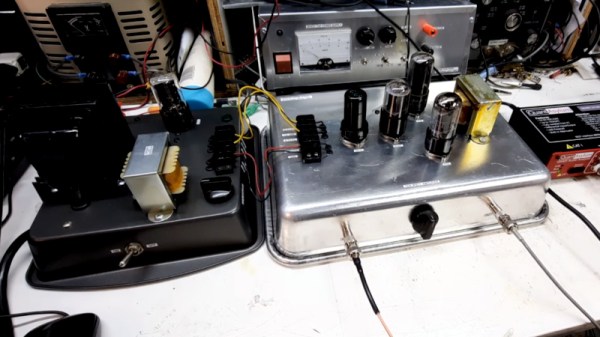
Design wise it’s relatively straightforward, with a preamplifier before a two-tube transformerless splitter circuit driving a push-pull output. She dives into the circuit a little, noting its feedback circuit to the cathode of the first splitter tube. There’s an accompanying power supply, a classic tube rectifier design that incorporates a hefty low-pass filter with a giant choke.

We particularly like her choice of chassis — while it’s possible to pay silly money for a tube chassis in 2026 she’s taken a much more down to earth approach with a pair of baking trays. We’re being honest here, they look surprisingly good. Component choices are limited by what’s available so most parts come from the junk box including the output transformer which causes her issues later. There’s a lot of mumbo-jumbo about tube amplifier layout, and she wisely sidesteps some of it.

The result after a few mishaps and a bit of unintended oscillation, is an amp which shows promise, but has distortion due to that transformer. We think she’ll have no problems sourcing a better one, which should bring that distortion figure into the acceptable range. You can watch the whole video below the break, and if that’s got you hooked, you can see one of our own youthful follies.

Continue reading “A Tube Amplifier That’s Oven Ready”

A Trackball 3D Controller

We use CAD packages in our 3D work, and it’s likely that many of us have become annoyed by the limitations of controlling the view of a 3D object using a 2D interface, our mouse. Joystick-like 3D controllers exist for this purpose, but [David Liu] found them inconvenient. He tried a trackball, but that didn’t improve matters. His response was to take the trackball and change the way it controlled the software, turning it from the equivalent of a ball rolling over a surface to a ball representing the object on the screen itself. He can turn and rotate the object intuitively just by moving the ball.

He started with a Kensington off-the-shelf trackball and adapted its electronics and handy twin optical sensors such that it worked in the required fashion. There was a lot of iterating and tuning to get the control feeling right, but he’s ended up with a peripheral that replaces both mouse and 3D joystick, and leaves the other hand free for those keyboard shortcuts.

Continue reading “A Trackball 3D Controller”

2026 Green Powered Challenge: A Portable Solar Panel, Made Better

Many of us will have seen the portable solar panels offered on our favourite online purveyors of electronics, but some who have bought them remain unimpressed with their performance.  [t.oster92] had just such an issue, and concluded that since it had great dull-day performance, it wasn’t the panels themselves that were at fault. There followed a teardown and an investigation of the circuitry inside.

The panels fed a small PCB containing a buck converter, with an 8-pin SOIC carrying an untraceable part number. Some detective work revealed it was likely to be a rebadged version of a more common part, which exposed the problem as a converter without the rating to deliver the power it should. The solution, at least in part, was to replace it with a more powerful chip on a module and reap the benefits.

This would be the end of the story, but this is an ongoing project. Next up will be adding MPPT capability to extract the last bit of juice from those panels. That makes this one a story to keep an eye on, because we could all use a decent set of panels.

This hack is part of our 2026 Green Powered Challenge.

2026 Green Powered Challenge: Ventilate Your Way To Power!

Have you ever looked out across the rooftops of a city and idly gazed at the infrastructure that remains unseen from the street? It seems [varunsontakke80] has, because here’s their project, harvesting energy from the rotation of a rooftop ventilator.

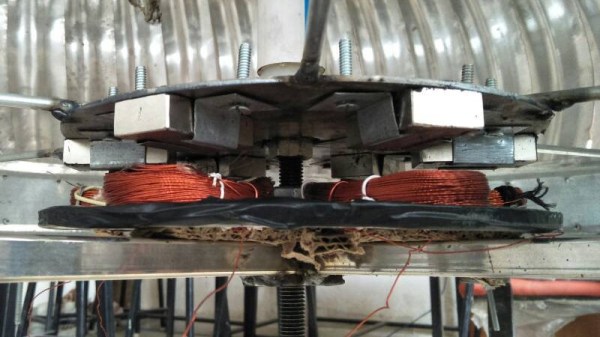
The build is a relatively straightforward one, with a pair of disks with magnets attached being mounted on the ventilator shaft inside its dome. A third disk sits between them and is stationary, with a set of coils in which the magnets induce current as they move. A rectifier and charge circuit completes the picture.

This appears to be part of a college project, but despite searching, we can’t find any measure of how much power this thing generates. We’d be concerned that it might reduce the efficiency of the ventilator somewhat. There will be an inevitable tradeoff as power is harvested. Still, it’s a neat use of a ubiquitous piece of hardware, and we like it for that.

This hack is part of our 2026 Green Powered Challenge. You’ve got time to get your own entry in, so get a move on!

2026 Green Powered Challenge: Cook With The Sun!

One of the problems facing any solar power installation comes in storing enough power for high-intensity operations such as cooking. The high-tech and expensive way involves battery banks and inverters, but [Solar Genius] is taking a more direct route by skipping the energy storage entirely.

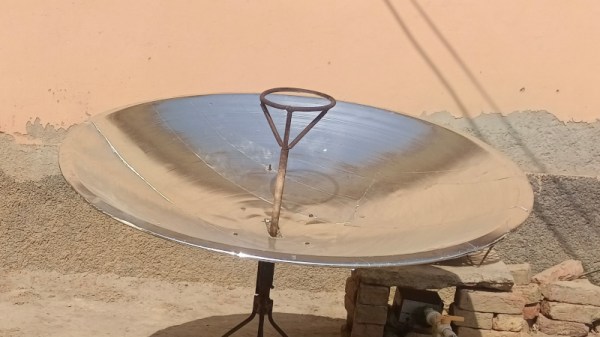
A pair of parabolic antennas are pressed into service as mirrors, catching and focusing the sun’s energy onto a cooking pot. Of course, solar cookers like this are nothing new, so what makes this one different is the in-depth analysis of its performance. This thing can cook!

One antenna is covered in square mirrors while the other is covered in sticky chrome-effect mirror sheeting. They’re described as sun tracking, but since we don’t see any mechanism we’re guessing the tracking is done by hand. The experiment takes place in Pakistan, so there’s a plentiful supply of sunlight that those of us in more northern climes can only dream of.

This hack is part of our 2026 Green Powered Challenge. You’ve just got time to get your own entry in, so get a move on!

KernelUNO, An OS For The Arduino Uno

If you were to point to a single device responsible for much of Hackaday’s early success, it might be the Arduino Uno. The little board from an Italian university with its easy to use dev environment changed microcontroller hacking forever, and while it’s now very much old hat, its shadow lies long across single board computing.

Just in case you thought there wasn’t much more life in that old AVR in 2026, along comes [Arc1011], with KernelUNO, describing itself a “A lightweight RAM-based shell for Arduino UNO with filesystem simulation, hardware control, and interactive shell“. It’s an OS for your Arduino, of sorts.

For flashing it to your Uno, you get a shell with some familiar looking filesystem and system commands, the ability to write to files though no editor, and a set of commands to control pins. It’s extremely basic, but you can see the potential.

If we were to speculate as to how this might become more useful then perhaps it might involve a more permanent filesystem perhaps on a flash chip. If possible, the ability to run script files containing a list of commands would also be very nice. Though we are guessing that maybe the reason these features are not in place lies in the meager specifications of an ATmega328, for which we can’t blame the developer at all. Even if it can’t be extended in this way though, it’s still a cool project.

We have to go back quite a while, but this isn’t the first time something like this has appeared on these pages.