Dangerous Greeting Cards You Probably Shouldn’t Send Anyone

Regular paper greeting cards are pricey for what they are, and of course the annoying musical variety are even more so. If you really want to go all out, however, you’ve got to go custom made. That’s what [Xyla] and [Ian] did, though we’d stop short of recommending you build or send these to anyone!

Two variants of the “dangerous cards” were built. One repurposed an electric shocking circuit from a handheld buzzer, tucking it inside a shiny Disney greeting card. Using a switch from a musical greeting card, when opened, the shocking circuit is activated. With the circuit connected to aluminium tape electrodes hidden in the shiny foil design, when the user opens the card, they receive a painful shock. The flamethrowing variant was triggered by the same mechanism, though instead sent power to an electric match, shooting a fireball with flash cotton when the card was opened.

These cards make excellent pranks, though we’d be wary about sending them by mail for obvious reasons. We’ve seen [Xyla’s] work before too, with her glowing kayak a particular highlight. Video after the break.

Continue reading “Dangerous Greeting Cards You Probably Shouldn’t Send Anyone”

The V-Bomber Ejector Seat Controversy

Once upon a time, bailing out of a plane involved popping open the roof or door, and hopping out with your parachute, hoping that you’d maintained enough altitude to slow down before you hit the ground. As flying speeds increased and aircraft designs changed, such escape became largely impossible.

Ejector seats were the solution to this problem, with the first models entering service in the late 1940s. Around this time, the United Kingdom began development of a new fleet of bombers, intended to deliver its nuclear deterrent threat over the coming decades. The Vickers Valiant, the Handley Page Victor, and the Avro Vulcan were all selected to make up the force, entering service in 1955 through 1957 respectively. Each bomber featured ejector seats for the pilot and co-pilot, who sat at the front of the aircraft. The remaining three crew members who sat further back in the fuselage were provided with an escape hatch in the rear section of the aircraft with which to bail out in the event of an emergency.

Continue reading “The V-Bomber Ejector Seat Controversy”

Lego Heist Bot Steals Keys

Breaking and entering is a felony offense, and one that risks the interloper receiving serious bodily harm for the trouble. Sending in a robot instead is an attractive alternative. While we doubt any actual intention to use their creation for evil, [Brick Experiment Channel] have nonetheless built a viable heist bot out of Lego.

The robot in question is actually two, that work together to execute their mission. Once lowered in the house, the scissor lift bot drives into position next to a coffee table. It then lifts its companion bot into position by extending its motor-driven linear actuators. The recovery bot then drives out onto the table, snatches a set of keys with its arm, and returns to the lift bot, before exiting the house. It’s all achieved with the use of the SBrick, a third-party Lego accessory which allows remote control of Lego motors over Bluetooth. A wireless camera also helps out with vision for the platform.

Lego really does make it easy to build quick, functional mechanisms without a whole lot of fuss. We’ve seen it employed in all sorts of ways, like this handy film scanner. Video after the break.

Continue reading “Lego Heist Bot Steals Keys”

Party Canoe Lights Up The Water

Generally, any activity out on the water is more dangerous when done at night. Hazards are less visible, and it can be easy to get into trouble. [Xyla Foxlin]’s party canoe can’t help with that, but it does look the business after dark.

The canoe is made out of fiberglass, directly formed onto an existing canoe to make getting the shape right easy. It was formed in two halves, with special care taken to make the final result as clear as possible. Obviously, fiberglass is never going to be perfectly transparent, but [Xyla] does a great job of getting a nice translucent frosted look. The final effect means that it’s the perfect canoe to stuff full of addressable LEDs. A string of WS2812Bs, hooked up to an Arduino, make for an appealing lightshow when boating at night.

The diffusive nature of the fiberglass really makes the difference here. We’ve talked about the topic before – it’s the key to making your glowy project really pop. Video after the break.

Continue reading “Party Canoe Lights Up The Water”

Active Camouflage Material Shows Promise At Hiding From Infrared Or Visual Detection

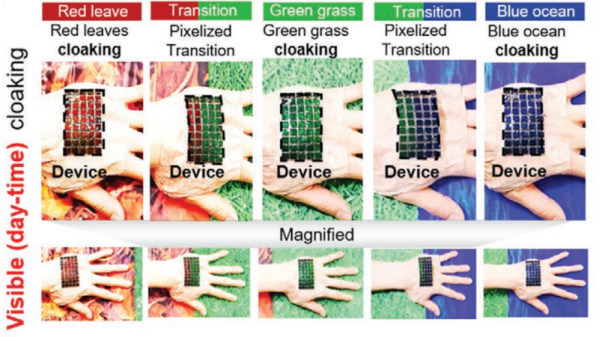
An invisibility cloak may seem like science fiction, but despite that, many scientists and engineers have put much time into developing the concept, pushing it closer to reality. A device which detects the nature of its surroundings and changes its own properties to blend in may be complex, but a multitude of examples in the animal world show that it’s not impossible to achieve.

A team from Seoul National University recently developed a flexible material designed in part as a flexible “cloaking” material. We’ll take a look at the underlying concept behind such devices below, and look at how this work furthers the state of the art in the field.

Continue reading “Active Camouflage Material Shows Promise At Hiding From Infrared Or Visual Detection”

Electric Puzzle Board Lets You Assemble Circuits With Ease

Many hackers learned about electronics over the years with home experimenter kits from Radio Shack and its ilk. Eschewing soldering for easier screw or spring based connections, they let the inexperienced build circuits with a minimum of fuss, teaching them the arcane ways of the electron along the way. [victorqedu] has put a modern spin on the form, with his Electric Puzzle Game.

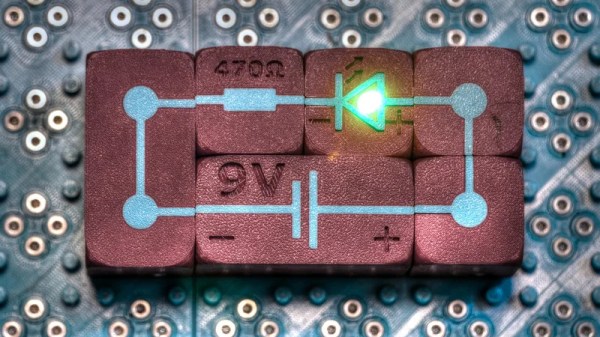
The build consists of a series of 3D printed blocks, each containing a particular electronic component or module. The blocks can be joined together to form circuits, with magnets in the blocks mating with screws in the motherboard to hold everything together and make electrical contact between the parts. It’s a project that requires a significant amount of 3D printing and upfront assembly to build, but it makes assembling circuits a cinch.

The variety of circuits that can be built is impressive. [victorqedu] shows off everything from simple LED and switch arrangements to touch sensors and even a low-powered “Tesla coil”. We imagine playing with the blocks and snapping circuits into place would be great fun. We’ve seen other unconventional approaches before, too – such as building squishy circuits for educational purposes. Video after the break.

Continue reading “Electric Puzzle Board Lets You Assemble Circuits With Ease”

Building A Website-Controlled Christmas Tree

Back in the day, Christmas lights were simple strings of filament bulbs, and if you really splashed out, you could get some that flashed. These days, we expect a lot more capability out of our blinking decorations. [JT] has put together a rather nifty website-controlled setup for his own tree.

The setup is a little different than builds you may be used to. The website runs on a cloud-hosted virtual machine on Digital Ocean, rather than running locally. This allows anyone on the web to visit the site, and use the interface to control the lights on the Christmas tree. An image of the tree is used as the interface, and allows users to set the color of each individual LED on the tree. The LEDs themselves are driven from an NodeMCU ESP8266, which uses its WiFi connection to query the website itself and grab the color data as needed. [JT] has also included a secondary interface, where the chat of the Youtube livestream can be used to control the LEDs, too.

It’s a build that’s a touch more complicated than most typical online LED blinkers, but one that teaches useful skills in interfacing on the web and using virtual machines. We’ve seen other builds in this genre too; even some that are reactive to “Christmas fever” itself. Video after the break.

Continue reading “Building A Website-Controlled Christmas Tree”