
Avian-Inspired Drones: How Studying Birds Of Prey Brings More Efficient Drones Closer

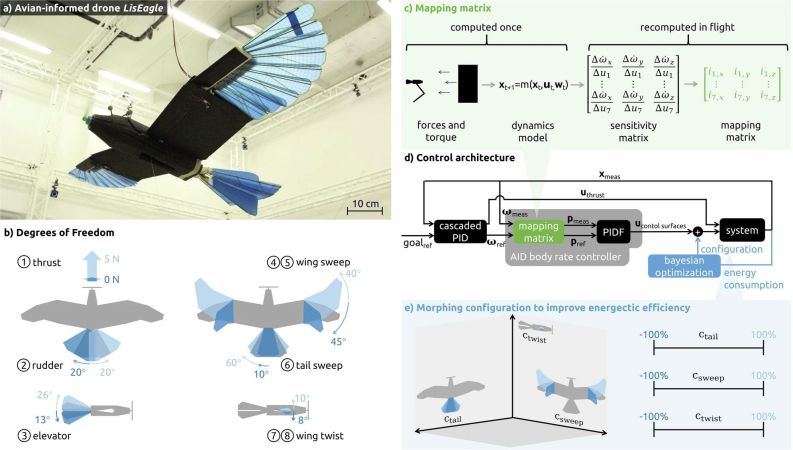
The EPFL LisRaptor with adjustable wings and tail.

Throughout evolution, the concept of powered flight has evolved and refined itself multiple times across both dinosaurs (birds), mammals (bats) and insects. So why is it that our human-made flying machines are so unlike them? The field of nature-inspired flying drones is a lively one, but one that is filled with challenges. In a recent video on the Ziroth YouTube channel, [Ryan Inis] takes a look at these efforts, in particular those of EPFL, whose recent RAVEN drone we had a look at recently already.

Along with RAVEN, there is also another project (LisRaptor) based on the Northern Goshawk, a bird of prey seen in both Europe and North-America. While RAVEN mostly focused on the near-vertical take-off that smaller birds are capable of, this project studies the interactions between the bird’s wings and tail, and how these enable rapid changes to the bird’s flight trajectory and velocity, while maintaining efficiency.

The video provides a good overview of this project. Where the LisRaptor differs from the animal is in having a rudder and a propeller, but the former should ideally not be necessary. Obviously the kinematics behind controlled flight are not at all easy, and the researchers spent a lot of time running through configurations aided by machine learning to achieve the ideal – and most efficient – wing and tail configuration. As these prototypes progress, they may one day lead to drones that are hard to differentiate from birds and bats.


Continue reading “Avian-Inspired Drones: How Studying Birds Of Prey Brings More Efficient Drones Closer”

Repairing A Real (and Broken) Apollo-era DSKY

Presumably the same DSKY unit installed in the simulator at MIT.

The Display/Keyboard unit – DSKY for short – is the primary way that Apollo-era astronauts communicated with the onboard computers. Not all DSKYs ended up in space, however, with the MIT hosting a simulator that features one of these units. Unfortunately the unit that ended up at [CuriousMarc]’s lab had seen better days, with the assumption being that it was the same DSKY that was installed in a photo of the old simulator. In addition to the busted EL display and two (improper) replacement keys, the insides show signs of damaged modules and possibly worse.

Without bothering to hook the unit up to the (previously restored) guidance computer, a full teardown was begun to assess the full extent of the damage. Considering that the DSKY uses latching relays for memory and two modules were ominously marked as being defective, this made for a tense wait as the unit was disassembled.

Fortunately making new DSKY-style EL displays has first been replicated in 2019, meaning that a replacement is possible. Perhaps surprisingly, the busted display still fires up in the test rig, as a testament to how robust the technology is. At the end of the teardown, the assessment is that the unit can be restored to its original condition, which will be done in the upcoming videos in this series.

Continue reading “Repairing A Real (and Broken) Apollo-era DSKY”

Selectively Magnetizing An Anti-Ferromagnet With Terahertz Laser

It’s a well-known fact that anti-ferromagnetic materials are called that way because they cannot be magnetized, not even in the presence of a very strong external magnetic field. The randomized spin state is also linked with any vibrations (phonons) of the material, ensuring that there’s a very strong resistance to perturbations. Even so, it might be possible to at least briefly magnetize small areas through the use of THz-range lasers, as they disrupt the phonon-spin balance sufficiently to cause a number of atoms to ‘flip’, resulting in a localized magnetic structure.

The research by [Baatyr Ilyas] and colleagues was published in Nature, describing the way the 4.8 THz pulses managed to achieve this feat in FePS3 anti-ferromagnetic material. The change in spin was verified afterwards using differently polarized laser pulses, confirming that the local structures remained intact for at least 2.5 milliseconds, confirming the concept of using an external pulse to induce phonon excitation. Additional details can be found in the supplemental information PDF for the (sadly paywalled with no ArXiv version) paper.

As promising as this sounds, the FePS3 sample had to be cooled to 118K and kept in a vacuum chamber. The brief magnetization also doesn’t offer any immediate applications, but as a proof of concept it succinctly demonstrates the possibility of using anti-ferromagnetic materials for magnetic storage. Major benefit if such storage can be made more permanent is that it might be more stable and less susceptible to outside influences than traditional magnetic storage. Whether it can be brought out of the PoC stage into at least a viable prototype remains to be seen.

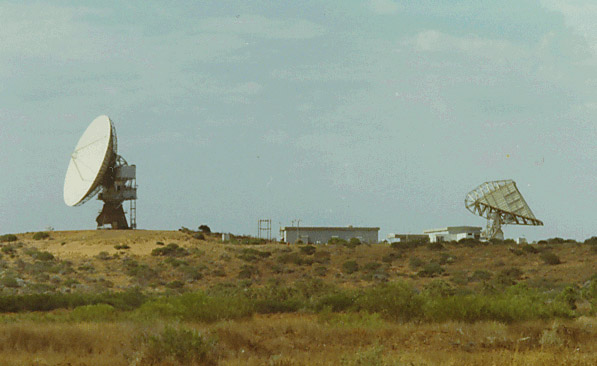
Carnarvon’s Decommissioned NASA Satellite Dish Back In Service After 40 Years

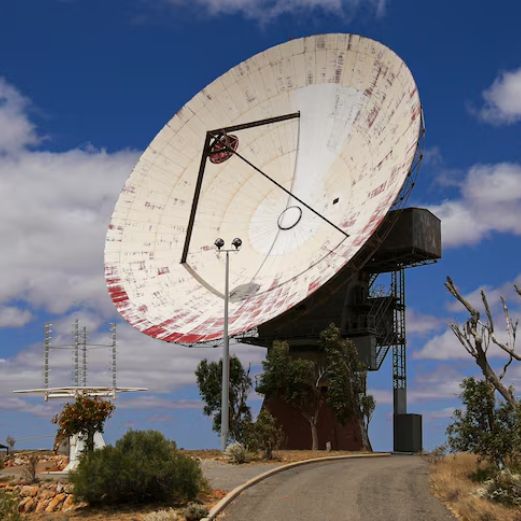
The OTC Station 29.8 meter dish at Carnarvon, Australia, in need of a bit of paint. (Credit: ABC News Australia)

Recently the 29.8 meter parabolic antenna at the Australian OTC (overseas telecommunications commission) station came back to life again after nearly forty years spent in decommissioning limbo.

This parabolic dish antenna shares an illustrious history together with the older 12.8 meter Casshorn antenna in that together they assisted with many NASA missions over the decades. These not only include the Apollo 11 Moon landing with the small antenna, but joined by the larger parabolic dish (in 1969) the station performed tracking duty for NASA, ESA  and many other missions. Yet in 1987 the station was decommissioned, with scrapping mostly averted due to the site being designated a heritage site, with a local museum.

Then in 2022 the 29.8 meter parabolic dish antenna was purchased by by ThothX Australia, who together with the rest of ThothX’s world-wide presence will be integrating this latest addition into a satellite tracking system that seems to have the interest of various (military, sigh) clients.

Putting this decommissioned dish back into service wasn’t simply a matter of flipping a few switches. Having sat mostly neglected for decades it requires extensive refurbishing, but this most recent milestone demonstrates that the dish is capable of locking onto a satellites. This opens the way for a top-to-bottom refurbishment, the installation of new equipment and also a lick of paint on the dish itself, a process that will still take many years but beats watching such a historic landmark rust away by many lightyears.

Featured image: OTC Earth Station. (Credit: Paul Dench)

Usagi’s PDP-11 Supercomputer And Appeal For Floating Point Systems Info

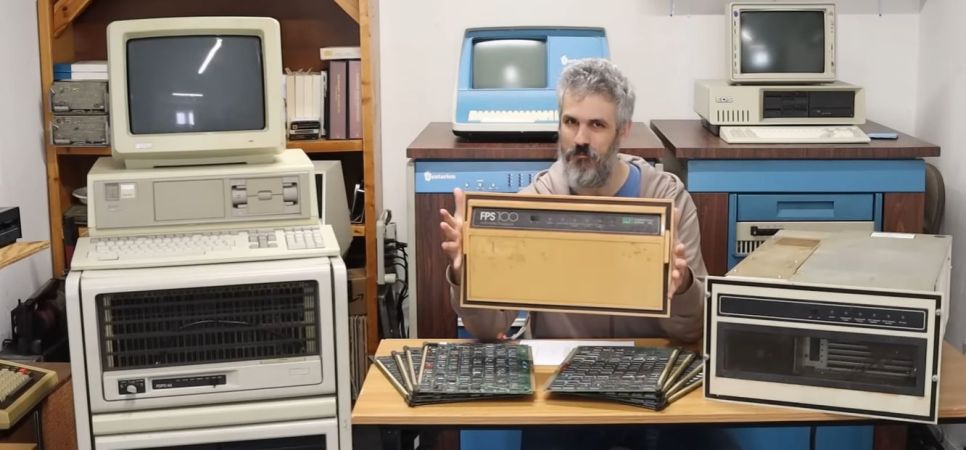
With an exciting new year of retrocomputing ahead for [David Lovett] over at the Usagi Electric YouTube channel, recently some new hardware arrived at the farm. Specifically hardware from a company called Floating Point Systems (FPS), whose systems provide computing features to assist e.g. a minicomputer like [David]’s PDP-11/44 system with floating point operations. The goal here is to use a stack of 1980s-era FPS hardware to give the PDP-11/44 MIMD (multiple instructions, multiple data) computing features, which is a characteristic associated with supercomputers.

The FPS hardware is unfortunately both somewhat rare and not too much documentation, including schematics, has been found so far. This is where [David] would love some help from the community on finding more FPS hardware, documentation and any related information so that it can all be preserved.

FPS itself was acquired by Cray in 1991, before SGI took over Cray Research in 1996. As is usual with such acquisitions, a lot of older information tends to get lost, along with the hardware as it gets tossed out over the years by companies and others. So far [David] has acquired an FPS-100 array processor, an interface card for the PDP-11 and an FPS-3000, the latter of which appears to be a MIMD unit akin to the FPS-5000.

Without schematics, let alone significant documentation, it’s going to be an uphill battle to make it all work again, but with a bit of help from us retrocomputer enthusiasts, perhaps this might not be as impossible after all.

Continue reading “Usagi’s PDP-11 Supercomputer And Appeal For Floating Point Systems Info”

Bad Apple But It’s 6,500 Regex Searches In Vim

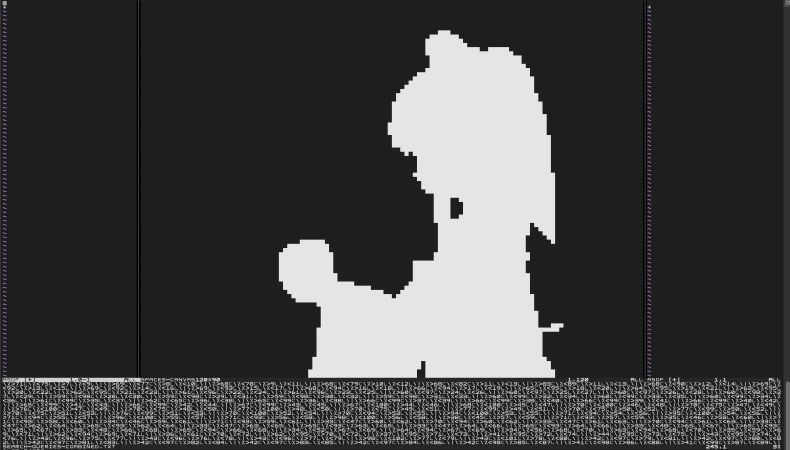
In the world of showing off, there is alongside ‘Does it play Doom?’ that other classic of ‘Does it play Bad Apple?’. Whereas either would be quaint in the context of the Vim editor, this didn’t deter [Nolen Royalty] from making Vim play the Bad Apple video. As this is a purely black and white video, this means that it’s possible to convert each frame into a collection of pixels, with regular expression based search and custom highlighting allowing each frame to be rendered in the Vim window.

The fun part about this hack is that it doesn’t require any hacking or patching of Vim, but leans on its insane levels of built-in search features by line and column, adjusting the default highlight features and using a square font to get proper pixels rather than rectangles. The font is (unsurprisingly) called Square and targets roguelike games with a specific aesthetic.

First 6,500 frames are fed through ffmpeg to get PNGs, which are converted these into pixel arrays using scripts on the GitHub project. Then the regex search combined with Vim macros allowed the video to be played at real-time speed, albeit at 120 x 90 resolution to give the PC a fighting chance. The highlighting provides the contrast with the unlit pixels, creating a rather nice result as can be seen in the embedded video.

Continue reading “Bad Apple But It’s 6,500 Regex Searches In Vim”

Comparing Ways To Add Threads To Your 3D Prints

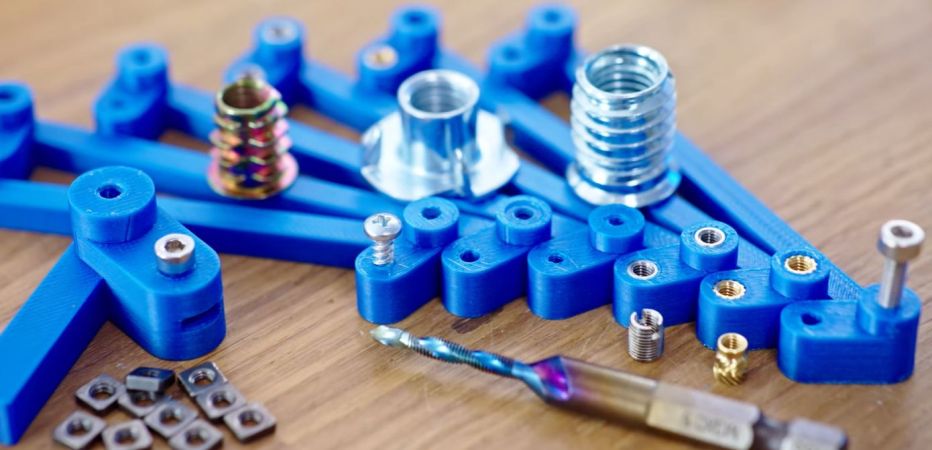
Adding threads to your 3D prints is a life-changing feature, but obviously there are a lot of trade-offs and considerations when deciding on how to go about this exactly. Between self-tapping screws, printed threads, heat inserts and a dozen other options it can be tough to decide what to go with. In a recent video [Thomas Sanladerer] runs through a few of these options, including some less common ones, and what he personally thinks of them.

Confounding factors are also whether you’re printing on an FDM or resin printer, what size thread you’re targeting and how often the screw or bolt will be removed. The metal heat inserts are generally a good option for durability, but when you have big bolts you get a few other metal-based options too, including thread repair inserts and prong nuts. Tapping threads into a print can also be an option, but takes a fair bit of patience.

Slotted nuts can be an idea if you don’t mind carving a space into your model, and the comments dove on embedding nuts in the print by pausing during printing. Ultimately [Thomas] really likes to use a type of self-forming threads with just three protruding sections into the hole that the bolt taps into, which reduces the stress on the part and works well enough for parts that only have to be screwed down once or twice.

Continue reading “Comparing Ways To Add Threads To Your 3D Prints”