A Look Inside The Super Nintendo Cartridges And Video System

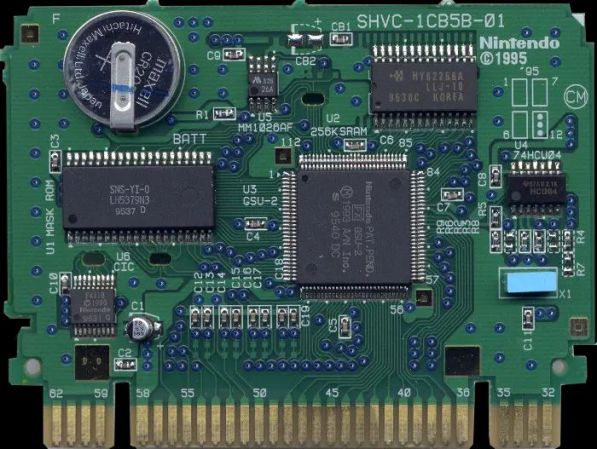
Despite being effectively sold as a toy in the 1990s, the Super Nintendo Entertainment System (SNES) was pretty bleeding-edge as far its computing chops were concerned. This was especially apparent with its cartridges, such as in this excellent summary article by [Fabien Sanglard].

In addition to the mask ROM that stored the game data and (optionally) battery-backed SRAM to store save data, a wide range of enhancement processors existed that upgraded the base SNES system with additional processors for more CPU performance, enhanced graphics and so on. Imagine sticking a game cartridge in a PlayStation 4 today that boosted CPU speed by 5x and gave it a much better GPU, this was the world of SNES games.

On the other side of the video game cartridges was the video output system, which seems easy enough in today’s world of digital HDMI and DisplayPort output. In the 90s video output did however mean NTSC and SECAM/PAL, which means playing nice with frequencies, different resolutions (lines) and squeezing as much as possible into a single frame in a way that works with the game console’s rendering pipeline. As a result of this the PAL version of Super Mario World has a larger vertical resolution than the NTSC version (240 vs 224 lines), even if it’s still squashed into the same 4:3 format. For the physical video output side, European gamers were spoiled with an AV connector to (RGB) SCART output, while the rest of the world dealt with some variety of RF composite or S-video.

Although the SNES’s successor in the form of the N64 would not take cartridges to the same extremes, it was this flexible architecture that gave the SNES such an amazing game library.
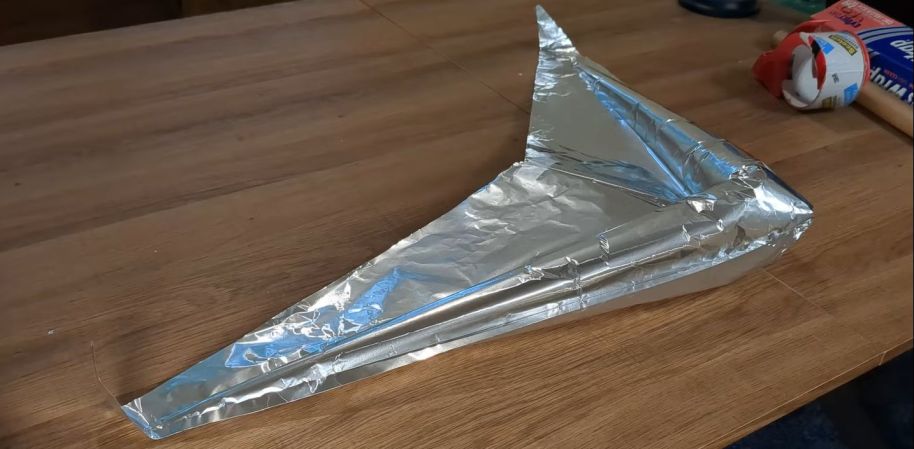

Making An Aluminium Foil Glider To Prototype Hydroforming

Hydroforming is a very effective way to turn a ductile metal like aluminium or stainless steel into a specific shape, either using a die or by creating a closed envelope in which the hydraulic fluid is injected. While trying to think of ways to create a hydroformed airplane without spending big bucks on having it done professionally – or learning to weld sheet metal together with waterproof welds along the seams – [Adrian Perez] decided that using plain aluminium foil as found in the average kitchen might be a good way to get his feet wet here. When stuck together with double-sided tape, the foil is both strong and light enough to be inflated like a party balloon and still fly better than a lead balloon (which do fly, albeit poorly).

The basic design for the initial Luma glider that he assembled is based around a Kline-Fogleman (KA) airfoil. This type of airfoil is mostly characterized by the simplicity of construction, having been devised in the 1960s for paper airplanes. It uses a stepped approach rather than a continuous airfoil and has seen mostly attention in hobby circles. Even if this Luma glider brings to mind the ill-fated Goodyear Inflatoplane, a hydroformed version of these foil prototype gliders would not have to rely on being inflated to function.

For small-scale prototypes, using low-cost aluminium foil or similar to test out shapes before committing to a design to be welded and hydroformed does seem like a useful approach.

Continue reading “Making An Aluminium Foil Glider To Prototype Hydroforming”

Programming Ada: Designing A Lock-Free Ring Buffer

Ring buffers are incredibly useful data structures that allow for data to be written and read continuously without having to worry about where the data is being written to or read from. Although they present a continuous (ring) buffer via their API, internally a definitely finite buffer is being maintained. This makes it crucial that at no point in time the reading and writing events can interfere with each other, something which can be guaranteed in a number of ways. Obviously the easiest solution here is to use a mutual exclusion mechanism like a mutex, but this comes with a severe performance penalty.

A lock-free ring buffer (LFRB) accomplishes the same result without something like a mutex (lock), instead using a hardware feature like atomics. In this article we will be looking at how to design an LFRB in Ada, while comparing and contrasting it with the C++-based LFRB that it was ported from. Although similar in some respects, the Ada version involves Ada-specific features such as access types and the rendezvous mechanism with task types (‘threads’).

Continue reading “Programming Ada: Designing A Lock-Free Ring Buffer”

Building The Unreleased Lemmings Arcade Cabinet From 1991

Back in the early 90s the world was almost graced with an arcade version of Lemmings, but after a few board revisions it was abandoned in 1991. Now the folk over at UK-based [RMC – The Cave] on YouTube have managed to not only get their mitts on a nearly finished prototype board, but have also designed and built a period-appropriate cabinet to go with it. This involved looking at a range of arcade cabinets created by Data East and picking a design that would allow both for the two-player mode of the game, and fit the overall style.

The finished Lemmings arcade cabinet. (Credit: RMC – The Cave, YouTube)

Arcade cabinets came in a wide range of cabinet styles and control layouts, largely defined by the game’s requirements, but sometimes with flourishes to distinguish the cabinet from the hundred others in the same arcade.

In this particular case the typical zig-zag (Z-back) style was found to be a good fit as on the Data East Night Slashers 1993-era cabinet, which then mostly left the controls (with two trackballs) and cabinet art to figure out. Fortunately there is plenty of inspiration when it comes to Lemmings art, leading to the finished cabinet with the original mainboard, the JAMMA wiring harness with MultiPi JAMMA controller, a 19″ CRT monitor and other components including the 3D printed controls panel.

With more and more new arcades popping up in the US and elsewhere, perhaps we’ll see these Lemmings arcade cabinets appear there too, especially since the ROMs on the prototype board were dumped for convenient MAME-ing.

Continue reading “Building The Unreleased Lemmings Arcade Cabinet From 1991″

Getting Linux Process List Without Forking Using Just A Bash Script

The ps command is extremely useful when you want to get some quick information on active system processes (hence the name), especially followed by piping it into grep and kin for some filtering. One gotcha is of course that ps doesn’t run in the current shell process, but is forked off into its own process, so what if everything goes wrong and you absolutely need to run ps aux on a system that is completely and utterly out of fresh process IDs to hand out? In that scenario, you fortunately can write a shell script that does the same, but all within the same shell, as [Isabella Bosia] did, with a Bash shell script.

The how and why is mostly covered in the shell script itself, using detailed comments. Initially the hope was to just read out and parse the contents of /proc/<pid>/status, but that doesn’t have details like CPU%. The result is a bit more parsing to get the desired result, as well as a significant amount of cussing in the comments. Even if it’s not entirely practical, as the odds of ending up on a system with zero free PIDs are probably between zero and NaN, but as an ‘entertaining’ job interview question and example of all the fun things one can do with shell scripting it’s definitely highly recommended.

A Look At The Intel N100 Radxa X4 SBC

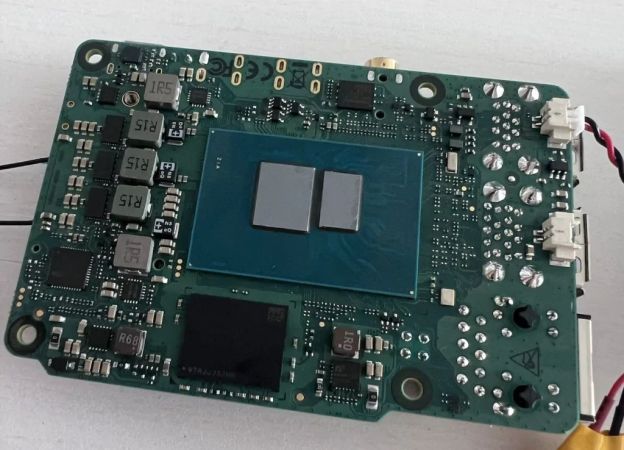
Recently Radxa released the X4, which is an SBC containing not only an N100 x86_64 SoC but also an RP2040  MCU connected to a Raspberry Pi-style double pin header. The Intel N100 is one of a range of Alder Lake-N SoCs which are based on a highly optimized version of the Skylake core, first released in 2015. These cores are also used as ‘efficiency’ cores in Intel’s desktop CPUs. Being x86-based, this means that the Radxa X4 can run any Linux, Windows and other OS from either NVMe (PCIe 3.0 x4) or eMMC storage. After getting his hands on one of these SBCs, [Bret] couldn’t wait to take a gander at what it can do.

Installing Windows 11 and Debian 12 on a 500 GB NVMe (2230) SSD installed on the X4 board worked pretty much as expected on an x86 system, with just some missing drivers for the onboard Intel 2.5 Gbit Ethernet and WiFi, depending on the OS, but these were easily obtained via the Intel site and installed. The board comes with an installed RTC battery and a full-featured AMI BIOS, as well as up to 16 GB of LPPDR5 RAM.

Using the system with the Radxa PoE+ HAT via the 2.5 Gbit Ethernet port also worked a treat once using a quality PoE switch, even with the N100’s power level set to 15 Watt from the default 6. The RP2040 MCU on the mainboard is connected to the SoC using both USB 2.0 and UART, according to the board schematic. This means that from the N100 all of the Raspberry Pi-style pins can be accessed, making it in many ways a more functional SBC than the Raspberry Pi 5, with a similar power envelope and cost picture.

At $80 USD before shipping for the 8 GB (no eMMC) version that [Bret] looked at one might ask whether an N100-based MiniPC could be competitive, albeit that features like PoE+  and integrated RPi-compatible header are definite selling points.

The BiVACOR Total Artificial Heart: A Maglev Bridge To Life

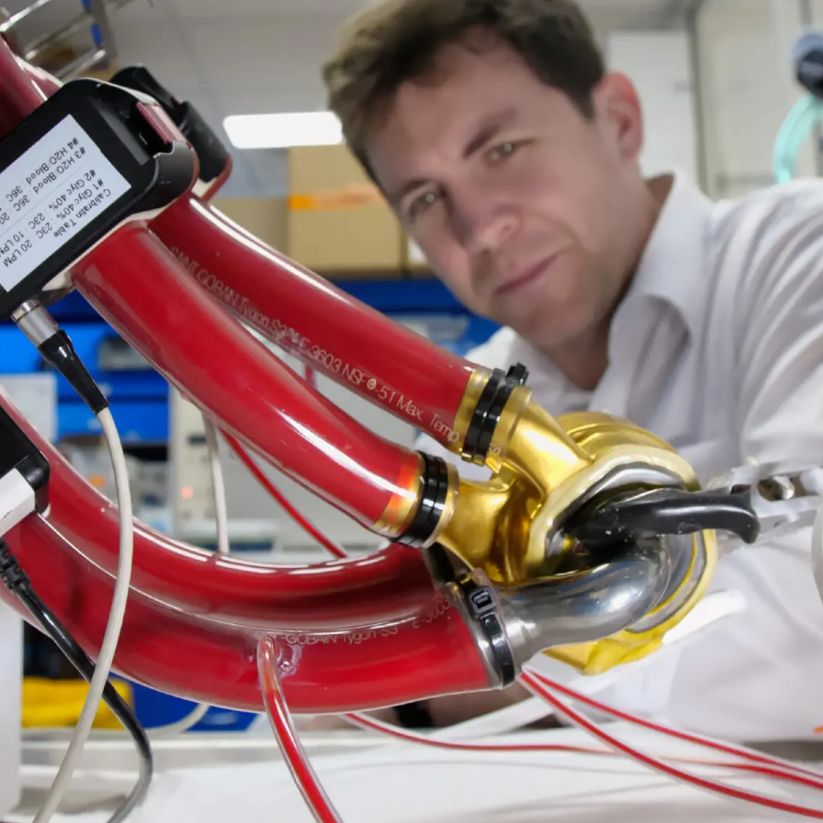
The BiVACOR THA hooked up with the CTO Dianiel Timms in the background. (Credit: BiVACOR)

Outside of the brain, the heart is probably the organ that you miss the most when it ceases to function correctly. Unfortunately, as we cannot grow custom replacement hearts yet, we have to keep heart patients alive long enough for them to receive a donor heart. Yet despite the heart being essentially a blood pump, engineering even a short-term artificial replacement has been a struggle for many decades. A new contender has now arrived in the BiVACOR TAH (total artificial heart), which just had the first prototype implanted in a human patient.

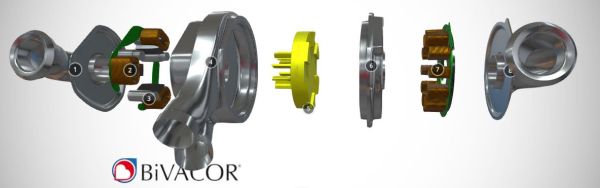
Unlike the typical membrane-based pumps, the BiVACOR TAH is a rotary pump that uses an impeller-based design with magnetic levitation replacing bearings and theoretically minimizing damage to the blood. This design should also mean a significant flowrate, enough even for an exercising adult. Naturally, this TAH is only being tested as a bridge-to-transplant solution, for patients with a failing heart who do not qualify for a ventricular assist device. This may give more heart patients a chance to that donor heart transplant, even if a TAH as a destination therapy could save so many more lives.

The harsh reality is that the number of donor hearts decreases each year while demand increases, leading to unconventional approaches like xenotransplantation using specially bred pigs as donor, as well as therapeutic cloning to grow a new heart from the patient’s own cells. Having a universal TAH that could be left in-place (destination therapy) for decades would offer a solid option next to the latter, but remains elusive. As shown by e.g. the lack of progress with a TAH like the ReinHeart despite a promising 2014 paper in a bovine model.

Hopefully before long we’ll figure out a reliable way to fix this ‘just a blood pump’ in our bodies, regardless of whether it’s a biological or mechanical solution.