Cybiko Repair-A-Thon With Memory Upgrade

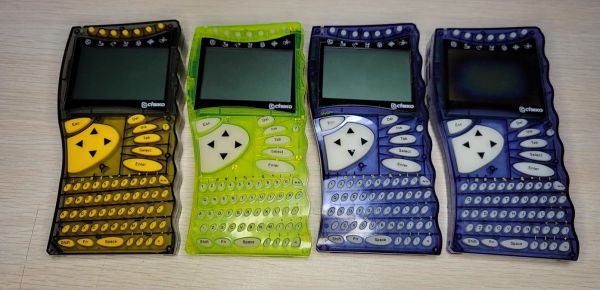
Concluding a four-part repair-a-thon on a stack of Cybiko handheld computers, [Robert] over at Robert’s Retro covered the intricate details of fixing a last batch of four in a nearly one-hour long video. These devices, with their colorful transparent cases, are a great time capsule of the early 2000s. Even with their limited hardware, they provided PDA-like capabilities to teens years before smartphones were a thing, with features including music playback and wireless chat (albeit limited to recipients within 100 meters).

Of the four units covered in this video, they are all the original Cybiko Classic, with two each of the first and second revision, none of which were booting due to a bad Flash chip. Another issue was the dead rumble motors on them, which fortunately are the easiest to replace. One of the units also has a dead display, which did not get replaced this time around.
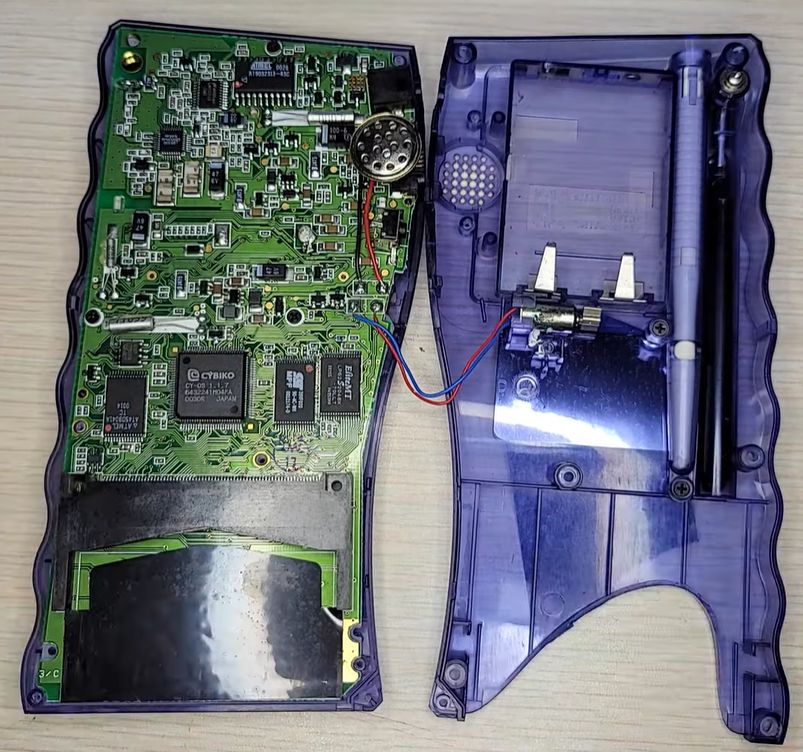
Insides of a Cybiko Classic (Credit: Robert's Retro, YouTube)
Insides of a Cybiko Classic (Credit: Robert’s Retro, YouTube)

The flash chip replacement was a bit more of a headache, as these devices don’t just take any chip, mostly due to how much the system relies on the ready-busy line. This led [Robert] to replace the old 4 Mb AT45DB041 chips with  the 16 Mb Atmel AT45DB161. Previously he had taken 1 MB chips from an expansion cartridge to replace more dead flash chips, so those were replaced with 2 MB chips.

With fresh flash in place, the next challenge was to get these written with a firmware image, with the v2 Cybiko units already having CyOS on the separate 256 kB Flash chip, but the v1 units relying on the single big Flash chip for all storage. Fortunately, an enterprising member of the community developed a tool to ease this ordeal by allowing a Cybiko unit in its serial dock to be flashed with no issues, other than the 2 MB Flash causing some issues as this was a previously unknown hardware configuration.

[Robert] now has four working Cybiko units, with one being headless due to the busted screen, and more room for apps on the 2 MB units than a 2000s teenager would have known what to do with.
Continue reading “Cybiko Repair-A-Thon With Memory Upgrade”

On The Merits Of A Solid-State Dehumidifier Filament Dry Box

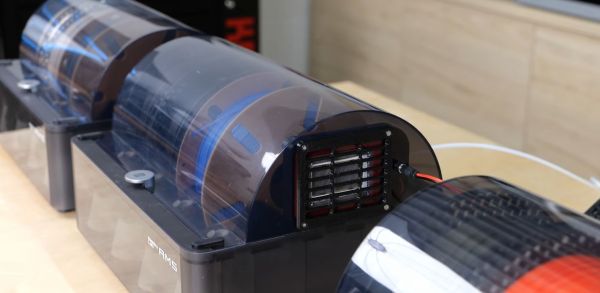
How good are ion membrane dehumidifiers for keeping FDM filament dry and ready for printing? This is the question which [Stefan] at CNC Kitchen sought to answer in a recent video. Like many of us, he was inspired by a video which [Big Clive] made a while ago in which said dehumidifiers were demonstrated for keeping an enclosure free from moisture. Yet would they be able to tackle the much bigger drying job of one or more spools of filament? Thanks to some free samples sent by Rosahl, [Stefan] was able to start answering this question.

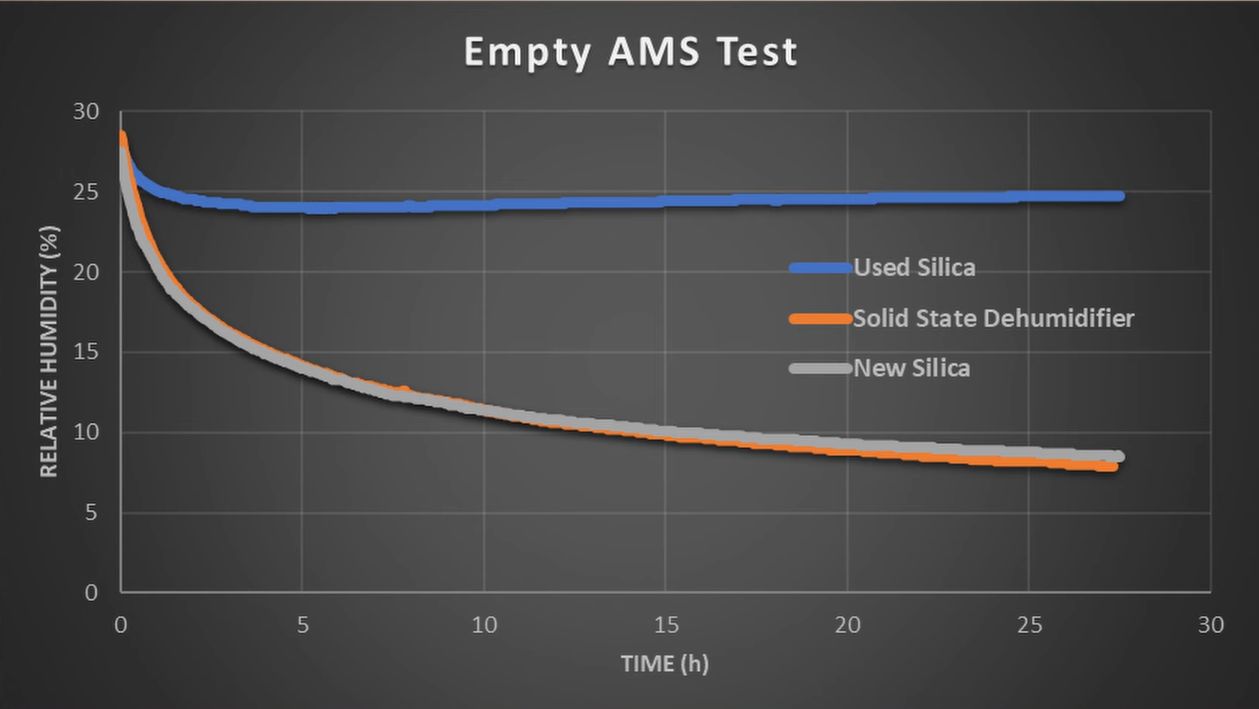
Performance of desiccants and dehumidifier element. (Credit CNC Kitchen)

In the experiments, he used the smaller RS1 (€36.25 a piece) for a single spool container, and the larger MDL-3 (€169) with a Bambu Lab AMS multi-spool unit. Normally such an AMS has three big containers with silica desiccant in it that have to be regularly swapped out, but he modified one AMS to only have the big MDL-3 membrane to dehumidify. A second AMS was left with older silica in its containers, and a third got fresh silica, allowing for some benchmarking between the three units.

The results say a lot, with the initial empty AMS test showing the older silica desiccants topping out quickly and leaving the fresh silica and the membrane dehumidifier to go neck to neck. This is not the usual scenario in which you’d use these dehumidification methods of course, and the small-scale test with the RS1 showed that with a full filament spool in the box, humidity inside the container would only drop very gradually as more and more moisture replaced what was removed from the air. In particular the cardboard element of the spool being used was suspected of being one of the biggest sources of moisture.

Continue reading “On The Merits Of A Solid-State Dehumidifier Filament Dry Box”

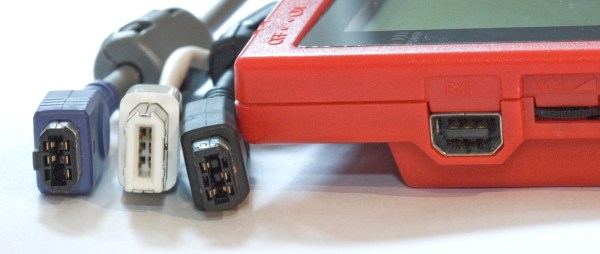
Easily Add Link Cable Support To Your Homebrew GBA Game

The Game Boy Advance (GBA) link cable is the third generation of this feature which originated with the Gameboy. It not only allows for peripherals to be connected, but also for multiplayer between GBAs – even with just one game copy – and item sharing and unlocking of features in specific games. This makes it an interesting feature to support in today’s homebrew GBA games and applications, made easy by libraries such as [Rodrigo Alfonso]’s gba-link-connection.

This C++  library can be used in a number of ways: either limited to just the physical link cable, just the wireless link option or both (universal link). These support either 4 (cable) or 5 (wireless) players to be connected simultaneously. As additional options there are the LinkGPIO.hpp and LinkSPI.hpp headers which allow the link port to be used either as a generic GPIO, or as an SPI link (up to 2 Mb/s). The multiboot feature where a single ROM image is shared among connected GBAs is supported with both wired and wireless links.

It’s heartening to see that a device which this year celebrates its 23rd birthday is still supported so well.

Thanks to [gudenau] for the tip.

The White House Memory Safety Appeal Is A Security Red Herring

In the Holy Programming Language Wars, the lingua franca of system programming – also known as C – is often lambasted for being unsecure, error-prone, and plagued with more types of behavior that are undefined than ones that are defined by the C standards. Many programming languages were said to be ‘C killers’, yet C is still alive today. That didn’t stop the US White House’s Office of the National Cyber Director (ONCD) from putting out a report in which both C and C++ got lambasted for being ‘unsafe’ when it came to memory management.

The full report (PDF) is pretty light on technical details, while citing only blog posts by Microsoft and Google as its ‘expert sources’. The claim that memory safety issues are the primary cause of CVEs is not substantiated, or at least ignores the severity of CVEs when looking at the CISA statistics for active exploits. Beyond this call for ‘memory safety’, the report then goes on to effectively call for more testing and validation, while kicking in doors that were opened back in the 1970s already with the Steelman requirements and the High Order Language Working Group (HOLWG) of 1975.

What truly is the impact and factual basis of the ONCD report?

Continue reading “The White House Memory Safety Appeal Is A Security Red Herring”

The Strange Metal Phase And Its Implications For Superconductivity

The behavior of electrons and the exact fundamentals underlying the phenomenon we call ‘electricity’ are still the subject of many competing theories and heated debates. This is most apparent in the area of superconducting research, where the Fermi liquid theory — which has has formed the foundation of much of what we thought we knew about interacting fermions and by extension electrons in a metal — was found to break down in cuprates as well as in other metals which feature a state that is a non-Fermi liquid, also called a ‘strange metal phase’.

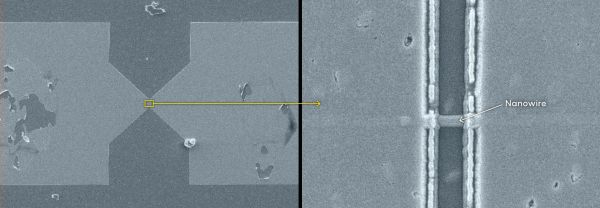
This phase was the subject of a 2023 research article by [Liyang Chen] and colleagues in Science titled Shot Noise in a Strange Metal. As summarized in a Quanta Magazine article, the term ‘shot noise’ refers hereby to the quasiparticles that are postulated by the Fermi liquid theory to form part of the electrical current as electrons interact and ‘clump’ together, creating discrete ‘particles’ that can be measured like rain drops falling on a roof. [Liyang Chen] and colleagues created a 200 nm thin nanowire (pictured, top) out of ytterbium, rhodium and silicon, followed by cooling it down to a few Kelvin and measuring the current.

What the team found was no sign of these discrete quasiparticles, but rather non-Fermi liquid continuous current. Yet what is exactly the nature of this measured current? Quite a few attempts at explaining this phenomenon have been undertaken, e.g. Jianfan Wang et al. (2022) in rare-earth intermetallic compounds. More recently [Riccardo Arpaia] and colleagues explore charge density fluctuations (CDF) as a signature of the quantum critical point (QCP), which is a point in the phase diagram where a continuous phase transition takes place at absolute zero.

They studied the CDF using X-ray scattering in cuprate superconductors with a wide doping range, using the measured CDF as an indication of the QCP, indicating that the former may be a result of the latter. With these results mostly inspiring more discussion and research, it’ll probably be a while still before we risk replacing the Fermi liquid theory, or apply strange metal findings to produce high-temperature superconductors.

Air Canada’s Chatbot: Why RAG Is Better Than An LLM For Facts

Recently Air Canada was in the news regarding the outcome of Moffatt v. Air Canada, in which Air Canada was forced to pay restitution to Mr. Moffatt after the latter had been disadvantaged by advice given by a chatbot on the Air Canada website regarding the latter’s bereavement fare policy. When Mr. Moffatt inquired whether he could apply for the bereavement fare after returning from the flight, the chatbot said that this was the case, even though the link which it provided to the official bereavement policy page said otherwise.

This latter aspect of the case is by far the most interesting aspect of this case, as it raises many questions about the technical details of this chatbot which Air Canada had deployed on its website. Since the basic idea behind such a chatbot is that it uses a curated source of (company) documentation and policies, the assumption made by many is that this particular chatbot instead used an LLM with more generic information in it, possibly sourced from many other public-facing policy pages.

Whatever the case may be, chatbots are increasingly used by companies, but instead of pure LLMs they use what is called RAG: retrieval augmented generation. This bypasses the language model and instead fetches factual information from a vetted source of documentation.

Continue reading “Air Canada’s Chatbot: Why RAG Is Better Than An LLM For Facts”

Wire Wrap Odyssey: A 7400-series Homebrew 8-bit Computer

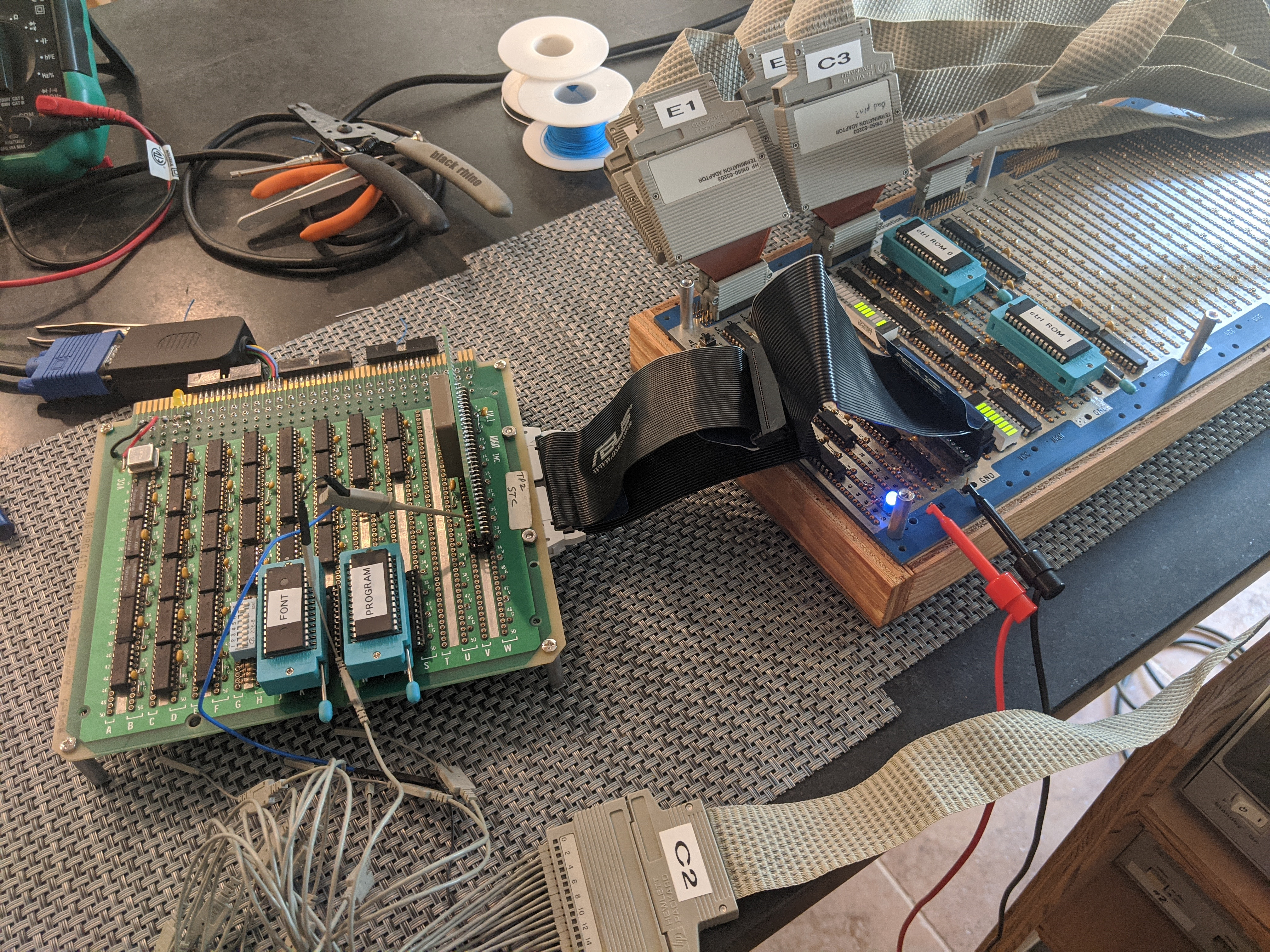
The Wire Wrap Odyssey's first Hello World from the CPU module, here hooked up to a logic analyzer in July of 2020. (Credit: Paul Krizak)
The Wire Wrap Odyssey’s first Hello World from the CPU module, here hooked up to a logic analyzer in July of 2020. (Credit: Paul Krizak)

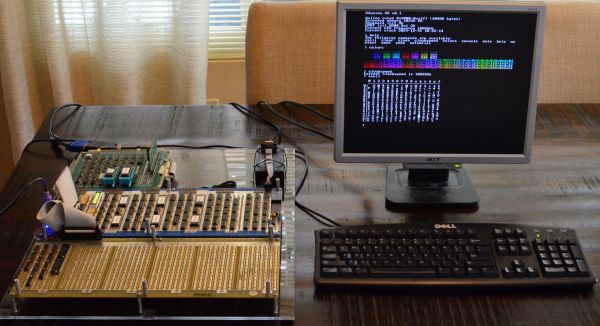
As part of his computer science curriculum at Texas A&M University in the early 2000s, [Paul Krizak] took a computer architecture course on the basics of their functioning. This and being exposed to dozens of homebuilt computer projects inspired him to begin building his own 8-bit computer in 2010, which eventually grew into the Wire Wrap Odyssey. This name covers both the primary construction method chosen around 2019 in the form of wire-wrapped connections, as well the harrowing journey to reach this point with a functioning computer system despite many choices and setbacks.

The Odyssey CPU is an 8-bit microcoded design with 16-bit address bus, using mostly 74HC-series logic. A VGA graphics card is also part of the design, which can output a 640×480 text display, with character glyphs read from the system ROM (32 kB AT28C256). As for the RAM, this is an extravagant 32 kB dual-port SRAM (Renesas 7007), which also allows both the CPU and video card to use the same SRAM. Currently the system has four peripherals: a PS/2 keyboard controller, an RTC and timer (DS1511Y+), 82C52 UART and 1 MB of extended RAM, but an ATA port and parallel port are in development.

Perhaps the most impressive part about this product is the level of documentation, from the early stages including paper doodles to the current state of the system, including the GitHub repository for the software. [Paul] was also an exhibitor at the Vintage Computing Festival (VCF) SoCal recently with his Wire Wrap Odyssey, where he was able to show off the progress so far. Next year he hopes to visit VCF SoCal again, with the remaining planned peripherals implemented.