San Francisco Sues To Keep Autonomous Cars Out Of The City

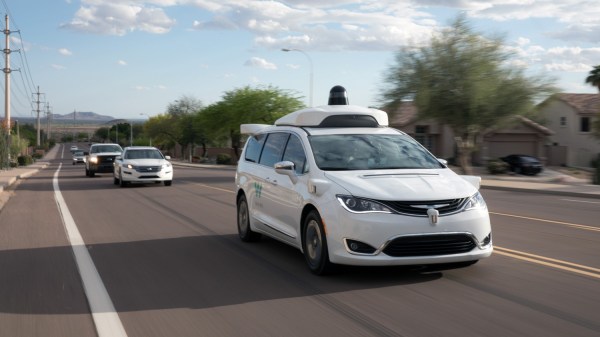
Although the arrival of self-driving cars and taxis in particular seems to be eternally ‘just around the corner’ for most of us, in an increasing number of places around the world they’re already operational, with Waymo being quite prevalent in the US. Yet despite approval by the relevant authorities, the city of San Francisco has opted to sue the state commission that approved Google’s Waymo and GM’s Cruise. Their goal? To banish these services from the streets of SF, ideally forever.

Whether they will succeed in this seems highly doubtful. Although Cruise has lost its license to operate in California after a recent fatal accident, Waymo’s track record is actually quite good. Using public information sources, there’s a case to be made that Waymo cars are significantly safer to be in or around than those driven by human operators. When contrasted with Cruise’s troubled performance, it would seem that the problem with self-driving cars isn’t so much the technology as it is the safety culture of the company around it.

Yet despite Waymo’s better-than-humans safety record, it is regarded as a ‘nuisance’, leading some to sabotage the cars. The more reasonable take would seem to be that although technology is not mature yet, it has the overwhelming advantage over human drivers that it never drives distracted or intoxicated, and can be deterministically improved and tweaked across all cars based on experiences.

These considerations have been taken into account by the state commission that has approved Waymo operating in SF, which is why legal experts note that SF case’s chances are very slim based on the available evidence.


The NSA’s Furby Artificial Intelligence Scare: FOIA Documents Provide Insight

For those of us who were paying a modicum of attention to the part of the news around 1999 which did not involve the imminent demise of humanity due to the Y2K issue, a certain toy called a ‘Furby’ was making the headlines. In addition to driving parents batty, it also gave everyone’s favorite US three-letter agency a scare, with it being accused of being both a spying tool and equipped with an advanced artificial intelligence chip. Courtesy of a recent Freedom of Information Act (FOIA) request we now have the low-down on what had the NSA all atwitter.

In a Twitter thread (Nitter) user [dakotathekat] announced the release, which finally answered many questions about the NSA’s on-premises ban of Furbys (or Furbees if you’re Swedish). The impression one gets is that this ‘Furby ban’ was primarily instated out of an abundance of caution, as unauthorized recording devices of any kind are strictly forbidden on NSA premises. With nobody at the NSA apparently interested in doing a teardown of a Furby to ascertain its internals, and the careful balance between allowing children’s toys on NSA grounds versus the risk of a ‘Furbygate’, a ban seemed the easy way out. Similarly, the FAA saw fit to also make people turn their Furbys off like all other electronic devices.

The original Furby toys did not have anything more complex inside of them than a 6502-derived MCU and a Ti TSP50C04 IC for speech synthesis duties, with the supposed ‘learning’ process using a hardcoded vocabulary that gradually replaced its default gibberish with English or another target language.

Flat Earth Theatre presents "R.U.R." by Karel Capek. January 23 - 31, 2009. Featuring Michael Wayne Smith, Karen Hart, Valerie Daum, Jeff Tidwell, Kevin Kordis, James Rossi, Bill Conley, Justus Perry, and Amy Lehrmitt. Directed by Jake Scaltreto. Arsenal Center for the Arts, Watertown.

Robot: You Keep Using That Word But It Doesn’t Mean What You Think It Means

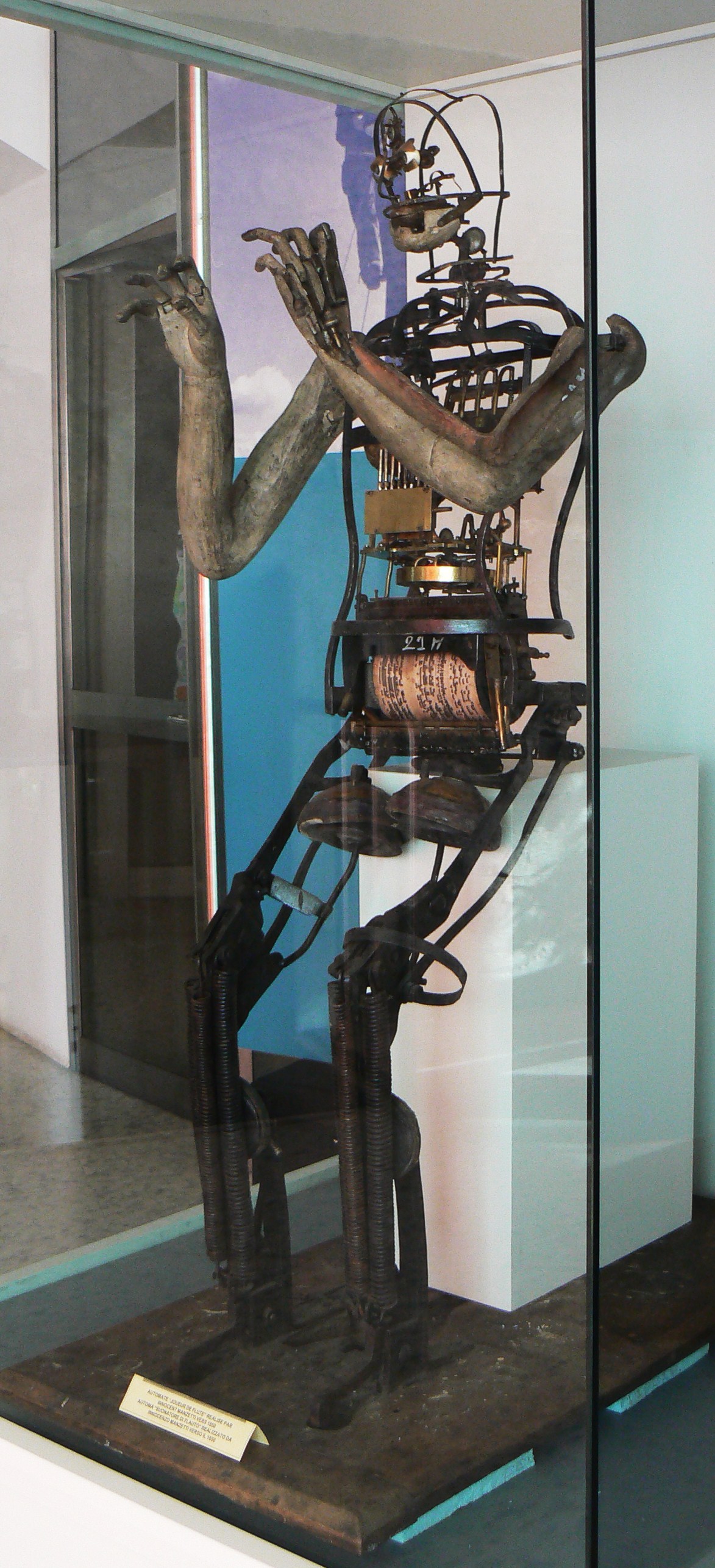
The flute player automaton by Innocenzo Manzetti (1840)

With many words which are commonly used in everyday vocabulary, we are certain that we have a solid grasp of what they do and do not mean, but is this really true? Take the word ‘robot’ for example, which is more commonly used wrongly rather than correctly when going by the definition of the person who coined it: [Karel Čapek]. It was the year 1920 when his play Rossumovi Univerzální Roboti was introduced to the world, which soon saw itself translated and performed around the world, with the English-speaking world knowing it as R.U.R.: Rossum’s Universal Robots.

Up till then, the concept of a relatively self-operating machine was known as an automaton, as introduced by the Ancient Greeks, with the term ‘android’ being introduced as early as the 18th century to mean automatons that have a human-like appearance, but are still mechanical contraptions. When [Čapek] wrote his play, he did not intend to have non-human characters that were like these androids, but rather pure artificial life: biochemical systems much like humans, using similar biochemical principles as proteins, enzymes, hormones and vitamins, assembled from organic matter like humans. These non-human characters he called ‘roboti’, from Old Czech ‘robot’ (robota: “drudgery, servitude”), who looked human, but lacked a ‘soul’.

Despite this intent, the run-away success of R.U.R. led to anything android- and automaton-like being referred to as a ‘robot’, which he lamented in a 1935 column in Lidové Noviny. Rather than whirring and clunking pieces of machinery being called ‘automatons’ and ‘androids’ as they had been for hundreds of years, now his vision of artificial life had effectively been wiped out. Despite this, to this day we can still see the traces of the proper terms, for example when we talk about ‘automation’, which is where automatons (‘industrial robots’) come into play, like the industrial looms and kin that heralded the Industrial Revolution.

(Heading image: Performance of R.U.R. by Flat Earth Theatre, showing the mixing of robot ingredients)

Human-Written Or Machine-Generated: Finding Intelligence In Language Models

What is the essential element which separates a text written by a human being from a text which has been generated by an algorithm, when said algorithm uses a massive database of human-written texts as its input? This would seem to be the fundamental struggle which society currently deals with, as the prospect of a future looms in which students can have essays auto-generated from large language models (LLMs) and authors can churn out books by the dozen without doing more than asking said algorithm to write it for them, using nothing more than a query containing the desired contents as the human inputs.

Due to the immense amount of human-generated text in such an LLM, in its output there’s a definite overlap between machine-generated text and the average prose by a human author. Statistical methods of detecting the former are also increasingly hamstrung by the human developers and other human workers behind these text-generating algorithms, creating just enough human-like randomness in the algorithm’s predictive vocabulary to convince the casual reader that it was written by a fellow human.

Perhaps the best way to detect machine-generated text may just be found in that one quality that these algorithms are often advertised with, yet which they in reality are completely devoid of: intelligence.

Continue reading “Human-Written Or Machine-Generated: Finding Intelligence In Language Models”

Reverse Engineering The Apple Touch Bar Screen

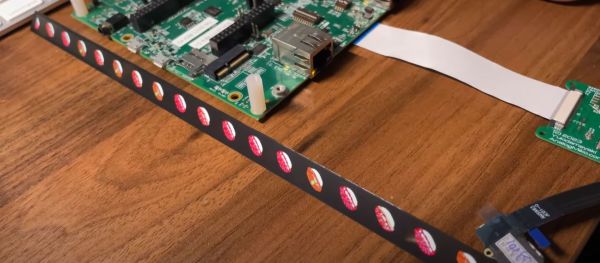
The Apple Touch Bar was an oddity on a fairly small number of Apple laptops which replaced the function key row with a touch display. Yet what is special about this display other than its odd form factor when you consider it as a generic touch display? As [Wenting Zhang] describes in a recent reverse-engineering video, this 2,170 x 60 pixel display is somewhat limited in that it doesn’t support the MIPI DSI video mode, only command mode, along with a special instruction (0x3C) for automatic address offsets. The results of this project can be found on the GitLab account.

In a way these limitations make sense when you consider Apple’s use case for these special MIPI-DSI displays. As a touch screen with dynamic controls being displayed on it, features such as video playback never were a goal, and thus Apple likely decided to save a few bucks, possibly also due to MIPI licensing costs. What this means is that if you had dreamed of snapping up an extremely long and narrow OLED display for a video project you’re in for somewhat of a bad time. Although animated content is possible – as [Wenting] demonstrates – this comes with all the limitations of command mode, meaning slower updates, higher power usage and a lot more overhead.

Continue reading “Reverse Engineering The Apple Touch Bar Screen”

Testing Your C Knowledge With This One Simple Quiz

One of the most exciting aspects of the C programming language — as effectively high-level assembly — is that although it’s a bit friendlier for the developer, it also adds a lot of required know-how on account of its portability across platforms and architectures. This know-how is what [Oleksandr Kaleniuk] manages to wonderfully illustrate with a simple 5-question, multiple-choice quiz on what the return value is of the provided function snippets of C code. How well do you know C?

For those who have had their run-ins with C directly (or indirectly via the support for it in languages like C++) the words ‘undefined behavior‘ (UB) are likely to induce a nervous twitch or two, along with a suspicious glance at whichever parts of reality are about to evaporate and destabilize the Universe this time. Although it is said that a proper C program is written with zero UB cases in it, in practice this can be rather tough, even before considering the other exciting ways in which a piece of code can fail to do the expected thing.

For languages other than C this is of course also a challenge, which is the reason why certification programs for e.g. avionics go out of their way to weed out such preventable issues, and only few programming languages like Ada (anything avionics, medical, etc.) and C++ (F-35 and other US DoD projects) make it into devices where failure is literally not an option.

Writing And Running Atari 2600 Games In Your Browser

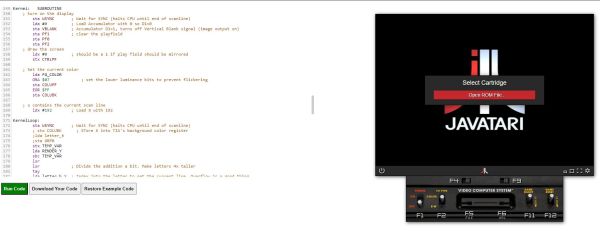
Here in 2024, writing new games for the venerable Atari 2600 game console is easier than ever, with plenty of emulators and toolchains to convert your code into ready-to-load ROMs. Yet what is easier than diving straight into 6502 assembly code without even having to download or set up a toolchain? That’s where [Henry Schmale]’s fully in-browser Atari IDE and associated emulator (using the Javatari project) comes into play.

As [Henry] explains in a blog post, the main goal was to get a project working in Emscripten, the LLVM-based toolchain to create WebAssembly binaries with. The target of this became DASM, the macro assembler for a range of 8-bit MPUs, including the 6502. In the blog post [Henry] describes the general procedure for how he compiled and integrated DASM, as part of creating the earlier linked Atari 2600.

In this IDE a number of example programs are provided, which can be selected, assembled and run in the integrated Javatari instance. Beyond this you can write your own custom 6502 ASM, of course, but at this point you may be interested in taking things further with the versatile Stella emulator that can even run on platforms which you’d be hard-pressed to get a browser running on, never mind Chromium.