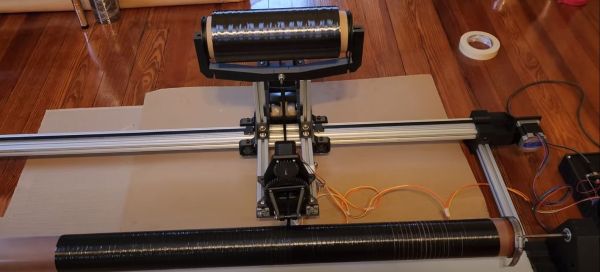

Make Carbon Fiber Tubes With An Open Source Filament Winder

Result of winding a carbon fiber tube. (Credit: Andrew Reilley)

Carbon fiber (CF) is an amazing material that provides a lot of strength for very little weight, making it very useful for a lot of applications, ranging from rods in CoreXY 3D printers to model- and full-sized rockets. The model rocketry hobby is the reason why [Andrew Reilley] developed his own CF tube winding machine called Contraption. A tutorial video (also embedded below) shows how this machine is prepped for a winding run, followed by the winding progress and finalizing before admiring the result.

The entire machine’s design with 3D printed parts and off-the-shelf components is open source, as is the TypeScript and NodeJS-based Cyclone software that creates the toolpath specifying the parameters of the tube, including number of layers and the tow angle.

As a wet winding tow machine, the carbon fiber strands are led through the liquid resin before being wound onto the prepared mandrel. During winding some excess resin may have to be removed, and after the winding has been finished the tube is wound with shrink tape. This is followed by a heat gun session to shrink the tape and letting the resin cure. Following curing, the tape and mandrel are removed, resulting in a rather fancy looking CF tube that can find a loving home in a lot of applications, except perhaps ones that involving crushing outside pressures like those found deep below the ocean surface.

Continue reading “Make Carbon Fiber Tubes With An Open Source Filament Winder”

Qantas Flight 32: When A Few Millimeters Of Metal Invite Disaster

A common saying is that every disaster is caused by a chain of events, some of which can stretch back by years. Airplane disasters and near-disasters are no exception here, with all too often a small mechanical issue worsening until suddenly everything goes south. In the best case the flight crew is still able to work through the problems and figure out a way to put the aircraft down on firm soil in a single piece. This was the situation that the crew of Qantas Flight 32 (QF32) found themselves forced to deal with, as detailed in a recent article by [Kyra Dempsey], aka [Admiral Cloudberg].

When QF32 started its flight from London Heathrow in early November of 2010, everything seemed normal, but a mere four minutes after take-off from a layover at Singapore on its way to its final destination of Sydney, the #2 engine on the left wing of the Airbus A380 essentially exploded, launching shrapnel through the wing and fuselage. Although the A380 has four engines (numbered 1-4 from the left wing tip) and normally a single engine failure is not a major deal, the loss of systems that got destroyed in the explosion left the crew scrambling to diagnose the damage and implement a solution.

Continue reading “Qantas Flight 32: When A Few Millimeters Of Metal Invite Disaster”

The Sol-1: A 16-bit Computer In 74HC Logic With C Compiler And Unix-like OS

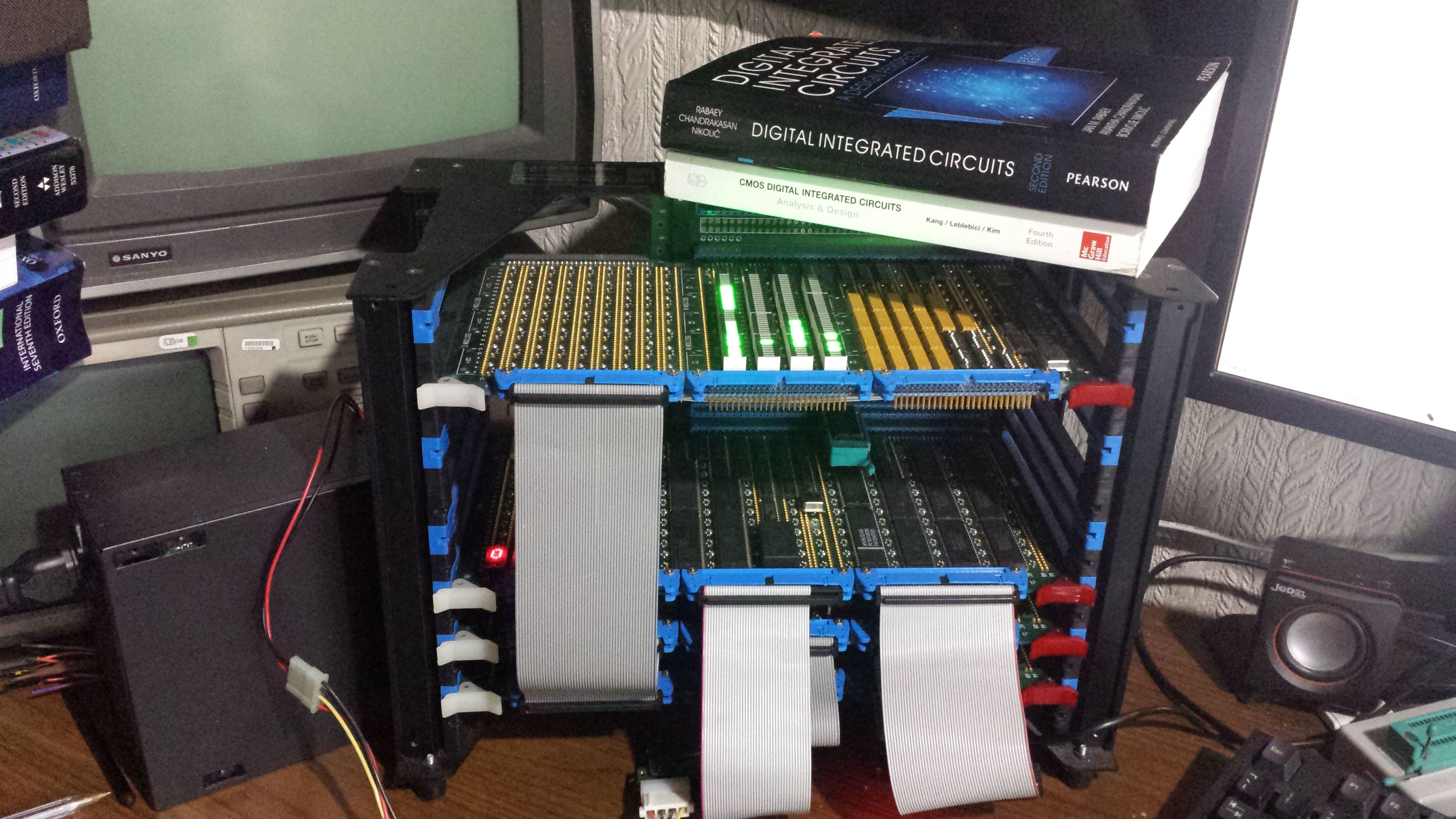
Sol-1 system pictured from the front. {Credit: Paulo Constantino)

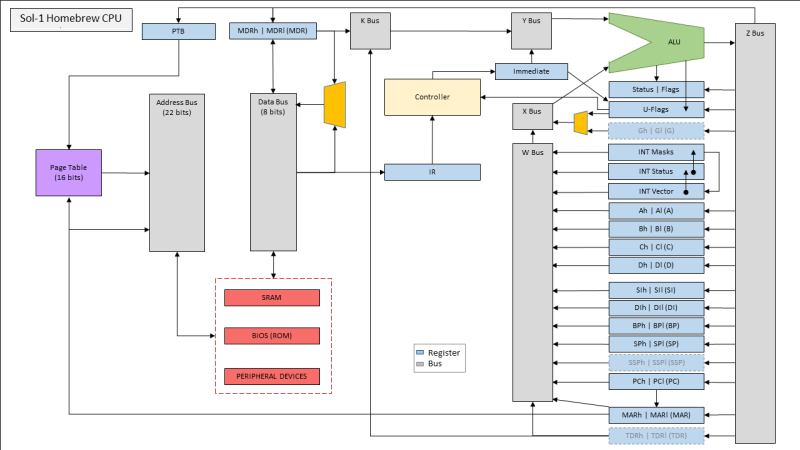
While the concept of a computer system implemented in discrete logic ICs is by itself not among the most original ideas, the way some machines are executed certainly makes them stick out. This is the case with [Paulo Constantino]’s Sol-1, which not only looks extremely professional, but also comes with a lot of amenities that allow for system development, including a C compiler and assembler, a Unix-like OS (in development), DMA, and a whole host of interfaces to interact with the system and peripherals (serial, parallel, IDE, etc.). Not to mention a SystemVerilog model and an emulator, all of which can be found on [Paulo]’s GitHub.

More photos and videos can be found on [Paulo]’s YouTube channel, as well as the Sol-1 website, which shows off the intricate wire wrap work on the back of each PCB. In terms of the ISA, there are 5 general purpose registers (one scratch) which can also be used as two 8-bit registers each. Most operations are supported, except for floating point. For future improvements and additions, Sol-1’s OS will get more features added, and the first major software to be ported to the Sol-1 should be Colossal Cave Adventure and similar text-based adventure (dungeon) games.

Impact Of Imperfect Timekeeping On Quantum Control And Computing

In classical control theory, both open-loop and closed-loop control systems are commonly used. These systems are well understood and rather straightforward, controlling everything from washing machines to industrial equipment to the classical computing devices that make today’s society work. When trying to transfer this knowledge to the world of quantum control theory, however, many issues arise. The most pertinent ones involve closed-loop quantum control and the clocking of quantum computations. With physical limitations on the accuracy and resolution of clocks, this would set hard limits on the accuracy and speed of quantum computing.

The entire argument is covered in two letters to Physical Review Letters, by Florian Meier et al. titled Fundamental Accuracy-Resolution Trade-Off for Timekeeping Devices (Arxiv preprint), and by Jake Xuereb et al. titled Impact of Imperfect Timekeeping on Quantum Control (Arxiv preprint). The simple version is that by simply increasing the clock rate, accuracy suffers, with dephasing and other issues becoming more frequent.

Solving the riddle of closed-loop quantum control theory is a hard one, as noted by Daoyi Dong and Ian R Peterson in 2011. In their paper titled Quantum control theory and applications: A survey, the most fundamental problem with such a closed-loop quantum control system lies with aspects such as the uncertainty principle, which limits the accuracy with which properties of the system can be known.

In this regard, an accurately clocked open-loop system could work better, except that here we run into other fundamental issues. Even though this shouldn’t phase us, as with time solutions may be found to the timekeeping and other issues, it’s nonetheless part of the uncertainties that keep causing waves in quantum physics.

Top image: Impact of timekeeping error on quantum gate fidelity & independent clock dephasing (Xuereb et al., 2023)

Cold War Spying And The Questionable Use Of Smuggled Blueprints In Developing Supersonic Airliners

Although spying is a time-honored tradition, the sheer scope of it reached a fever pitch during the Cold War, when everyone was spying on everyone, and conceivably for both sides at the same time. In an era where both McCarthyism and the character of James Bond enjoyed strong popularity, it should come as no surprise that a project of geopolitical importance like the development of the world’s first supersonic airliner would come amidst espionage, as well as accusations thereof.

This is the topic of a documentary that recently aired on Channel 4 in the UK called Concorde: The Race for Supersonic, yet what is the evidence that the Soviet Tu-144 truly was just a Concorde clone, a derogatory nicknamed ‘Concordski’?

Three views of a Boeing 2707-300.

At the time that the Concorde was being developed, there wasn’t just the competition from the Tu-144 team, but also the Boeing 2702 (pictured) and Lockheed L-2000, with the latter two ultimately being cancelled. Throughout development, all teams converged on a similar design, with a delta wing and similar overall shape. Differences included the drooping nose (absent on Boeing 2707-300) and use of canards (present on Tu-144 and 2707-200), and wildly different engines, with the production Tu-144S requiring an afterburner on its Kuznetsov NK-144A engines just like the Concorde, before the revised Tu-144D removing the need for afterburners with the Koliesov RD36-51 engines.

Although generally classified as a ‘failure’, the Tu-144’s biggest issues appear to have been due to the pressure on the development team from Soviet leadership. Once the biggest issues were being fixed (Tu-144D) it saw continued use for cargo use and even flying missions for NASA (Tu-144LL) until 1999. Although Soviet spies were definitely caught with Concorde blueprints, the practical use of these for the already overburdened Tu-144 development team in terms of reverse-engineering and applying it to the Tu-144’s design would be limited at best, which would seem to be reflected in the final results.

Meanwhile, although supersonic airliners haven’t been flying since the Concorde retired in 2003, the Lockheed Martin X-59 Quesst supersonic airplane that is being built for NASA looks set to fix the sonic boom and fuel usage issues that hampered supersonic flight. After the L-2000 lost to Boeing so many decades ago, it might be Lockheed that has the last laugh in the race towards supersonic flight for airliners.


Top image: Tu-144 with distinctive droop nose at the MAKS-2007 exhibition)

DIY Walkie-Talkie With ESP32 And ESP-NOW

In a recent article in Elektor magazine, [Clemens Valens] describes the construction and software for an ESP32 walkie-talkie system that uses ESP-NOW for the wireless connection between units, along with a low-cost condenser microphone with a transistor-based preamplifier and an LM386 op-amp for the speaker circuit. In the ESP32 module the built-in DAC and ADC are used for audio in and output, which provide just about enough resolution for voice communication.

So why use ESP-NOW rather than WiFi or Bluetooth? Mostly because of range, power usage and convenience with no SSIDs and passwords to bother with.

The DIY Walkie-Talkie circuit diagram. (Credit: Clemens Valens, Elektor magazine)

ESP-NOW is Espressif’s own network protocol that uses the same underlying hardware as 2.4 GHz WiFi and Bluetooth, but focuses on more basic direct and mesh-style communication. It can be considered to be somewhat like low-level UDP with MAC address instead of IP address, which makes it useful for fire-and-forget traffic such as from IoT devices.

In the past, we’ve seen ESP-NOW control everything from fake security cameras to CNC machines. In fact, we’ve even seen it used in another walkie-talkie a couple years back.

Hacking The Xiaomi Mi Band 8 With Custom Firmware

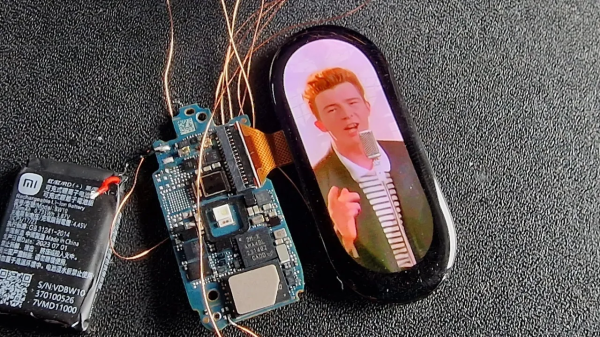
Over the past years, fitness trackers have gone from fairly unobtrusive bands that relied mostly on smartphone apps for interaction to essentially being fashion statements and smart watches, with large screens and impressive specs. The Xiaomi Mi Band 8 is no exception, with a zippy MCU and a 1.62″ AMOLED screen that just asks for some serious rick-rolling. This was a challenge which [Aaron Christophel] was all too happy to accept, resulting in some reverse-engineering and flashing of custom firmware onto one of these marvels of modern wearable technology.

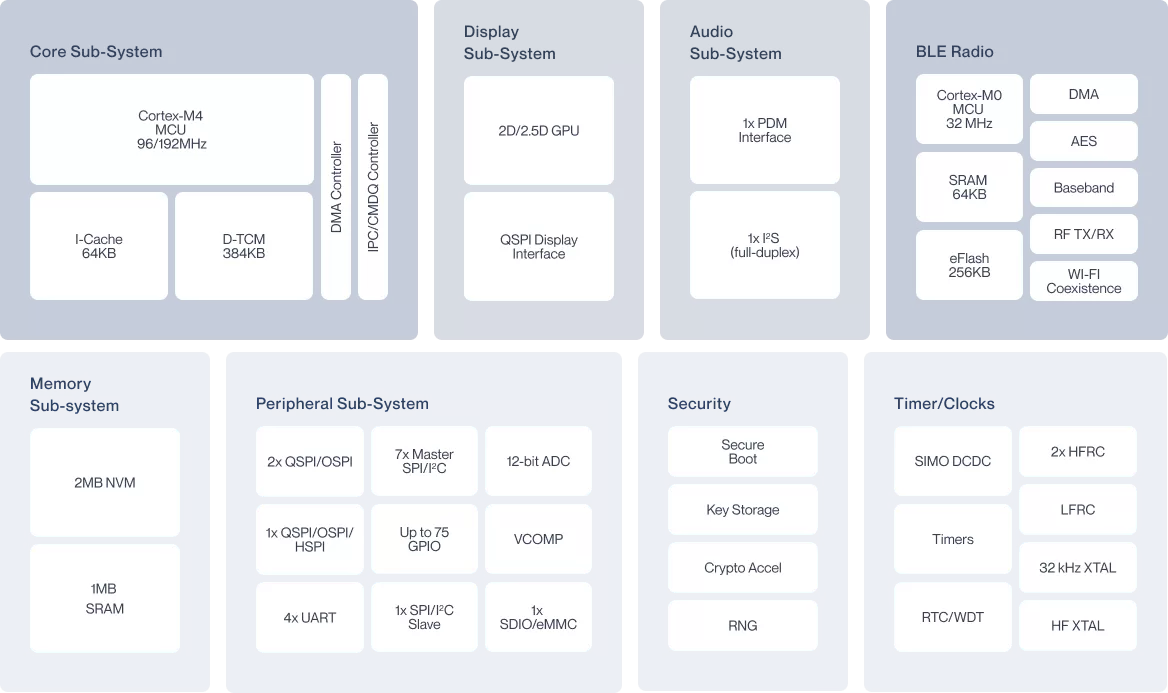
Block Diagram for the Apollo4 Blue Lite. (Credit: Ambiq)

The Mi Band 8 is built around an Ambiq Apollo4 Blue Lite MCU which features a Cortex-M4 core for applications, along with a Bluetooth LE radio and a lot of SRAM and Flash. This naturally implies an SWD interface for programming, which was mostly a matter of reverse-engineering the PCB to find the locations for these signals and realizing that the original firmware disables the SWD interface on boot. Unfortunately the Ambiq SDK requires you to create an account, but you can get the basics from [Aaron]’s GitHub project. It appears that for BLE you do need the full SDK, and OTA updates feature a signing check, so physical access is required.

So far the display, touchscreen and light sensor are working, with the remaining peripherals just a matter of time. With a list price of around $64 for one of these fitness bands with a 192 x 490 touch-enabled AMOLED display and a variety of health-related sensors, they’d seem to be a fun toy to hack, especially when found on sale or used.

Continue reading “Hacking The Xiaomi Mi Band 8 With Custom Firmware”