Remembering The MUDdiest Of Times With The MUD1 And MUD2 Online RPGs

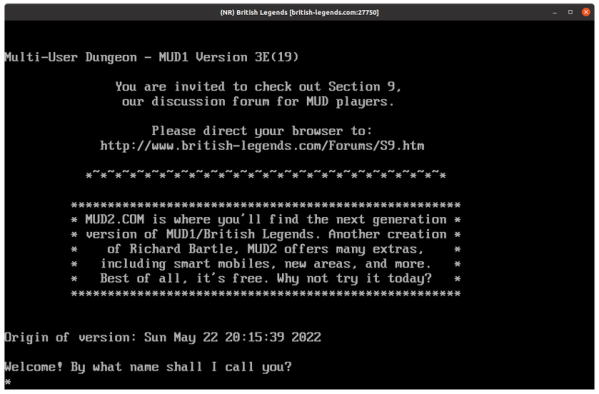
Before there were massively multiplayer online role-playing games (MMORPGs) like EverQuest, the genre was called a Multi-User Dungeon (MUD), following in the trend of calling text adventures at that time ‘dungeon crawlers’. These multi-player games required you to bring along your own imagination, for these were purely text-based affairs. Despite the first of these (MUD1) having been released all the way back in 1978 for the DEC PDP-10, these games are still being played today, long after they stopped being in the (game) news cycle.

The brief history and today’s status of MUD1 is covered in a recent article by [Bryan Lunduke], following its creation in 1979 in the UK by [Richard Bartle] and [Roy Trubshaw], its struggles and eventual renaming to ‘British Legends

Technically all you need to play is a telnet client, though you can always use a graphical web browser to log into a text adventure. Much like playing a game like Zork — which heavily inspired MUDs — you got to use your wits and map drawing skills to figure out how to navigate around the world. You can also play the new and improved MUD: MUD2. Make sure to take a peek on [Richard]’s aesthetically yellow MUD-related website and the latest gossip in the Muddled Times before joining either the UK MUD2 server or the Canadian one.

Although definitely leaning on one’s imagination more than the advanced graphics of a graphical MUD like EverQuest require, there’s a lot of fun to be had in these MUDs, as well as the plethora of others.

Thanks to [Stephen Walters] for the tip.

The Simulated Universe Thought Experiment And Information Entropy

Do we live in a simulation? This is one of those questions which has kept at least part of humanity awake at night, and which has led to a number of successful books and movies being made on the subject, topped perhaps by the blockbuster  movie The Matrix. Yet the traditional interpretation of the ‘simulated universe’ thought experiment is one in which we – including our brains and bodies – are just data zipping about in a hyper-advanced simulation rather than physical brains jacked into a computer. This simulation would have been set up by (presumably) a hyper-advanced species who seem to like to run their own version of The Sims on a Universe-sized scale.

Regardless of the ‘why’, the aspect of this question where at least some scientific inquiry is possible concerns whether or not it would be possible to distinguish anything uniquely simulation-like in our environment that’d give the game away, like a sudden feeling of déjà vu in the world of The Matrix where you can suddenly perceive the fabric of the simulation. However, the major problem which we have to consider when trying to catch a simulation in the act is that to this point we cannot ourselves create even a miniature galaxy and intelligent beings inside it to provide a testable hypothesis.

Beyond popular media like movies and series like Rick & Morty, what do science and philosophy have to say about this oddly controversial subject? According to some, we have already found the smoking gun, while others are decidedly more skeptical.

Continue reading “The Simulated Universe Thought Experiment And Information Entropy”

Using LEDs To Determine A Video Camera’s True Framerate

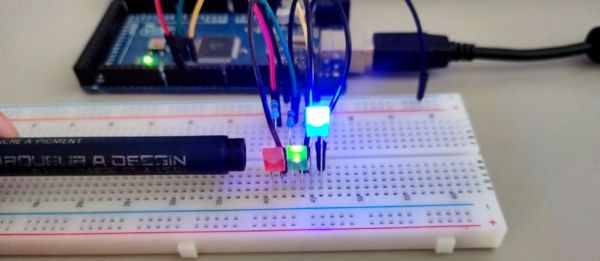
Interpolation and digital cropping are two techniques which are commonly used by marketing folk to embellish the true specifications of a device. Using digital cropping a fictitious zoom level can be listed among the bullet points, and with frame interpolation the number of frames per second (FPS) recorded by the sensor is artificially padded. This latter point is something which [Yuri D’Elia] came across with a recently purchased smartphone that lists a 960 FPS recording rate at 720p. A closer look reveals that this is not quite the case.

The smartphone in question is the Motorola Edge 30 Fusion, which is claimed to support 240 and 960 FPS framerates at 720p, yet the 50 MP OmniVision OV50A sensor in the rear camera is reported as only supporting up to 480 FPS at 720p. To conclusively prove that the Motorola phone wasn’t somehow unlocking an unreported feature in this sensor, [Yuri] set up an experiment using three LEDs, each of which was configured to blink at either 120, 240 or 480 Hz in a side-by-side configuration.

As [Yuri] explains in the blog post, each of these blinking frequencies would result in a specific pattern in the captured video, allowing one to determine whether the actual captured framerate was equal to, less than or higher than the LED’s frequency. Perhaps most disappointingly about the results is that this smartphone didn’t even manage to hit the 480 FPS supported by the OV50A sensor, and instead pegged out at a pedestrian 240 FPS. Chalk another one up for the marketing department.

NASA JPL’s Voyager Team Is Patching Up Both Voyagers’ Firmware

It’s not every day that you get to update the firmware on a device that was produced in the 1970s, and rarely is said device well beyond the boundaries of our solar system. This is however exactly what the JPL team in charge of the Voyager 1 & 2 missions are facing, as they are in the process of sending fresh firmware patches over to these amazing feats of engineering. These patches should address not only the attitude articulation and control system (AACS) issues that interrupted Voyager 1’s communication with Earth a while ago, but also prevent the thruster propellant inlet tubes from getting clogged up as quickly.

Voyager 2 is the current testbed for these patches, just in case something should go wrong despite months of Earth-based checking, testing and validation. As Voyager 1 is the furthest from Earth, its scientific data is the more valuable, but ideally neither spacecraft should come out worse for wear after this maintenance session.

The AACS fixes are more of an insurance policy, as the original cause of the issue was found to be that the AACS had entered into an incorrect mode, yet without a clear understanding of how this could have happened. With these changes in place, recovery should be much easier. Similarly, the changes to the use of the thrusters are relatively minor, in that they will mostly let the spacecraft drift a bit more out of focus before the thrusters engage, reducing total thruster firings and thus the build-up of material in these inlet tubes.

With these changes the antennae of both spacecraft should remain trimmed firmly towards the blue planet which they left over forty-five years ago, and enable them to hopefully reach that full half century mark before those of us who are still listening have to say our final farewells.

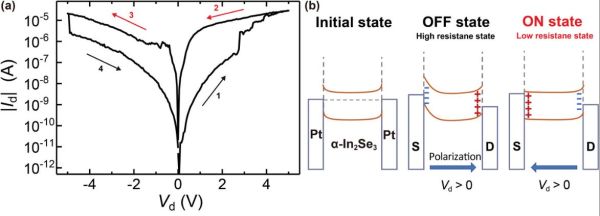
Electrically controlled behaviors of the lateral α-In2Se3 Fe-FET. a) Hysteresis loop of Id–Vd curve of the planar Fe-FET with 29 nm thick α-In2Se3. b) Band diagram of the ferroelectric switching mechanism. (Credit: Miao et al., 2023)

New Type Of Ferroelectric Memory Constructed Using α-In2Se3 Material

The ferroelectrical properties of materials have found a variety of uses over the years, including in semiconductor applications. Ferroelectric memory is among the most interesting and possibly world-changing as it could replace today’s fragile and (relatively) slow NAND Flash with something that’s more robust and scalable. Yet as with any good idea, finding the right materials and process to implement it is half the battle. Here is where a recently released paper in Advanced Science by Shurong Miao and colleagues demonstrates a FeFET-based memory cell design using α-In2Se3 material on platinum-based source-drain electrodes. Continue reading “New Type Of Ferroelectric Memory Constructed Using α-In2Se3 Material”

Reverse-Engineering The Mechanical Bendix Central Air Data Computer

Before the era of digital electronic computers, mechanical analog computers were found everywhere. From the relative simplicity of bomb sights to the complexity of fire control computers on 1940s battleships, all the way to 1950s fighter planes, these mechanical wonders enabled feats which were considered otherwise impossible at the time.

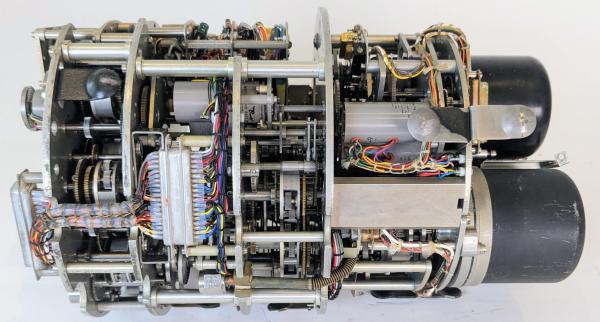
One such system that [Ken Shirriff] looked at a while ago is the Bendix Central Air Data Computer. As the name suggests, it is a computer system that processes air data. To be precise, it’s the mechanism found in airplanes that uses external sensor inputs to calculate parameters like altitude, vertical speed, Mach number and air speed.

Continue reading “Reverse-Engineering The Mechanical Bendix Central Air Data Computer”

Ready For The Rapture: This Wind-Up Cassette Player Can Play Anywhere

As useful as electronics are, the need to have some source of power for them can be a bit of an issue, especially for small, portable devices. One of the most low-tech but universally applicable source is human mechanical power, as demonstrated by the rugged 1980s-era Messenger II tape player in a recent [TechMoan] video. Without beating around the bush, this is indeed a device created by an evangelical organization (GRN) that missionaries would take with them to wherever their mission took them. Naturally this put the availability of power from a wall outlet in question, especially in the 1980s when this tape player was produced. Continue reading “Ready For The Rapture: This Wind-Up Cassette Player Can Play Anywhere”