Commodore Floppy Drive Fixing Chaos

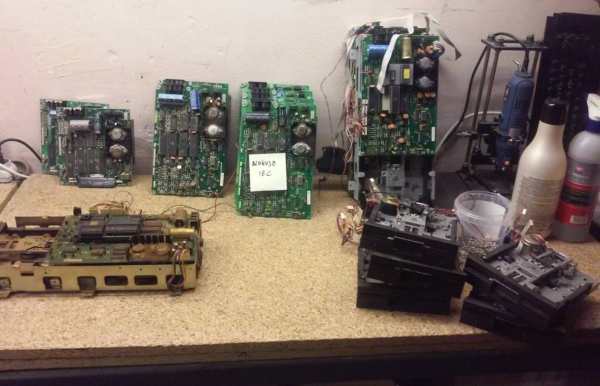
One of the best parts of retrocomputing is that you can obtain so many broken systems and peripherals for repairing and other assorted fun. This was the wholesome activity that [Drygol] embarked on recently with a gaggle of Commodore floppy disk drives that he obtained, involving a lot of cleaning, soldering, calibrating and other assorted entertainment. This follows cold on the heels of an earlier repair session of a stash of Commodore 1541 FDDs.
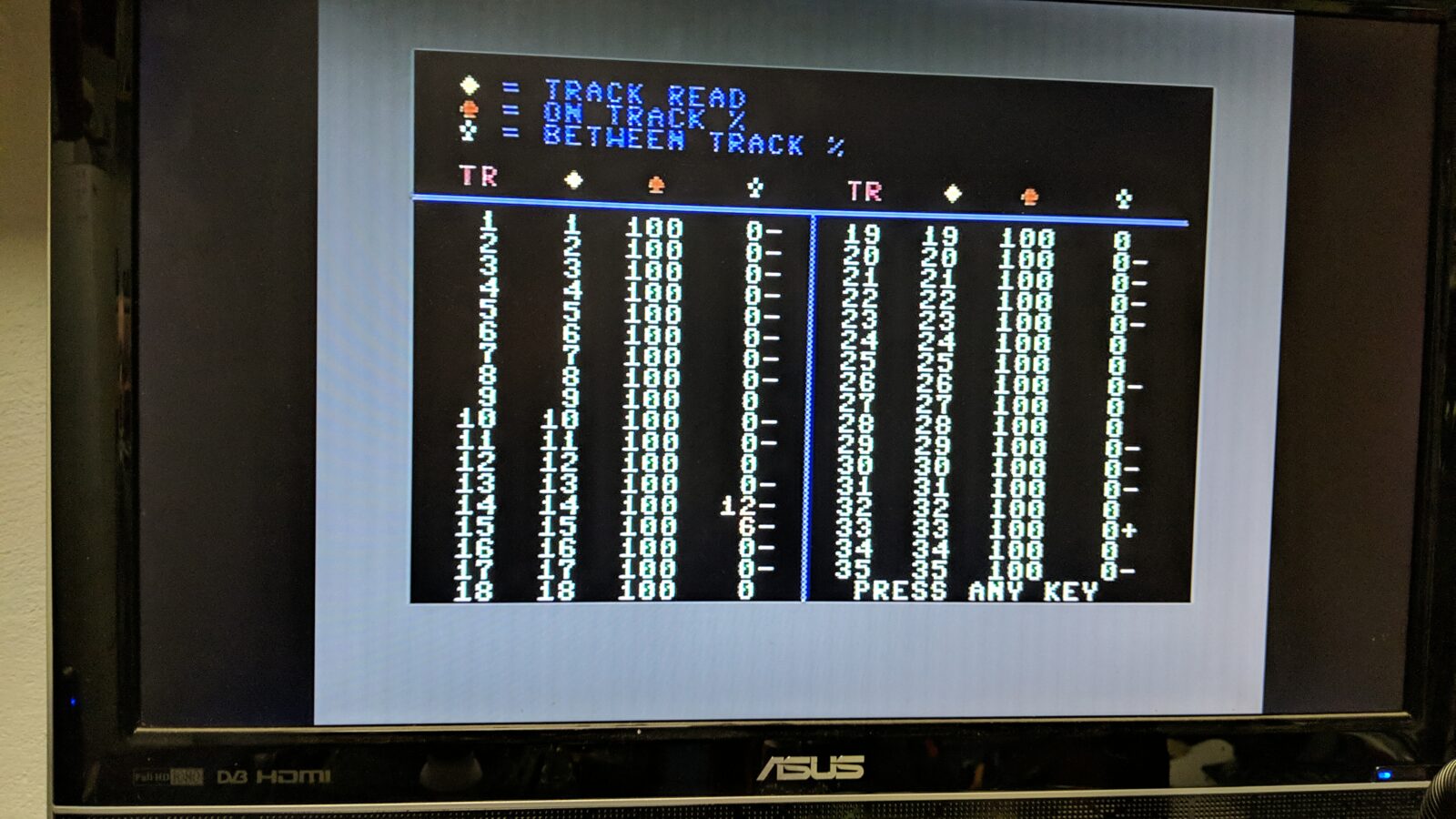
Testing Commodore FDD head alignment using the 1541 diagnostic cartridge.

As with any such devices, the first thing to do is to clean the heck out of them, to remove forty-odd years of dust and other debris, followed by testing of functionality, replacing dead ICs and the usual round of (electrolytic) capacitor replacement. Retrobrighting gives it that fresh-out-of-packaging look, which leaves just the calibrating of these drives. This procedure is essential to make sure the read/write head is aligned with the tracks on the disks, and is the most fiddly part of the process.

What helps a lot here is the 1541 diagnostic cartridge by [World of Jani] that displays real-time information on the drive while you are tweaking its speed and head alignment. All you have to do is tweak the speed potentiometer, and adjust the position of the drive motor, which takes a bit of patience and a steady hand. After this repair session a few Mitsumi drives unfortunately remained dead due to busted coils. Despite a valiant repair attempt on the heads by manually rewinding the coils, this remains a topic for a potential part III.


Will The Lilium Jet Work? A Deep-Dive Into The Physics Behind EVTOL Aircraft

The Lilium Jet is a proposed eVTOL (electric Vertical Take Off and Landing) aircraft that the German company Lilium GmbH has claimed it will bring to the market ‘soon’, which would made it the first eVTOL aircraft in the world to enter into commercial service. As anyone who has any experience with VTOL knows, it’s a tricky subject to engineer, let alone when you want to do it fully electric. In a deep-dive video on the Lilium Jet and eVTOL in general, [John Lou] goes through the physics behind VTOL take-off, landing and flight, as well as range and general performance.

It is clear that Lilium’s presented aircraft concept has many issues, some of which are due to new and unproven technologies, while others seem to be founded in over-promising and likely under-delivering. With Lilium having signed a number of contracts to deliver the first Pioneer Edition Lilium Jets and commercial service promised by 2025, it’s hard to ignore that the first full prototype of the 7-seater Lilium Jet is supposed to fly this year.

Although as [John] points out in the video, eVTOL is not an impossible concept, it is important to remain realistic about what is physically possible, and not seek to push the boundaries. When the UK introduced its first mass-produced VTOL jet in the form of the Harrier, it too faced an uncomfortable time as bugs got ironed out. As these eVTOL aircraft would be carrying real human passengers, it’s a good place to realize that although you can pick a fight with physics, you will never come out on the winning side.

Hopefully Lilium realizes this too, and these sleek, battery-powered aircraft will truly take to the skies in a few years.

Continue reading “Will The Lilium Jet Work? A Deep-Dive Into The Physics Behind EVTOL Aircraft”

The Many Robots That Ventured Into The Chernobyl NPP #4 Reactor

Before the Chernobyl Nuclear Power Plant (ChNPP, spelled ‘Chornobyl’ in Ukrainian) disaster in 1986, there had been little need for radiation-resistant robots to venture into high-risk zones.

The MF-2 Joker, also used for clearing debris at the Chernobyl NPP #4 disaster site.

Yet in the aftermath of the massive steam explosion at the #4 reactor that ripped the building apart — and spread radioactive material across the USSR and Europe — such robots were badly needed to explore and provide clean-up services. The robots which were developed and deployed in a rush are the subject of a recent video by [The Chornobyl Family].

While some robots were more successful than others, with the MF-2 remote mine handling robot suffering electronic breakdowns, gradually the robots became more refined. As over the years the tasks shifted from disaster management to clean-up and management of the now entombed #4 reactor, so too did the robots. TR-4 and TR-5 were two of the later robots that were developed to take samples of material within the stricken reactor, with many more generations to follow.

The video also reveals the fate of many of these robots. Some are buried in a radioactive disposal site, others are found on the Pripyat terrain, whether set up as a tourist piece, or buried in shrubbery. What’s beyond doubt is that it are these robots that provided invaluable help and saved countless lives, thanks to the engineers behind them.

Continue reading “The Many Robots That Ventured Into The Chernobyl NPP #4 Reactor”

Cottonization: Making Hemp And Flax Fibers Into The Better Cotton

These days it’s hard to imagine that fabrics were ever made out of anything other than cotton or synthetic fibers, yet it wasn’t too long ago that hemp and flax-based fabrics — linen — were the rule rather than the exception. Cotton production has for centuries had the major disadvantages of requiring a lot of water and pesticides, and harvesting the cotton was very labor-intensive, making cotton rather expensive. In order to make separating the cotton fibers from the seed easier, improved versions of the cotton gin (‘cotton engine’) were developed, with the 19th century’s industrial revolution enabling a fully automated version.

What makes cotton attractive is the ease of processing these fibers, which are part of the seed pod. These fibers are 25 mm – 60 mm long, 12 μm – 45 μm fine fibers that can be pulled off the seeds and spun into yarn or whatever else is needed for the final product, much like wool. Hemp and flax fibers, in contrast, are extracted from the plant stem in the form of bast fibers. Rather than being pure cellulose, these fibers are mostly a mixture of cellulose, lignin, hemicellulose and pectin, which provide the plant with rigidity, but also makes these fibers coarse and stiff.

The main purpose of cottonization is to remove as much of these non-cellulosic components as possible, leaving mostly pure cellulose fibers that not only match the handleability of cotton fibers, but are also generally more durable. Yet cottonization used to be a long and tedious process, which made bast fiber-based textiles expensive. Fortunately, the steam explosion cottonization method that we’ll be looking at here may be one of the methods by which the market will be blown open for these green and durable fibers.

Continue reading “Cottonization: Making Hemp And Flax Fibers Into The Better Cotton”

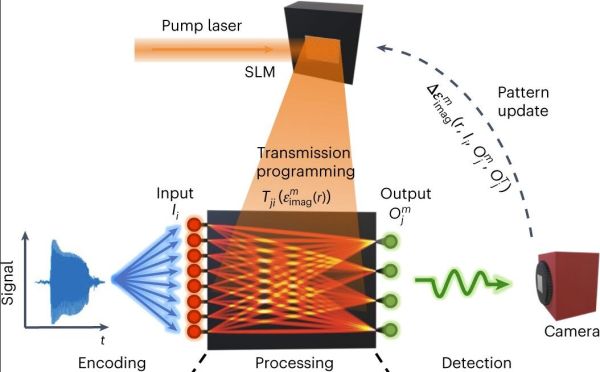
Creating Lithography-Free Photonic Reprogrammable Circuits

The field of photonics has seen significant advances during the past decades, to the point where it is now an integral part of high-speed, international communications. For general processing photonics is currently less common, but is the subject of significant research. Unlike most photonic circuits which are formed using patterns etched into semiconductor mask using lithography, purely light-based circuits are a tantalizing possibility. This is the focus of a recent paper (press release, ResearchGate) in Nature Photonics by [Tianwei Wu] and colleagues at the University of Pennsylvania.

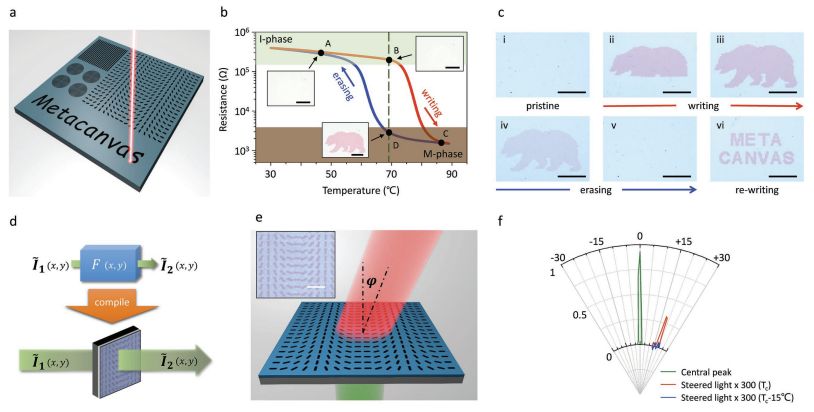
What is somewhat puzzling is that despite the lofty claims of this being ‘the first time’ that such an FPGA-like device has been created for photonics, this is far from the case, as evidenced by e.g. a 2017 paper by [Kaichen Dong] and colleagues (full  article PDF) in Advanced Materials. Here the researchers used a slab of vanadium dioxide (VO2) with a laser to heat sections to above 68 °C where the material transitions from an insulating to a metallic phase and remains that way until the temperature is lowered again. The μm-sized features that can be created in this manner allow for a wide range of photonic devices to be created.

A rewritable metacanvas. a) Schematic of laser writing different photonic operator patterns on a metacanvas. b) Temperature-dependentresistance of a VO2 film. c) Optical images from writing and erasing process on the metacanvas. . d) Diagram showing the mathematical matrix (F) is compiled onto a metacanvas in the form of a photonic operator for manipulation of light waveform (I ). e) Schematic of a metacanvas programmed as a beam steerer with a steering angle ϕ. (Credit: Dong et al., 2018)
A rewritable metacanvas. a) Schematic of laser writing different photonic operator patterns on a metacanvas. b) Temperature-dependent resistance of a VO2 film. c) Optical images from writing and erasing process on the metacanvas. . d) Diagram showing the mathematical matrix (F) is compiled onto a metacanvas in the form of a photonic operator for manipulation of light waveform. e) Schematic of a metacanvas programmed as a beam steerer with a steering angle ϕ. (Credit: Dong et al., 2018)

What does appear to be different with the photonic system presented by [Wu] et al. is that it uses a more traditional 2D approach, with a slab of InGaAsP on which the laser pattern is projected. Whether it is more versatile than other approaches remains to be seen, with the use of fully photonic processors in our computers still a long while off, never mind photonics-accelerated machine learning applications.

Using Trash To Keep Plastic Trash Out Of Oceans By Kabooming Them

For a few years now, [Richard] of Tropical Ocean Cleanup fame has been working hard to clean the Philippines of the plastic trash that litters everything, and washes down the canals and rivers into the ocean. Using nothing but what is essentially trash – old car tires, rope and empty soda bottles – he creates ‘kabooms’ that prevent this trash  floating in the canals from polluting the beaches, kill wildlife and gather in the oceans. In a recent video he covers how he creates these systems, and the basics of how they are installed.

We previously covered [Richard]’s efforts, and although these kabooms have received a few tweaks along the way, the basic principle has remained the same. The empty bottles provides the buoyancy, while the tires are excellent structural elements that can take a beating from the weather and debris. Some of the kabooms are lashed together with rope, while for other types holes are drilled into the tires using a hole saw, all of which help to create a self-supporting trash capture system that can be installed easily with a group of volunteers.

Fetching the thus captured trash is still a bit of a struggle, requiring a fair bit of manual labor, nets and boats from local fishermen when they have some spare time, but the effect is very much noticeable on the nearby beaches. In addition to these trash capturing kabooms, [Richard] also promotes trash collecting at schools, organizes trash pick-up events and trash collecting points, to raise local awareness of the need to keep plastic trash out of the environment and burn pits.

Continue reading “Using Trash To Keep Plastic Trash Out Of Oceans By Kabooming Them”

The FPGA board in question which was programmed to run the algorithm. (Source: iranintl)

Iran’s Military Quantum Claim: It’s Only 99.4% Ridiculous

When Iran recently announced a quantum processing algorithm (Google translation) that would help its military to detect water surface disturbances, the instant response from Western media was one of ridicule, based on the displayed hardware. The hardware in question was the Digilent ZedBoard Zynq-7000 hybrid SoC/FPGA development board, which can be yours for less than $600.

Seems absurd, and the claim about any realistic military use absolutely is. But buried deep, deep down, there may be a tiny kernel of truth: because quantum computers are inherently parallel, FPGAs can make a good fit for small-scale quantum simulations.

Does this mean that the Iranian Navy would be better off simulating quantum circuits on an FPGA board than on a GPU or even a used laptop? Probably not. Will this hardware serve the proposed military application in the forseeable future? Absolutely not! Was this a misleading and ridiculous photo op? Yup. 100%.

But is emulating qubits in FPGA fabric a real thing? Turns out it is! Let’s have a look.

Continue reading “Iran’s Military Quantum Claim: It’s Only 99.4% Ridiculous”