Uranium-241 Isotope Created And Examined Via Multinucleon Transfer Reactions And Mass Spectrometry

A recent paper (PDF) in Physical Review Letters by T. Niwase and colleagues covers a fascinating new way to both create and effectively examine isotopes by employing a cyclotron and a mass spectrograph. In the paper, they describe the process of multinucleon transfer (MNT) and analysis at the recently commissioned KEK Isotope Separation System (KISS), located at the RIKEN Nishina Center in Japan.
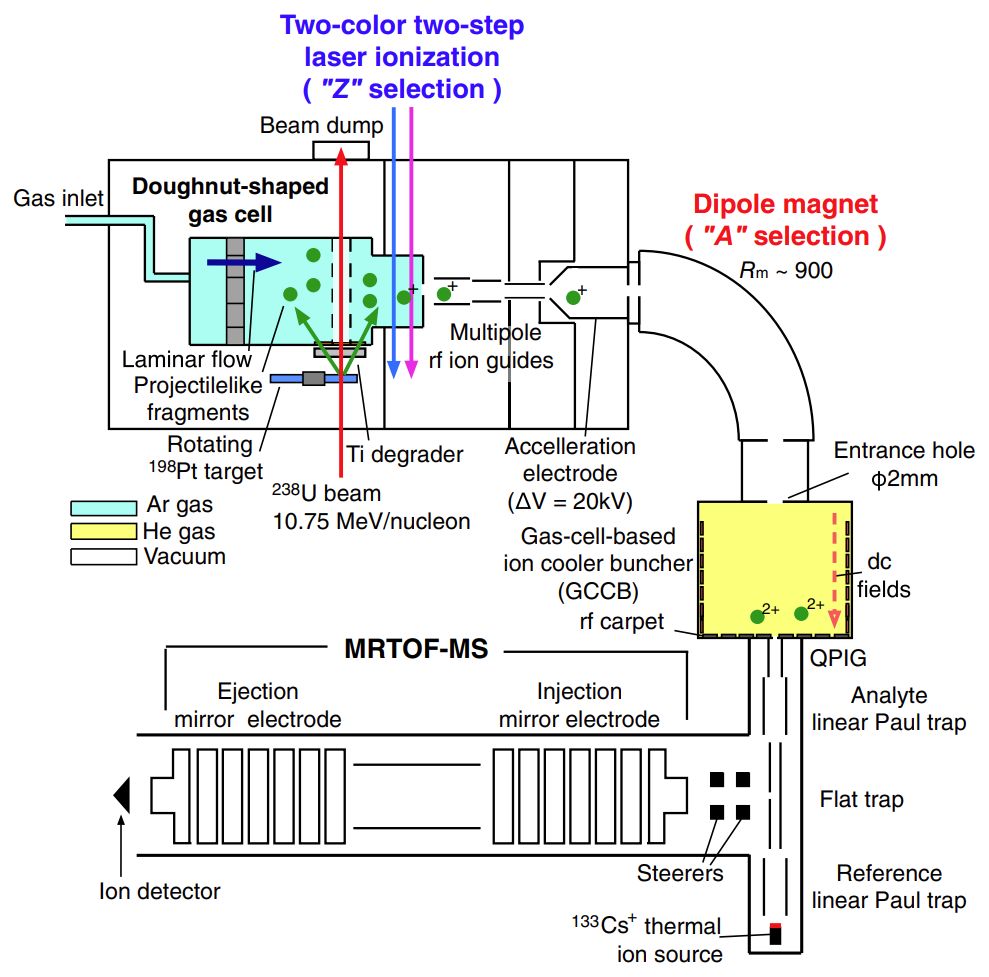
Sketch of the KISS experimental setup. The blue- and yellow-colored areas are filled with Ar and He gases, respectively. Differential pumping systems are located after the doughnut-shaped gas cell as well as before and after the GCCB. (Credit: Niwase et al., 2023)
Sketch of the KISS experimental setup. The blue- and
yellow-colored areas are filled with Ar and He gases, respectively. Differential pumping systems are located after the doughnut-shaped gas cell as well as before and after the GCCB. (Credit: Niwase et al., 2023)

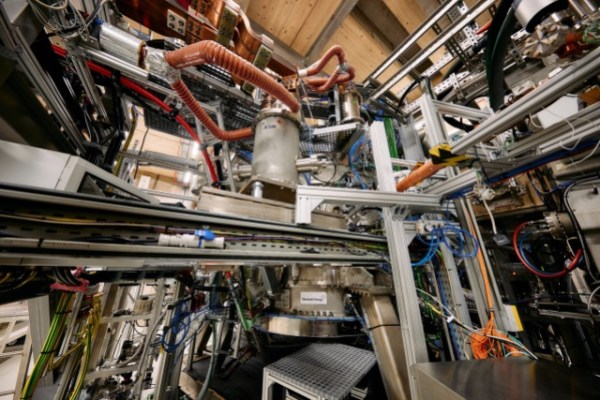
The basic process which involves the RIKEN Ring Cyclotron, which was loaded for this particular experiment with Uranium-238 isotope. Over the course of four days, 238U particles impinged on a 198Pt target, after which the resulting projectile-like fragments (PLF) were led through the separation system (see sketch). This prepared the thus created ions to be injected into the multi-reflection time-of-flight mass spectrograph (MRTOF MS), which is a newly installed and highly refined mass spectrograph which was also recently installed at the facility.

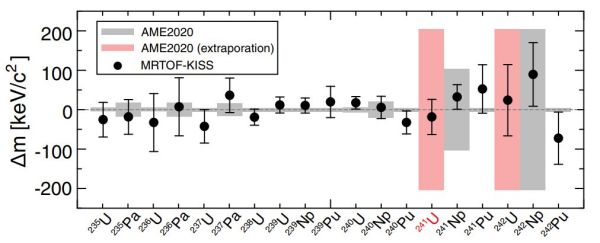
Using this method, the researchers were able to establish that during the MNT process in the cyclotron, the transfer of nucleons from the collisions had resulted in the production of 241U as well as 242U. Although the former had not previously been produced in an experimental setting, the mass of 242U had not been accurately determined. During this experiment, the two uranium as well as neptunium and other isotopes were led through the MRTOF MS instrument, allowing for the accurate measurement of the characteristics of each isotope.

The relevance of producing new artificial isotopes of uranium lies not so much in the production of these, but rather in how producing these atoms allows us to experimentally confirm theoretical predictions and extrapolations from previous data. This may one day lead us to amazing discoveries such as the famously predicted island of stability, with superheavy, stable elements with as of yet unknown properties.

Even if such astounding discoveries are not in the future for theoretical particle physics, merely having another great tool like MNT to ease the burden of experimental verification would seem to be more than worth it.

The Challenges Of Producing Graphene In Quantity

We’ve all heard the incredible claims made about graphene and its many promising applications, but so far the wonder-material has been held back by the difficulty of producing it in large quantities. Although small-scale production was demonstrated many years ago using basic Scotch tape, producing grams or even kilograms of it in a scalable industrial process seemed like a pipedream — until recently. As [Tech Ingredients] demonstrates in a new video, the technique of flash Joule heating of carbon may enable industrial graphene production.

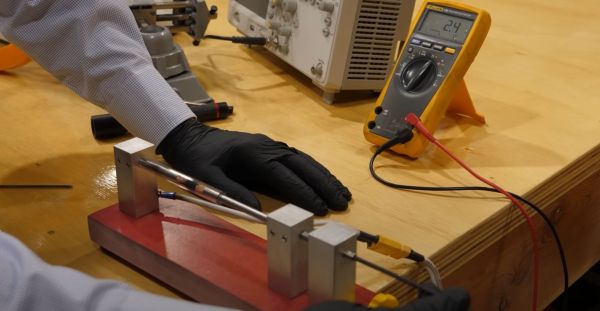
The production of this flash graphene (FG) was first demonstrated by Duy X. Luong and colleagues in a 2020 paper inĀ Nature, which describes a fairly straightforward process. In the [Tech Ingredients] demonstration it becomes obvious how easy graphene manufacturing is using this method, requiring nothing more than carbon black as ingredient, along with a capacitor bank, vacuum chamber and a number of reasonably affordable items.

Perhaps best of all is that no refinement or other complicated processes are required to separate the produced graphene from the left-over carbon black and other non-graphene products. Using multiple of these carbon black-filled tubes in parallel, producing graphene could conceivably be scaled up to industrial levels. This would make producing a few kilograms of graphene significantly easier than coating hard drive platters with the substance.

Continue reading “The Challenges Of Producing Graphene In Quantity”

Using Old Coal Mines As Cheap Sources Of Geothermal Heat

For as much old coal mines are a blight upon the face of the Earth, they may have at least one potential positive side-effect. Where the coal mine consists out of tunnels that were drilled deep into the soil, these tend to get flooded by groundwater after the pumps that keep them dry are turned off. Depending on the surrounding rock, this water tends to get not only contaminated, but also warmed up. As the BBC explains in a recent video as a follow-up to a 2021 article, when the water is pumped up for decontamination, it can be run through a heat exchanger in order to provide heat for homes and businesses. Continue reading “Using Old Coal Mines As Cheap Sources Of Geothermal Heat”

The UK’s ST40 Spherical Tokamak Achieves Crucial Plasma Temperatures

As the race towards the first commercially viable nuclear fusion reactor heats up, the UK-based Tokamak Energy has published a paper on its recent achievements with its ST40 spherical tokamak. Most notable is the achieving of plasma temperatures of over 100 million Kelvin, which would put this fusion reactor firmly within the range for deuterium-tritium fusion at a rate that would lead credence to the projection made by Tokamak Energy about building its first commercial fusion plants in the 2030s.

The ST40 is intended to provide the necessary data to construct the ST80-HTS by 2026, which itself would be a testing ground for the first commercial reactor, called the ST-E1, which would be rated at 200 MWe. Although this may seem ambitious, Tokamak Energy didn’t come out of nowhere, but is a spin-of of Culham Centre for Fusion Energy (CCFE), the UK’s national laboratory for fusion research, which was grounded in 1965, and has been for decades been involved in spherical tokamak research projects like MAST and MAST-Upgrade, with STEP as its own design for a commercial fusion reactor.

The advantage offered by spherical tokamaks compared to regular tokamaks is that they favor a very compact construction style which puts the magnets very close to the plasma, effectively making them more efficient in retaining the plasma, with less power required to maintain stable plasma. Although this makes the use of super-conducting electromagnets not necessary, it does mean that wear and tear on these magnets is significantly higher. What this does mean is that this type of tokamak can be much cheaper than alternative reactor types, even if they do not scale as well.

Whether or not Tokamak Energy will be the first to achieve commercial nuclear fusion remains to be seen. So far Commonwealth Fusion’s SPARC and a whole host of Western and Asian fusion projects are vying for that gold medal.

Busting Wireless ESD Wrist Straps With LTT And ElectroBOOM

Nobody likes getting zapped from an electrostatic discharge, no matter whether you’re a fragile ASIC or a bag-of-mostly-salty-water humanoid. To prevent this, ESD wrist straps and similar are essential tools, as they prevent the build-up of a charge on your humanoid’s skin, essentially like a very large electrolyte-filled capacitor. Yet you can buy wireless ESD straps everywhere that are supposed to somehow dissipate this charge into the ether, even though this would seem to undermine the laws of physics that make capacitors work.

In a practical experimentation and assorted hijinks video collaboration by [Linus] from Linus Tech Tips and [Mehdi Sadaghdar] from ElectroBOOM put these wireless ESD straps to the test, featuring [Mehdi]’s DIY Van de Graaff generator to charge [Linus] up. What is excellently demonstrated in this video is how effective a real ESD strap is, and how the ‘wireless’ version is just a scam that does absolutely nothing to dissipate the charge, being just a waste of a 1 MOhm resistor and what could have been a real ESD strap.

Also covered in the video are what the reason for the resistor in an ESD strap is, and why metal bracelet type ESD straps are not appropriate, for very good reasons.

Continue reading “Busting Wireless ESD Wrist Straps With LTT And ElectroBOOM”

Supercon 2022: Aedan Cullen Is Creating An AR System To Beat The Big Boys

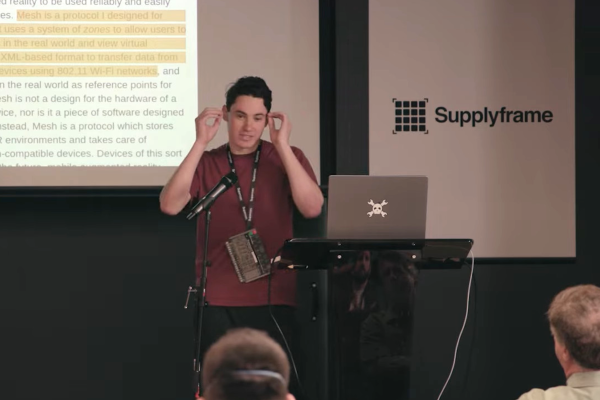
There’s something very tantalizing about an augmented reality (AR) overlay that can provide information in daily life without having to glance at a smartphone display, even if it’s just for that sci-fi vibe. Creating a system that is both practical and useful is however far from easy, which is where Aedan Cullen‘s attempt at creating what he terms a ‘practical augmented reality device’.

In terms of requirements, this device would need to have a visual resolution comparable to that of a smartphone (50 pixels/degree) and with a comparable field of view (20 degrees diagonal). User input would need to be as versatile as a touchscreen, but ‘faster’, along with a battery life of at least 8 hours, and all of this in a package weighing less than 50 grams.

Continue reading “Supercon 2022: Aedan Cullen Is Creating An AR System To Beat The Big Boys”

Playing 78 RPM Shellac Records: It’s Not Just About Speed

What is the difference between 78, 45, and 33 RPM records? Obviously most people would say the speed, which of course is true to a degree. But as [Techmoan] covers in a recent video, there’s a whole lot more to the playback of 78 RPM records. Especially the older type without so-called ‘microgrooves’. Even if you have a record player that can do 78 RPM speeds, you may have noticed that the sound is poor, with a lot of clicking and popping.

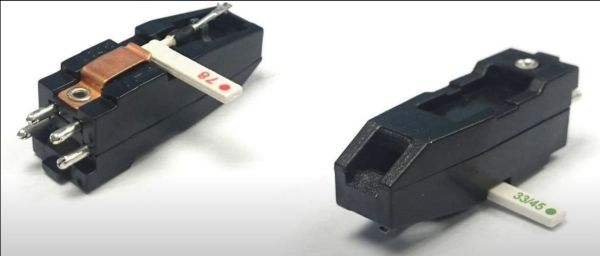
The primary reason for this is that on an average 78 RPM record, the groove containing the sound pattern is 3 mil (thousandth of an inch) wide, whereas the grooves on microgroove and 33/45 RPM records is a mere 1 mil wide. This difference translates into the stylus tip, which is comically undersized for the 3 mil grooves and ends up dragging somewhere in the very bottom of the groove, missing entirely out on the patterns etched higher up on the sides. This is why in the past styluses would often come in the flip-style version, as pictured above.

It’s also possible to purchase the mono, 3 mil styluses today from Audio-Technica and other well-known brands, requiring only to switch the stylus cartridge between playing sessions with different groove sizes. As [Techmoan] demonstrates in the video, the difference between a too small and just right stylus is night and day, but it reveals the second issue with playing records: equalization.

Virtually all records have some kind of equalization applied to the recorded audio, to balance out the imperfections of the recording medium. Upon playback, this effect is inverted, restoring the original signal as much as possible. Since 1954, the de facto standard has been RIAA equalization, and this is what the average record preamplifier also assumes you are using. Unfortunately, this means that for many records from around that time and before, the wrong equalization will be applied, as basically every publisher had their own standard.

In the video, [Techmoan] figures out a way to get an affordable way to playback these wide groove, 78 RPM records, and to dodge the RIAA equalization step by tapping directly into the signal from the cartridge. This would likely be a lot easier if one threw more money at the whole thing, but where is the fun in that?

Continue reading “Playing 78 RPM Shellac Records: It’s Not Just About Speed”