Combining Acoustic Bioprinting With Raman Spectroscopy For High-Throughput Identification Of Bacteria

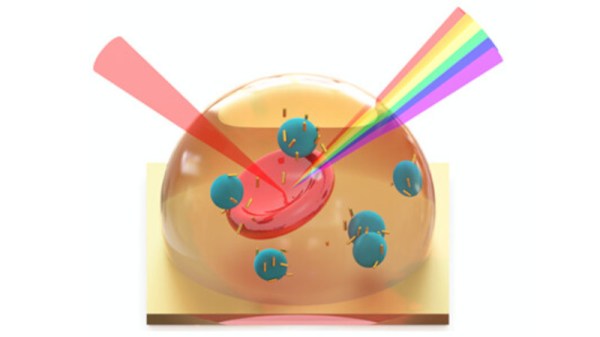
Rapidly analyzing samples for the presence of bacteria and similar organic structures is generally quite a time-intensive process, with often the requirement of a cell culture being developed. Proposed by Fareeha Safir and colleagues in Nano Letters is a method to use an acoustic droplet printer combined with Raman spectroscopy. Advantages of this method are a high throughput, which could make analysis of samples at sewage installations, hospitals and laboratories significantly faster.

Raman spectroscopy works on the principle of Raman scattering, which is the inelastic scattering of photons by matter, causing a distinct pattern in the thus scattered light. By starting with a pure light source (that is, a laser), the relatively weak Raman scattering can be captured and the laser light filtered out. The thus captured signal can be analyzed and matched with known pathogens. Continue reading “Combining Acoustic Bioprinting With Raman Spectroscopy For High-Throughput Identification Of Bacteria”
Fresh PCBs For The Quickshot II And II Plus Joysticks

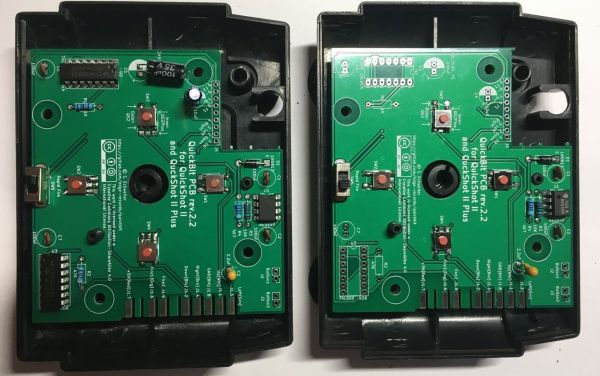
The Quickshot II was released by Spectravideo in 1983 for the Commodore 64 and compatible systems, with the Quickshot II Plus following the next year. After decades of regular use, it’s quite understandable that these old-timers may be having some functional issues, but as long as the plastic parts are still good, [Stephan Eckweiler]’s replacement PCBs may be just the thing that these joysticks need to revitalize them for another few decades.

What may be a matter of taste is that these replace the nice tactile clicky switches on the QS II Plus with SMD push buttons, but compared to the stamped metal ‘button’ construction of the original QS II, the new board is probably a major improvement. As for the BOM, it features two ICs: a 74LS00 latch and NE555 timer, along with the expected stack of passives and switches, both through-hole and SMD.

The PCB contains break-off boards for the switches within the joystick itself, requiring a bit of wiring to be run to the main PCB before soldering on the DE-9 connector and connecting the joystick for a test run to a Commodore 64. All one needs now is a 3D printable enclosure version to create more QS II joysticks for some multiplayer action.

Modifying Artwork With Glaze To Interfere With Art Generating Algorithms

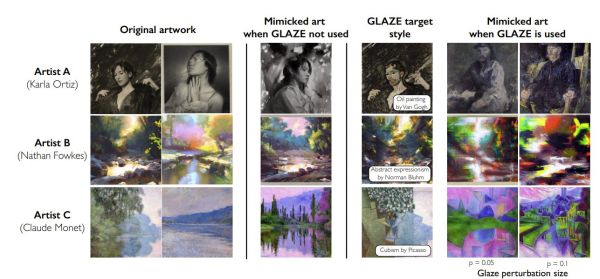
With the rise of machine-generated art we have also seen a major discussion begin about the ethics of using existing, human-made art to train these art models. Their defenders will often claim that the original art cannot be reproduced by the generator, but this is belied by the fact that one possible query to these generators is to produce art in the style of a specific artist. This is where feature extraction comes into play, and the Glaze tool as a potential obfuscation tool.

Developed by researchers at the University of Chicago, the theory behind this tool is covered in their preprint paper. The essential concept is that an artist can pick a target ‘cloak style’, which is used by Glaze to calculate specific perturbations which are added to the original image. These perturbations are not easily detected by the human eye, but will be picked up by the feature extraction algorithms of current machine-generated art models. Continue reading “Modifying Artwork With Glaze To Interfere With Art Generating Algorithms”

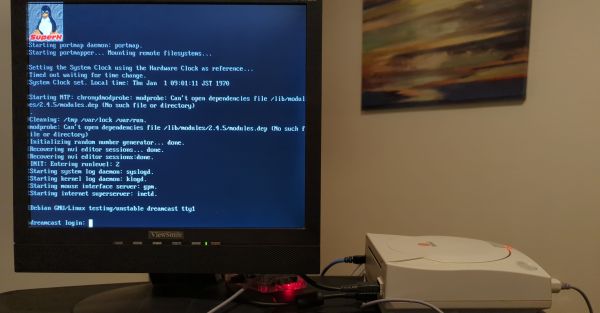
Dreamcast Linux: Looking Back At Linux On A SuperH-based Gaming Console

The Dreamcast is probably best known as the swansong of Sega’s ambitions as a gaming console manufacturer, but perhaps lesser known is the fact that you can run Linux on it. In a deep-dive by [Cameron Kaiser] over at the Old VCR blog, it is demonstrated what it takes to make this feat even work in 2023, and what one can expect from a system with a 200 MHz HItachi SuperH SH-4 CPU, 16 MB of RAM and the luxuries of VGA and network interfaces.

What’s interesting about Dreamcast Linux is that it was among the first times that Linux got put on a gaming console, even if it wasn’t entirely official or remotely supported by Sega. In fact, the fact that it works at all has its roots firmly in an exploit that was discovered shortly after the Dreamcast’s release. While Dreamcast discs are generally in a format called GD-ROM (Gigabyte Disc), early on it also supported the MIL-CD standard, which was Sega’s ill-fated attempt at creating multimedia CDs with MIL-CDs.

Not only did MIL-CDs flop in the market, the support form in Dreamcast units also provided a juicy exploit via the firmware that handles detecting and switching between GD-ROM and the much more constrained, audio-only MIL-CD mode. Later Dreamcast models dropped MIL-CD support and will thus also not boot Dreamcast Linux, which is an important gotcha to keep in mind when dragging out a Dreamcast for some Linux action.

As for running Linux on a Dreamcast, it’s pretty much what you’d expect from running it on such a constrained, RAM-disk only device. While [Cameron] was able to use workarounds such as swap-over-NFS to increase functionality, a lot more work remains to be done. Linux SuperH support seems to have petered out around the 2.6.x era, which would seem to have cemented the fate of Dreamcast Linux and similar SuperH platforms.

We’re curious, would double the RAM make a difference to this Linux platform?

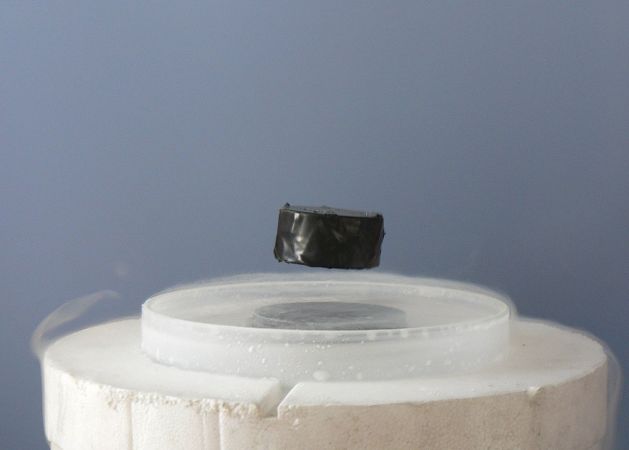
Another Room-Temperature Superconductivity Claim And Questions Of Scientific Integrity

In early March of 2023, a paper was published in Nature, with the researchers claiming that they had observed superconductivity at room temperature in a conductive alloy, at near-ambient pressure. While normally this would be cause for excitement, what mars this occasion is that this is not the first time that such claims have been made by these same researchers. Last year their previous paper in Nature on the topic was retracted after numerous issues were raised by other researchers regarding their data and the interpretation of this that led them to conclude that they had observed superconductivity.

According to an interview with one of the lead authors at the University of Rochester – Ranga Dias – the retracted paper has since been revised to incorporate the received feedback, with the research team purportedly having invited colleagues to vet their data and experimental setup. Of note, the newly released paper reports improvements over the previous results by requiring even lower pressures.

Depending on one’s perspective, this may either seem incredibly suspicious, or merely a sign that the scientific peer review system is working as it should. For the lay person this does however make it rather hard to answer the simple question of whether room-temperature superconductors are right around the corner. What does this effectively mean?

Continue reading “Another Room-Temperature Superconductivity Claim And Questions Of Scientific Integrity”

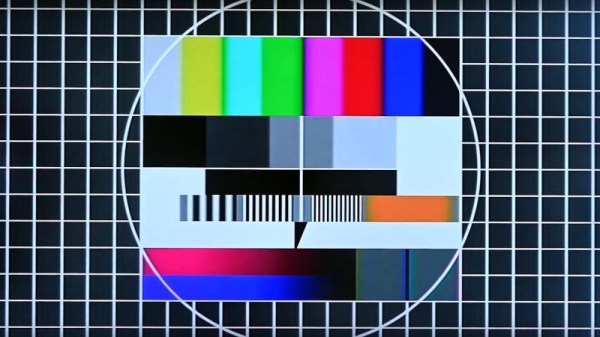
A Look At Zweikanalton Stereo Audio And Comparison With NICAM

With how we take stereo sound for granted, there was a very long period where broadcast audio and television with accompanying audio track were in mono. Over the decades, multiple standards were developed that provide a way to transmit and receive two mono tracks, as a proper stereo transmission. In a recent video, [Matt] over at [Matt’s Tech Barn] takes a look at the German Zweikanalton (also known as A2 Stereo) standard, and compares it with the NICAM standard that was used elsewhere in the world.

Zweikanalton is quite simple compared to NICAM (which we covered previously), being purely analog with a second channel transmitted alongside the first. Since it didn’t really make much of a splash outside of the German-speaking countries, equipment for it is more limited. In this video [Matt] looks at the Philips PM 5588 and Rohde & Schwarz 392, analyzing the different modulations for FM, Zweikanalton and NICAM transmissions and the basic operation of the modulator and demodulator equipment.

An interesting aspect of these modulations are the visible sidebands, and the detection of which modulation is used. Ultimately NICAM’s only disadvantage compared to Zweikanalton was the higher cost of the hardware, but with increased technological development single-chip NICAM solutions like the Philips SAA7283 (1995) began to reduce total system cost and by the early 2000s NICAM was a standard feature of TV chipsets, just in time for analog broadcast television to essentially become irrelevant.

Continue reading “A Look At Zweikanalton Stereo Audio And Comparison With NICAM”

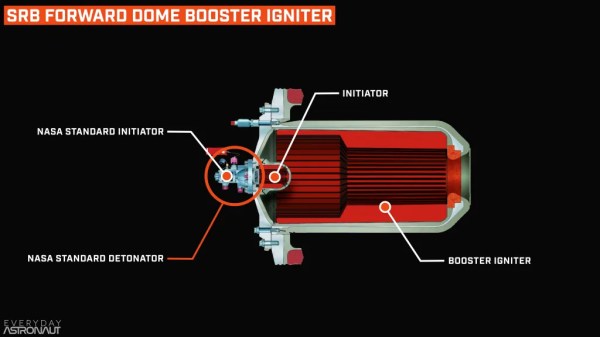
The Intricacies Of Starting A Rocket Engine

Rockets are conceptually rather simple: you put the pointy bit upwards and make sure that the bit that will go flamey points downwards before starting the engine(s). Yet how to start each rocket engine type in a way that’s both safe and effective? Unlike in the Wile E. Coyote cartoons, real-life rocket engines do not have a fuse you light up before dashing off to a safe distance. Rather they use increasingly more complicated methods, which depend on the engine type and fuels used. In a recent article written by [] with accompanying video featuring everyone’s favorite Everyday Astronaut [Tim Dodd], we’re taken through the intricacies of how flamey ends are made. Continue reading “The Intricacies Of Starting A Rocket Engine”