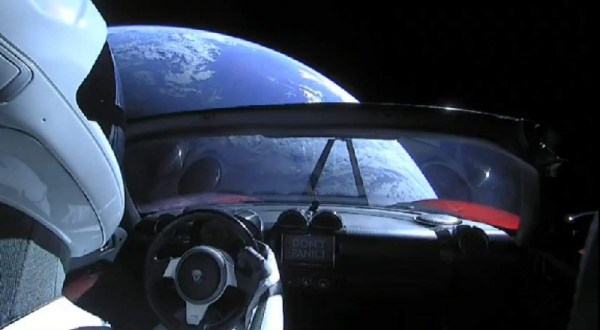
Five Years On, Where Is Starman And Where Will He Go?

On 6 February 2018, a Tesla Roadster was launched as the mass simulator on the first ever Falcon Heavy launch — putting for the first time ever a car on a Mars-crossing orbit. While undoubtedly a bit of a stunt, the onboard cameras provided an amazing view of our planet Earth as the Starman dummy in the Roadster slowly drifted away from that blue marble, presumably never to be seen again.

This “never” is the point that researchers at the University of Toronto would like to clarify in a paper published after the launch titled The Random Walk of Cars and Their Collision Probabilities with Planets. Using N-body simulations, they come to the conclusion that there’s a 22%, 12%, and 12% chance of the Roadster impacting the Earth, Venus, and the Sun, respectively. But don’t get too excited, it’s not due to happen for a few million years, so it isn’t something any of us will be around to see.

As the Where Is Starman? website shows, the Roadster never reached escape velocity from the Sun’s gravity, meaning that it’s still zipping around in an orbit around our day star. Exposed to the harsh UV and other radiation, it’s likely that very little is left at this point of the Tesla, or Starman himself. Even so, scientists to this day are feeling less than amused by what they see as essentially littering, adding to the discarded rocket stages, dead satellites and other debris that occasionally makes it into the news when it smashes into the Moon, or threatens the ISS.
The ARPANET Of Things And CMU’s History Of Networked Soda Machines

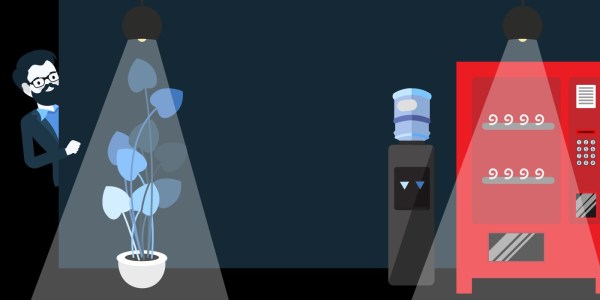
When the computer science department of Carnegie Mellon University expanded in the 1970s, this created a massive issue for certain individuals who now found that they had to walk quite a distance to the one single Coke machine. To their dismay, they’d now find that after braving a few flights of stairs, they’d find that the Coke machine (refilled randomly by grad students) was empty, or worse, had still warm Coke bottles inside. What happened next is detailed by the Coke machine itself, straight from the CMU’s servers.

A follow-up by the IBM Industrious blog adds more feedback from those responsible for we now refer to as an IoT device, though technically it was an AoT at the time, being a pre-Internet era. For the bottle-based, 1970s machine, microswitches were installed by students in the machine to keep track of the fill state of each column and for how long the bottles had been inside. After about 3 hours newly added bottles were registered as being ‘COLD’, which could be queried from the PDP-10’s mainframe (CMUA) or via ARPANET using the finger command on the special ‘coke’ user account with finger coke@cmua.

As time moved on and the coke machine was replaced  in the early 90s with a newer (and very much non-IoT) model, students would once again attempt to modify it, much to the chagrin of the Coke company’s maintenance people, resulting in the students reverting modifications prior to a maintenance appointment. This tracking system used the empty column lights on the machine, leading to a similar tracking system as on the 1970s machine, except now running on a PC-XT class computer that also tracked the status of the M&M snack machine nearby.

Whether CMU CS students can still query such highly relevant information today is not mentioned, but we presume it is an issue of paramount importance that has been addressed in an expedient fashion over the intervening years.

(Thanks to [Daniel T Erickson] for the tip)

Custom Enclosure For 3D Printer

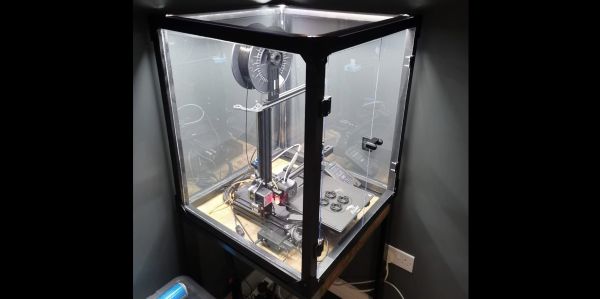
Having an enclosure around an FDM 3D printer is generally a good idea, even when printing only with PLA, as it keeps the noise in, and the heat (and smell, with ABS) inside. With all the available options for enclosures out there, however, [David McDaid] figured that it should be possible to make an enclosure that does not look like a grow tent and is not overly expensive. He also shared the design files on GitHub.

The essential idea is very simple and straightforward: the structural part is cut out of pine beams that are cut to size and joined into a cube by (3D-printed) corner brackets, with acrylic (Perspex) sheets filling in the space between the wooden beams. A door is formed using (also 3D-printed) hinges and door handles. The whole enclosure is rounded off with a lick of paint on the wooden elements, and a diffused set of LED lights for internal illumination.

It definitely has to be admitted that it makes for a very stylish enclosure, with a lot of modding potential. It can also easily be adapted to differently sized printers and filament material demands.

Equipping Rats With Backpacks To Find Victims Under Rubble

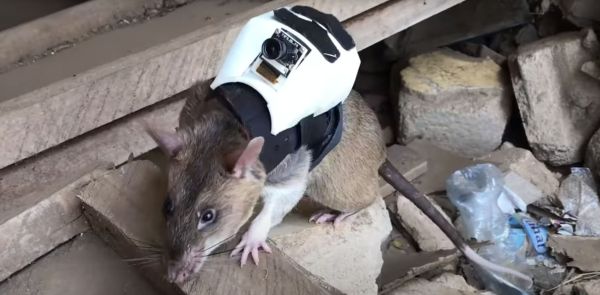
When it comes to demining or finding victims after a disaster, dogs are well-known to aid humans by sniffing out threats and trapped humans with ease. Less well-known, but no less impressive are rats, with the African giant pouched rat being the star of the show. Recently a student at the Dutch Technical University of Eindhoven (TU/e) has demonstrated how these rats can sniff out buried victims, aided by a high-tech backpack that gives them a communication link back to their human handler.

All of this is done in association with the Belgian-registered and Tanzania-based NGO APOPO, whose achievements include training gold medal winner Magawa the rat, who helped find 71 landmines and dozens more types of UXO over a 5-year career. These landmine-hunting rats are known as HeroRATs and have been helping demine nations since the 1990s. They may be joined by RescueRats in the near future.

Each RescueRat is equipped with a backpack that contains a camera and battery, as well as GPS and altimeter. Each backpack includes a button that the rat is trained to press when they have found a victim — essentially dropping a pin on their human rescuer’s maps.

Figuring out the location of the victim inside the rubble pile is the real challenge. This is where a (LoRa) radio beacon in the backpack is triangulated using receivers placed around the area, allowing the rescuers to determine with reasonable accuracy where to focus their efforts.

(Thanks to [Roel] for the tip!)

Continue reading “Equipping Rats With Backpacks To Find Victims Under Rubble”

The Effect Of Filament Color On Print Strength And More

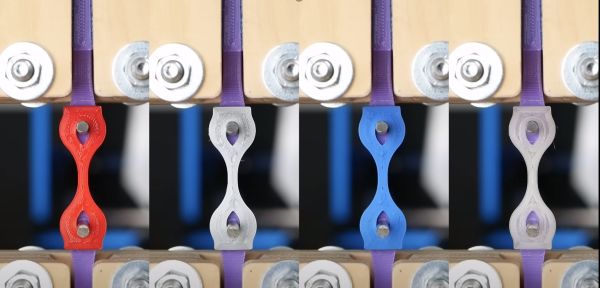
What is an FDM filament coloring’s purpose but to be an aesthetic choice? As it turns out, the additives that create these changes in coloring and transparency also affect the base properties of the polymer, whether it’s PLA, PETG, or another material. This is where a recent video by [CNC Kitchen] is rather illustrative, using a collection of colored PLA filaments from a single filament manufacturer.

[CNC Kitchen] ran a range of tests including tensile strength, ductility, layer adhesion, impact resistance, and annealing performance. The results showed no clear overall winner between plain PLA polymer and any specific color. Perhaps most fascinating was just how much these color additives change the material’s response to annealing. Baking the PLA at 100°C for 30 minutes generally improves material properties, but also can cause warping and shrinking. The effective warping and shrinking differed wildly between the filament.

The general conclusion would seem to be that the natural polymer isn’t necessarily the optimal choice, but that you should test and pick the filament from a specific manufacturer to fit your project’s needs.

Continue reading “The Effect Of Filament Color On Print Strength And More”

Reliving A Bitmapped Past With A Veritable Hoard Of Bitmap Fonts

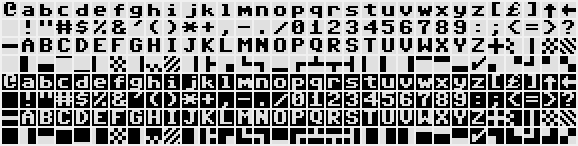
The fonts seen with old computer systems such as those from Apple and Commodore, as well as Microsoft Windows 3.1 and older, form an integral part of our interaction with these systems. These days such bitmap fonts are a rarity, with scalable vector-based fonts having taken their place on modern-day systems. This unfortunately also means that these fonts are at major risk of being lost to the sands of time. This is where [Rob Hagemans] seeks to maintain an archive of such bitmap fonts, ranging from Acorn to MSX to Windows.

Many of these fonts are extracted from character ROMs, with a preview of some of these fonts available via the Monobit viewer. The fonts themselves are made available in YAFF format, which is a text-based format that can be converted back to a binary format using the Monobit tool. If you ever wanted to use one of these old bitmap fonts in a project, this would seem to offer a treasure trove of options. The hoard of bitmap fonts might be the perfect fit for your next graphic LCD project.

(Via [SuperIlu] on Mastodon)

The Struggle Of Keeping A 1950s Candlepin Bowling System Working

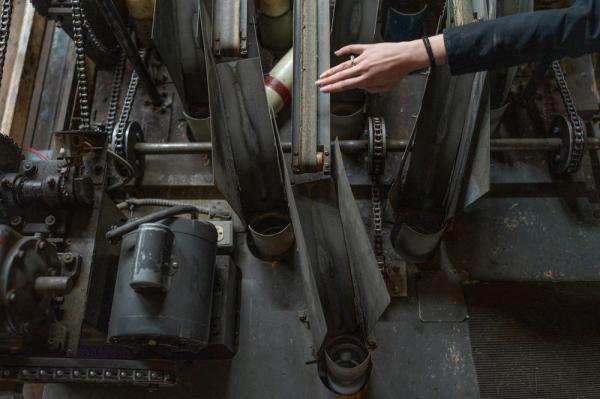
When we hear the term ‘bowling’, most of us think of what is known as ten-pin bowling, yet this is only one of the many variations. Candlepin bowling — so called because of the distinctive pin shape — has been around since 1880, yet is mostly played within the US New England and Canadian Maritime provinces. Because of how relatively uncommon it is, candlepin bowling alleys such as the one that [Autumn Mowery]’s family runs is struggling to keep the system working, much of it due to a lack of spare parts.

On [Autumn]’s YouTube channel she goes through many of the behind the scene details at the Ellsworth, Maine-based bowling alley, the repairs and the scavenging of spare parts from the sacrificial bowling lanes that are used to keep the other lanes going for as long as possible. With the mechanics of the installed candlepin bowling system dating back to the 1940s and having been use constantly since the 1950s, it’s an every day struggle to keep the system from breaking down, with no spare parts available for sale.

Although the financially responsible approach might be to give up on the system and have a readily available tenpin bowling system installed instead, there’s a lot more to this form of bowling than the difference in pin shape. Differences include the much stricter rules, the use of a smaller ball without finger holes, lower chance of hitting a pin, and so on. This, along with the historical significance of the sport and this particular system would make it appear to be something that’s right up the (bowling) alley of our audience.

How’d you keep a 1950s-era bowling system up and running?

Thanks to [Tara Calishain] for the tip!