Asbestos: The Miracle Mineral Of Our Worst Nightmares

For much of the 19th and 20th century, the mining and use of asbestos saw near-constant growth, with virtually every material used in the construction of homes, offices, ships, road networks and industries featuring this miraculous mineral in some fashion. Some of these materials would contain only a few percent asbestos mineral as a binder, while others would be mostly or entirely composed out of asbestos.

What had begun as mostly a curiosity thousands of years prior was now turning into the material that was helping propel humanity into an era of hitherto unknown levels of prosperity and technological progress. It seemed as if the addition of even just a bit of asbestos would make houses weather- and fireproof, make concrete and asphalt nearly indestructible and add just that little bit of zing to tiling and interior decorations, as well as rigidity to the predecessor to today’s plastics: bakelite. Continue reading “Asbestos: The Miracle Mineral Of Our Worst Nightmares”
Hackerboards: Making Finding The Right Single-Board Computer Easy

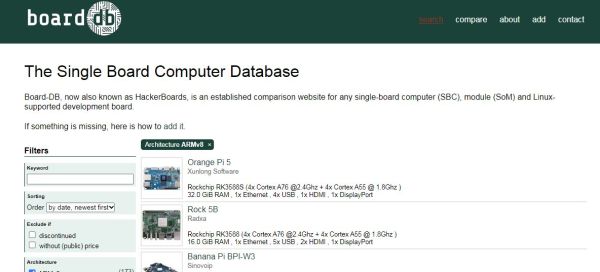
The great thing about the wide availability of single-board computers (SBCs) is that it offers such a large selection of options, in terms of CPU performance, GPU features, RAM size, I/O options and much more. This is however also the largest issue, especially with the annual surge of new boards with new feature sets. Trying to make sense of all these offerings is the recently overhauled Board-DB, also known as Hackerboards.

As [Martijn Braam] explains in the blog post on the changes, a major upgrade over the old Hackerboards (which we covered in 2016) is a far more extensive set of parameters that can be filtered against. This makes a fine-grained selection of detailed features significantly easier, which is also reflected in the technical specifications comparison feature. With over 450 active entries there are a lot of boards that can already be filtered on, but manufacturers are invited to take up contact to add further entries, which should keep the list up to date.

Incidentally, if you’d like to know how [Martijn] gets those gorgeous PCB photographs, he wrote a whole a separate write-up that goes over his camera setup.

Thanks to [Vlad] for the tip.

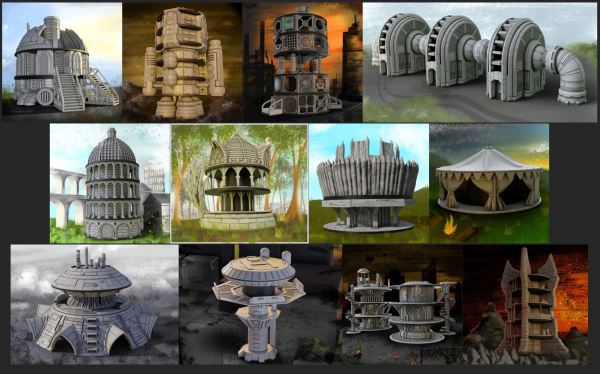
Digital Taxidermy Spool Recycling concept art.

Spool Tower: Empty Filament Spool Or Base For Miniature Civilizations

While churning through rolls of FDM filament, there are these empty spools that remain at the end. These can be thrown out with the trash, or be used as a standard base for miniatures, for use with Dungeons & Dragons tabletop gaming or similar, or just as a display piece. The latter is what the blokes over at Digital Taxidermy ran with when they started their first Spool Tower Kickstarter campaign. Now they’re back with Spool Tower 2: The Re-Spoolening.

These are STL bundle packs that should contain all that’s needed to turn an empty filament spool into an art piece, minus of course the painting. To get a free taste of what the experience is like, Digital Taxidermy provides a few free STLs, such as for the Ye Olde Taxidermee Shoppee and the Hab Block from the new crowdfunding campaign.

This effort raises the interesting question of what other standard (plastic) shapes of packaging could conceivably be used in a similar manner. After all, why print the whole thing when half the model could be made from something you’d otherwise just toss into the trash bin?

Thanks to [scat happens] for the tip.

Using I²C Sensors With Any Linux Via USB And IIO

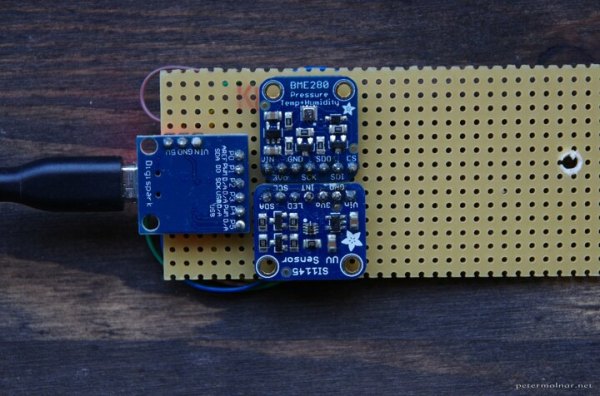
Hooking up I2C sensors is something which is generally associated with microcontrollers and SBCs, yet it’s very easy to use such I2C sensors from basically any system that runs Linux. After all, I2C (that is, SMBus) is one of the interfaces that is highly likely to be used on your PC’s mainboard as well as peripherals. This means that running our own devices like the well-known BME280 temperature, pressure and humidity sensor, or Si1145 light sensor should be a piece of cake.

In a blog post from a few years ago, [Peter Molnar] explains in detail how to wire up a physical adapter to add a USB-connected I2C interface to a system. At its core is the ATtiny85 AVR-based MCU, which provides a built-in USB interface, running the I2C-Tiny-USB firmware.

The essential part here is that the MCU shows up to the Linux kernel as an i2c device, requiring the i2c-dev driver to be loaded. After this the I2C device that is connected to the adapter MCU’s I2C bus can be used via the Linux module’s API calls, either directly or via existing drivers. [Peter] found that the BMP280 driver came with Debian Sid, for example.

Making SVD Files Searchable With Svd2db

Everyone who writes bare-metal code for microcontrollers probably know the joys of looking up the details of specific registers in the reference manual, including their absolute address. Although the search function of the PDF viewer can be helpful, it’d be rather nice if there was a way to search only the registers, and have the offset calculations performed automatically. This is basically what [Terry Porter]’s Svd2db tool enables. As the name suggests, this tool turns the SVD hardware description files that come with ARM-based MCUs into a database file.

This database file is an SQLite database, which allows it to be searched using the provided readdb tool, or any other SQLite tool. This would make the utility useful not just for quick look-ups during development, but presumably also for automated testing scenarios where having an easily searchable database of registers is of use. At this point Svd2db is guaranteed to work with STM32 SVDs, but may work with SVDs for other ARM-based SVD files as well.


Making A Do-It-Yourself Sand Battery

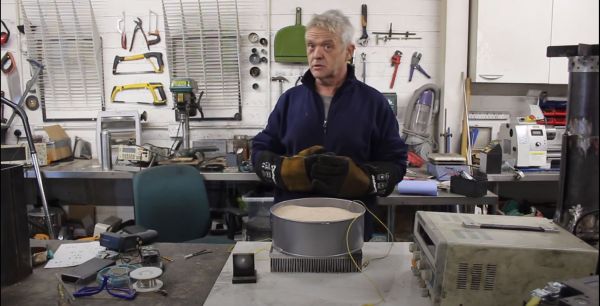
Storing energy can be done in many ways, with the chemical storage method of a battery being one of the most common. Another option is a thermal battery, which basically means making something hot, and later extracting that heat again. In this video by [Robert Murray-Smith] the basic concept of a thermal battery that uses sand is demonstrated.

By running a current through a resistive wire that’s been buried inside a container with sand, the sand is heated up to about 200 °C. As [Robert] points out, the maximum temperature of the sand can be a 1000 °C or more. Because sand doesn’t boil like water, the total amount of energy stored in sand is correspondingly higher.

Extracting the thermal energy can be done rather inefficiently using the demonstrated Peltier element. A Stirling engine, or steam generator and turbine, would get a lot more energy out. Either way, the thermal battery itself is made using just plain sand, which makes it an attractive DIY target to tinker with.

Continue reading “Making A Do-It-Yourself Sand Battery”

FDA’s Approval Of Cell Culture Chicken: The Rise Of Fresh Meat Without The Animal?

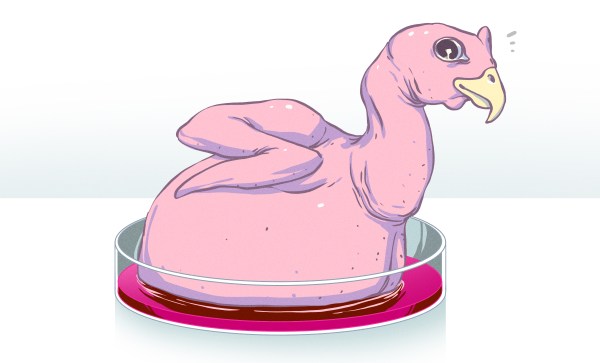
On November 14th of this year, the FDA cleared the path for Upside Foods to sell its cell-culture-based chicken products within the US. This is the first product of its kind to be cleared for commercial sale within the Americas, with only Singapore having previously cleared a similar product for sale, back in December of 2020. This latter product comes courtesy of another California start-up called Eat Just.

Since that initial approval in Singapore, Eat Just has begun to set up a 2,800 square meter (~30,000 square feet) production facility in Singapore that is scheduled to begin producing thousands of kilograms of slaughter-free meat starting in the first quarter of 2023. This would make it the top-runner in the cultured meat industry, which to this point has seen dozens of start-ups, but precious few actual products for sale.

With CEO Josh Tetrick of Eat Just projecting price equality between their cultured meat and meat from animals by 2030, could the FDA’s approval herald the dawn of slaughter-free meat? There are obviously still hurdles, but as we’ll see, the idea is not nearly as far-fetched as one might think.

Continue reading “FDA’s Approval Of Cell Culture Chicken: The Rise Of Fresh Meat Without The Animal?”