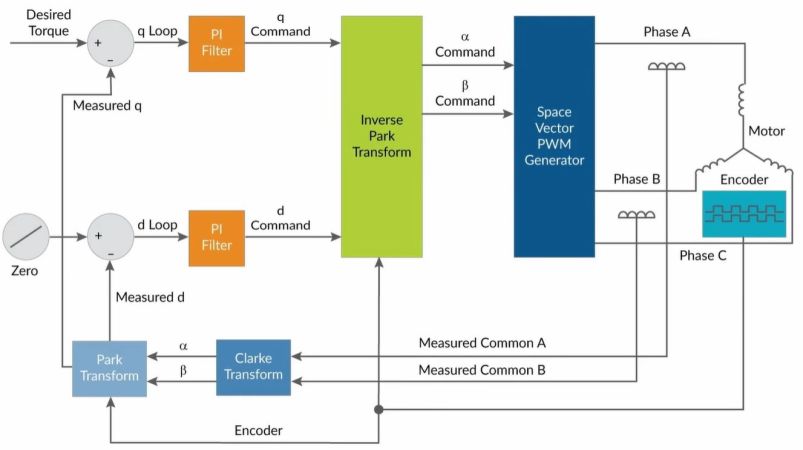
Testing the FOC-based motor controller. (Credit: Excessive Overkill, YouTube)
Vector Control, also known as Field Oriented Control or FOC is an AC motor control scheme that enables fine-grained control over a connected motor, through the precise control of its phases. In a recent video [Excessive Overkill] goes through the basics and then the finer details of how FOC works, as well as how to implement it. These controllers generally uses a proportional integral (PI) loop, capable of measuring and integrating the position of the connected motor, thus allowing for precise adjustments of the applied vector.
If this controller looks familiar, it is because we featured it previously in the context of reviving old industrial robotic arms. Whether you are driving the big motors on an industrial robot, or a much smaller permanent magnet AC (PMAC) motor, FOV is very likely the control mechanism that you want to use for the best results. Of note is that most BLDC motors are actually also PMACs with ESC to provide a DC interface.
Carnivorous plants are a fascinating part of the natural world, especially species like the Venus flytrap (Dionaea muscipula) that rely on what is effectively a spring-loaded trap to ensnare unsuspecting prey. As also seen with species like the waterwheel plant (Aldrovanda vesiculosa), species like sundews are a lot more chill with movement in the order of seconds, excluding D. glanduligera which displays a similar sub-second response as the Venus flytrap. Over the years there has been much speculation about the exact mechanism that enables such a fast response, with [Hiraku Suda] and colleagues offering an explanation, via a recently published paper in Nature Communications.
The calcium response in a Venus flytrap with the DmMSL10 knockout variant. The ant is allowed to just waddle around. (Credit: Hiraku Suda et al., Nature Comm, 2025)
The sensory hairs that line the Venus flytrap’s leaves are finely tuned to respond to certain kind of stimuli using calcium threshold signals. This is something which was previously known already, but the exact mechanism still proved to be elusive.
This new study shows that a mechanosensor called DmMSL10 lies at the core of the touchiness of these plants by breeding a version where this particular stretch-activated chloride ion (Cl–) channel is absent.
While the mechanical action of the sensor hair triggers the release of calcium ions in both the wild- and knockout dmmsl10 variant, the action potential generation rate was much lower in the latter, while the former continued to generate action potentials even after major stimulation had ceased. This demonstrates that DmMSL10 is essential for the processing of slight stimulation of the sensor hairs and thus prey detection.
A subsequent experiment with some ants being allowed to wander around on the leaves of the wild- and knockout type plants further served to demonstrate the point, with the wild type catching the first ant to waddle onto the leaf, while the knockout type leaf didn’t even twitch as four successive ants failed to propagate the calcium signal sufficiently to close the leaf.
With this knowledge we now have a likely mechanism for how D. muscipula and friends are able to generate the long range calcium signals that ultimately allow them to snack on these tasty protein-and-nitrogen packets on legs. Further research is likely to illuminate how exactly these mechanisms were evolved in parallel with similar mechanisms in animals.
The overall theme of the early part of the Cold War was that of subterfuge — with scientific missions often providing excellent cover for placing missiles right on the USSR’s doorstep. Recently NASA rediscovered Camp Century, while testing a airplane-based synthetic aperture radar instrument (UAVSAR) over Greenland. Although established on the surface in 1959 as a polar research site, and actually producing good science from e.g. ice core samples, beneath this benign surface was the secretive Project Iceworm.
By 1967 the base was forced to be abandoned due to shifting ice caps, which would eventually bury the site under over 30 meters of ice. Before that, the scientists would test out the PM-2A small modular reactor. It not only provided 2 MW of electrical power and heat to the base, but was itself subjected to various experiments. Alongside this public face, Project Iceworm sought to set up a network of mobile nuclear missile launch sites for Minuteman missiles. These would be located below the ice sheet, capable of surviving a first strike scenario by the USSR. A lack of Danish permission, among other complications, led to the project eventually being abandoned.
It was this base that popped up during the NASA scan of the ice bed. Although it was thought that the crushed remains would be safely entombed, it’s estimated that by the year 2100 global warming will have led to the site being exposed again, including the thousands of liters of diesel and tons of hazardous waste that were left behind back in 1967. The positive news here is probably that with this SAR instrument we can keep much better tabs on the condition of the site as the ice cap continues to grind it into a fine paste.
Top image: Camp Century in happier times. (Source: US Army, Wikimedia)
Although the saying of caveat emptor rings loudly in the mind of any purveyor of electronic components, the lure of Very Cheap Stuff is almost impossible to resist. Sure, that $0.60 Ti ADS1115 ADC on LCSC feels like it almost has to be a knock-off since the same part on Digikey is $4 a pop, and that’s when you buy a pack of 1,000. Yet what if it’s a really good knockoff that provides similar performance for a fraction of the price, such as with those cheap ADC boards you can get from Amazon? Cue [James Bowman] letting curiosity getting the better of him and ordering a stash of four boards presumably equipped with at least some kind of cheapo knockoff part, mostly on account of getting all boards for a mere $2.97.
The goal was of course to subject these four purported ADS1115s to some testing and comparison with the listed performance in the Ti datasheet. Telling was that each of the ADCs on the boards showed different characteristics, noticeably with the Data Rate. This is supposed to be ±10% of the nominal, so 7.2 – 8.8 times per second in 8 samples per second mode, but three boards lagged at 6.5 – 7 SPS and the fourth did an astounding 300 SPS, which would give you pretty noisy results.
Using a calibrated 2.5 voltage source the accuracy of the measurements were also validated, which showed them to be too low by 12 mV. The good news was that a linear correction on the MCU can correct for this, but it shows that despite these parts being ADS1115 compatible and having features like the PGA working, you’re definitely getting dinged on performance and accuracy.
[James] said that he’s going to run the same tests on an ADS1115 board obtained from Adafruit, which likely will have the genuine part. We would also love to see someone test the $0.60 version from LCSC to see whether they can match the datasheet. Either way, if you are eyeing this ADC for your own projects, it pays to consider whether the compromises and potential broken-ness of the knockoffs are worth it over coughing up a bit more cash. As they say, caveat emptor.
There’s no rule that says that logic circuits must always use electrically conductive materials, which is why you can use water, air or even purely mechanical means to implement logic circuits. When it comes to [soiboi soft]’s squishy robots, it thus makes sense to turn the typical semiconductor control circuitry into an air-powered version as much as possible.
We previously featured the soft and squishy salamander robot that [soiboi] created using pneumatic muscles. While rather agile, it still has to drag a whole umbilical of pneumatic tubes along, with one tube per function. Most of the research is on microfluidics, but fortunately air is just a fluid that’s heavily challenged in the density department, allowing the designs to be adapted to create structures like gates and resistors.
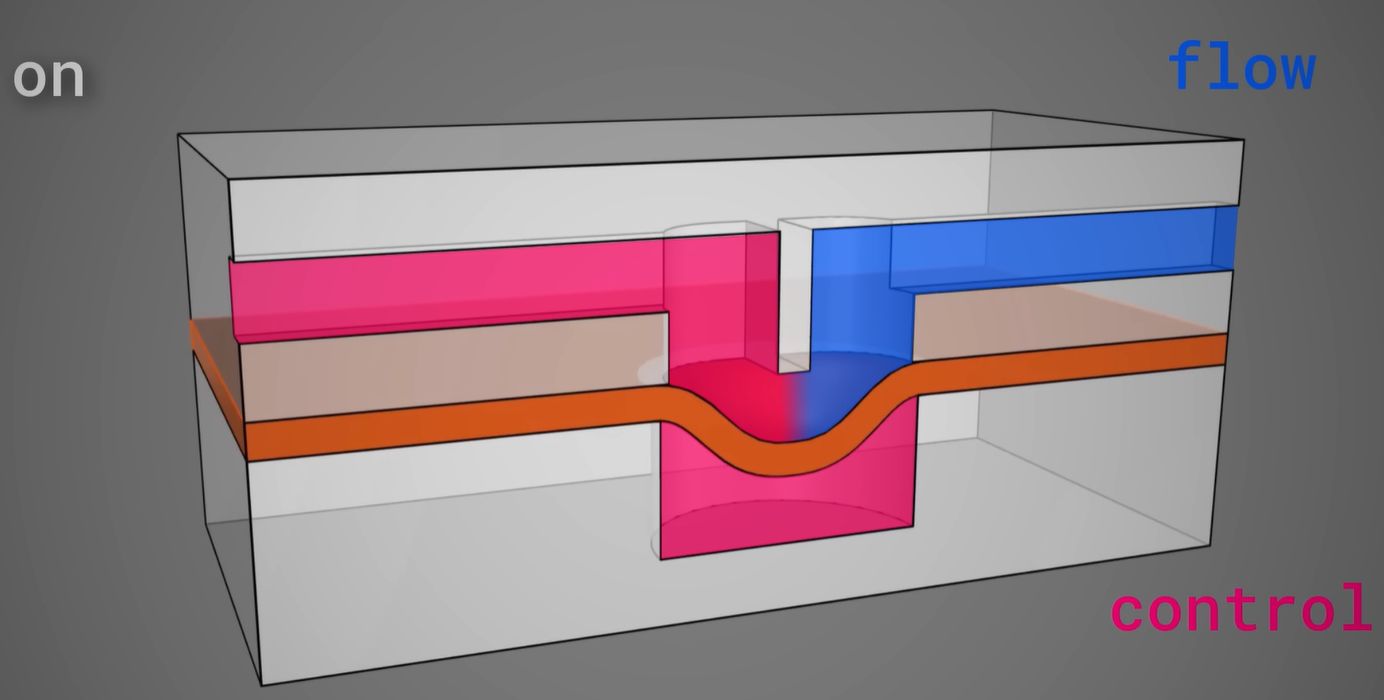
A transistor or valve using a silicone membrane. (Credit: soiboi soft, YouTube)
Logically, a voltage potential or a pressure differential isn’t so different, and can be used in a similar way. A transistor for example is akin to the vacuum tube, which in British English is called a valve for good reason. Through creative use of a flexible silicone membrane and rigid channels, pulling a vacuum in the ‘gate’ channel allows flow through the other two channels.
Similarly, a ‘resistor’ is simply a narrowing of a channel, thus resisting flow. The main difference compared to the microfluidics versions is everything is a much larger scale. This does make it printable on a standard FDM printer, which is a major benefit.
Quantifying these pneumatic resistors took a bit of work, using a pressure sensor to determine their impact, but after that the first pneumatic logic circuits could be designed. The resistors are useful here as pull-downs, to ensure that any charge (air) is removed, while not impeding activation.
The design, as shown in the top image, is a 5-stage ring oscillator that provides locomotion to a set of five pneumatic muscles. As demonstrated at the end of video, this design allows for the entire walking motion to be powered using a single input of compressed air, not unlike the semiconductor equivalent running off a battery.
While the somewhat bulky nature of pneumatic logic prevents it from implementing very complex logic, using it for implementing something as predictable as a walking pattern as demonstrated seems like an ideal use case. When it comes to making these squishy robots stand-alone, it likely can reduce the overall bulk of the package, not to mention the power usage. We are looking forward to how [soiboi]’s squishy robots develop and integrate these pneumatic circuits.
If there ever was a toy that enjoys universal appeal and recognition, the humble Rubik’s Cube definitely is on the list. Invented in 1974 by sculptor and professor of architecture Ernő Rubik with originally the name of Magic Cube, it features a three-by-three grid of colored surfaces and an internal mechanism which allows for each of these individual sections of each cube face to be moved to any other face. This makes the goal of returning each face to its original single color into a challenge, one which has both intrigued and vexed many generations over the decades. Maybe you’ve seen one?
Although there have been some variations of the basic 3×3 grid cube design over the years, none have been as controversial as the recently introduced WOWCube. Not only does this feature a measly 2×2 grid on each face, each part of the grid is also a display that is intended to be used alongside an internal processor and motion sensors for digital games. After spending many years in development, the Rubik’s WOWCube recently went up for sale at $299, raising many questions about what market it’s really targeting.
Is the WOWCube a ‘real’ Rubik’s Cube, and what makes something into a memorable toy and what into a mere novelty gadget that is forgotten by the next year like a plague of fidget spinners?
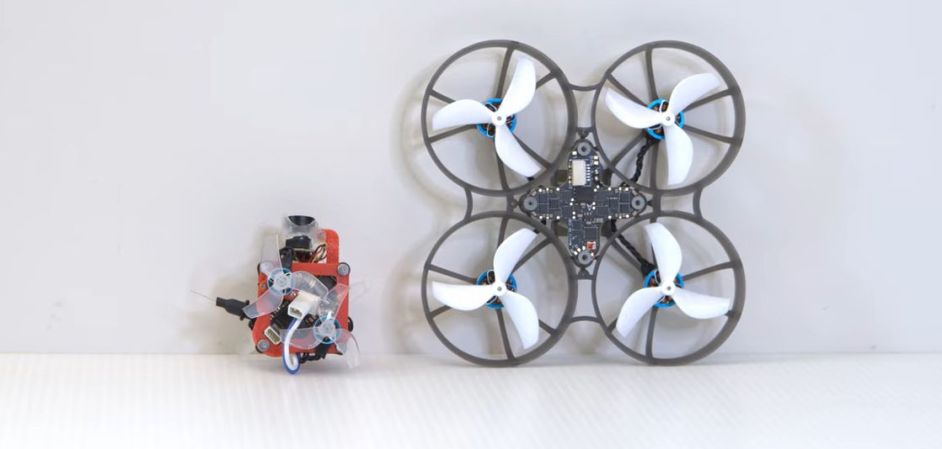
First person view (FPV) quadcopter drones have become increasingly more capable over the years, as well as much smaller. The popular 65 mm format, as measured from hub to hub, is often considered to be about the smallest you can make an FPV drone without making serious compromises. Which is exactly why [Hoarder Sam] decided to make a smaller version that can fit inside a Pringles can, based on the electronics used in the popular Air65 quadcopter from BetaFPV.
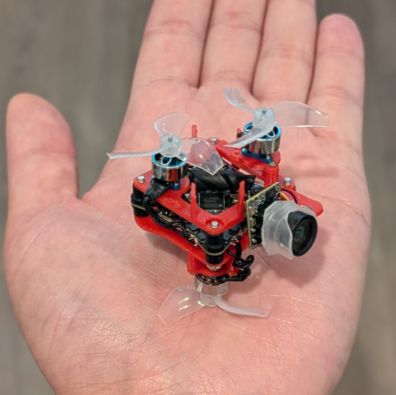
The 22 mm FPV drone with camera installed and looking all cute. (Credit: Hoarder Sam)
The basic concept for this design is actually based on an older compact FPV drone design called the ‘bone drone’, so called for having two overlapping propellers on each end of the frame, thus creating a bone-like shape. The total hub-to-hub size of the converted Air65 drone ends up at a cool 22 mm, merely requiring a lot of fiddly assembly before the first test flights can commence. Which raises the question of just how cursed this design is when you actually try to fly with it.
Obviously the standard BetaFPV firmware wasn’t going to fly, so the next step was to modify many parameters using the Betaflight Configurator software, which unsurprisingly took a few tries. After this, the fully loaded drone with camera and battery pack, coming in at a whopping 25 grams, turns out to actually be very capable. Surprisingly, it flies not unlike an Air65 and has a similar flight time, losing only about 30 seconds of the typical three minutes.
With propellers sticking out at the top and bottom – with no propeller guards – it’s obviously a bit of a pain to launch and land. But considering what the donor Air65 went through to get to this stage, it’s honestly quite impressive that this extreme modification mostly seems to have altered its dimensions.