Childhood Tech Exposure Is Slowly Killing The Keyboard

I see the disturbing trend of moving away from keyboards as input devices — and I’m talking about a real, physical keyboard. This isn’t a matter of one decision that kills the keyboard, but an aggregate that is slowly changing the landscape. If you blink, you’ll miss it. We will not find ourselves in a world without keyboards, but in one where most of the available keyboards suck.

Rise of the Virtual Keyboard Generation
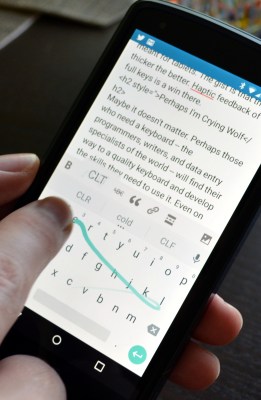
Is swipe-style keying the future of coding?

Tablets are great for screwing around, but when you want to get real work done in a reasonable amount of time, you grab a physical keyboard. In this scenario I don’t see the problem being those in the workforce going away from keyboards; it’s how the younger generations are learning to interact with technology that is troubling. The touchscreen is baby’s first computer. Families gather and the kids are handed their parent’s tablets while the grown-ups watch the game. More and more schools are outfitting classrooms with tablets, and for this I’m an advocate. Getting kids involved early in technology is imperative; knowledge evolves much more rapidly than printed textbooks. The tablet is a powerful tool in both of these areas. But most of the screen time kids get is with touchscreens and no physical keyboard.

How much time are K-12 kids spending in front of a physical keyboard? In the United States, if keyboard (typing) classes exist at all in a public school’s curriculum they’re usually only one-semester. Students who spend half of Elementary school using a tablet, and just one semester at a keyboard, are bound to prefer touchscreen-based entry over a physical keyboard.

Keyboard Erosion

We’ve already seen a strong push into touch-screens on laptops as the tablet market has grown. This is not necessarily a bad thing. Think of the computer mouse, it didn’t replace the keyboard, but augmented it and now is seen as a tool that itself is a necessity.

Continue reading “Childhood Tech Exposure Is Slowly Killing The Keyboard”

Meetup In Boston This Thursday

Hackaday is headed to Boston this week. Meet up with us on Thursday at 6pm to show off your projects and meet other hackers in the area. Admission is free, just tell us you’re coming.

We’re hosting a Hackaday meetup at Artisan’s Asylum hackerspace. That name should sound familiar. This is the group that decided to throw down the robot gauntlet with Japan. We can’t wait to see what that’s all about first hand!

While in town we’ll also be stopping by the MIT Media Lab, a legendary den of cutting edge research that springs forth wave after wave of awesome inspiration. If you know of any projects going on there that we just shouldn’t miss please let us know below. We’re also looking for suggestions of other places we should check out while in town.

See you Thursday!

Hacker Airlines: United Awards 1M Air Miles For Vulnerability

We’re really happy to see companies getting serious about rewarding white hat hackers. The latest example of this is when [Jordan Wiens] submitted two bugs and was awarded 1,000,000 Sky Miles on United Airlines.

The bounty is so high because he uncovered a method of remote code execution which United has since patched. Unfortunately, United requires bug secrecy so we’re not getting any of the gritty details like we have for some of the recently discovered Facebook vulnerabilities. That’s really too bad because sharing the knowledge about what went wrong helps programmers learn to avoid it in the future. But we still give United a big nod for making this kind of work and responsible reporting worthwhile. [Jordan] did an AMA last night which covered some more general hacking questions.

If you want to turn your leet skills into free travel you need to be a MileagePlus member and not reside in a US sanctioned country. Details on United’s Bug Bounty page.

Nixie Tube Speedometer In Motorcycle Handlebars

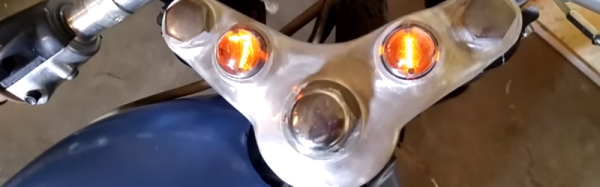
The handlebars of this Honda CL175 ended up being perfect for holding two Nixie tubes which serve as the speedometer. There are two circular cavities on the front fork tree which are the same size as the Nixies. Wrapping the tubes in a bit of rubber before the installation has them looking like they are factory installed!

This isn’t a retrofit, he’s added the entire system himself. It starts with a hall effect sensor and magnets on the rear wheel and swing arm. Right now the result is 4 MPH resolution but he plans to add more magnets to improve upon that. For now, the driver and speedometer circuitry are hosted on protoboard but we found a reddit thread where [Johnathan] talks about creating a more compact PCB. If your own bike lacks the fork tree openings for this (or you need help with the drivers) check out this other Nixie build for a slick-looking enclosure idea.

The link at the top is a garage demo, but last night he also uploaded a rolling test to show the speedometer in action. Check out both videos after the break.

Continue reading “Nixie Tube Speedometer In Motorcycle Handlebars”

Show Us Your Human Interface; Win Laser Cutting Time

Our newest Hot List is Human Interfaces. This is anything you’ve designed into your project to interact with people. And we want to see it all! Do you have something bristling with buttons, boasting many LCD screens, hosting controls organized with the principles of Feng Shui, or intuitively voice activated? Show us the user interface you’re proud of and you could win one of thirty $100 gift cards for Ponoko laser cutting service.

We’re in the thick of judging the Wheels, Wings, and Propellers hot list from this week. We’ll be announcing the rankings in the coming days, but for now you need to get your project onto the Your Human Interface hot list. Here’s what you need to do before Thursday, 7/16/15:

Good luck, and per usually we’d like to encourage you to Vote this week. It’s a great way to explore the entries in this year’s 2015 Hackaday Prize, and you just might win $1000 from the Hackaday Store just for voting!

The 2015 Hackaday Prize is sponsored by:

50 Winners Using Atmel Parts

For the last few weeks we’ve been celebrating builds that use parts from our manufacturer sponsors of the 2015 Hackaday Prize. Today we are happy to announce 50 winners who used Atmel parts in their builds. Making the cut is one thing, but rising to the top is another. These builds show off some amazing work from those who entered them. In addition to the prizes which we’ll be sending out, we’d like these projects to receive the recognition they deserve. Please take the time to click through to the projects, explore what has been accomplished, and leave congratulations a comment on the project page.

Still Time to Win!

We’re far from the end of the line. We’ll be giving roughly $17,000 more in prizes before the entry round closes in the middle of August. Enter your build now for a chance in these weekly contests!

Continue reading “50 Winners Using Atmel Parts”

50 Winners Using Freescale Parts

For the last few weeks we’ve been celebrating builds that use parts from our manufacturer sponsors of the 2015 Hackaday Prize. Today we are happy to announce 50 winners who used Freescale parts in their builds. Making the cut is one thing, but rising to the top is another. These builds show off some amazing work from those who entered them. In addition to the prizes which we’ll be sending out, we’d like these projects to receive the recognition they deserve. Please take the time to click through to the projects, explore what has been accomplished, and leave congratulations a comment on the project page.

Still Time to Win!

We’re far from the end of the line. We’ll be giving roughly $17,000 more in prizes before the entry round closes in the middle of August. Enter your build now for a chance in these weekly contests! This week we’re looking for things that move in our Wings, Wheels, and Propellers Contest.

One voter will win $1000 from the Hackaday Store this week as well! Anyone is welcome to vote in Astronaut or Not.  The drawing is this afternoon, Vote Now!

Continue reading “50 Winners Using Freescale Parts”