Quick, you need 1000 pieces of wire of the same length, what do you do? The disappointing answer is to put on the miniseries masterpiece Frank Herbert’s Dune and get to work snipping those bits by hand. We usually clamp a scrap piece of molding protruding perpendicular to the bench to use as a length guide in these cases.
The more exciting answer is to build a robot to do it for you. There’s no way you can build the robot faster than you could cut the wire… unless you have admirable rapid prototyping skills like [Eberhard]. He strapped together a barebones machine from two motors, and one switch in no time. Pretty amazing!
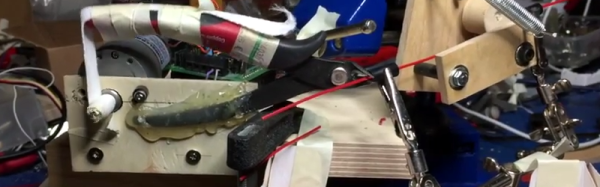
Wire coming off the spool feeds through two guides held by a third-hand. The outfeed length depends entirely on timing; two slices of wine cork drive the wire which passes through the open jaws of a wire snip. Those snips are hot-glued in place, with a motor winding up a strip connected to the other handle in order to make the cut. The only feedback is a limit switch when the snip is fully open.
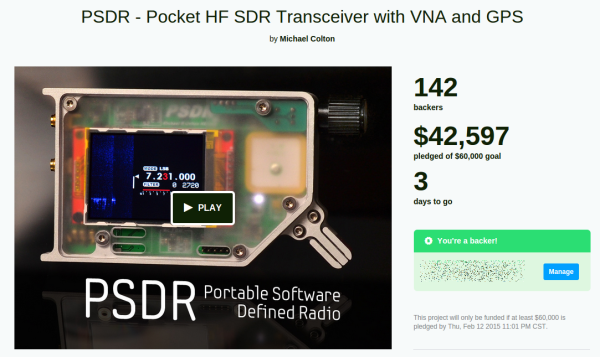
If you haven’t backed PortableSDR on Kickstarter, now’s the time to do it. [Michael Colton’s] project which frees a Software Defined Radio from being shackled to a computer is in the final three days and needs about $17,500 to make it.
We’d really like to see this one succeed, and not just because PortableSDR took 3rd place in the 2014 Hackaday Prize. Many a time we’ve heard people forecast the death of amateur radio (ham if you will). The ham community is special, it’s a great way to get mentorship in electronics, and deals in more than just digital circuitry. Plus, as [Greg] has pointed out, having a license and some know-how lets you build and operate really powerful stuff!
We see the PortableSDR as one way to renew interest in the hobby. We especially like it that you don’t need a license to operate the basic model — the transmitting circuits aren’t enabled when it arrives. This means you can learn about SDR, explore what’s going on over the airwaves, and only then take the leap by applying for your license and hack the unit to transmit. To be fair, the transmitter portion of the project hasn’t been published yet, which is about the only real concern we read in the Kickstarter comments. But we have faith that [Michael] will come through with that part of it. And if he needs help we’re sure he’ll have no problem finding it.
Now’s the time… let’s pull this one out in the final days!
On Thursday night Hackaday hosted an event in San Francisco to commemorate the launch of the 2014 Hackaday Omnibus. Our first print edition, compiled to commemorate some of the finest original content which we published last year should begin shipping as early as today. To celebrate the occasion, we were graced by a full house of amazing guests. Is it lame to say some of the people I respect most in the world were there?
Lightning Talks
[David Grossman]
[Chris McCoy]
[Emile Petrone]
[Elecia White]
[Jonathan Foote]
[Priya Kuber]
[Sophi Kravitz]
[Mike Szczys]
Whenever you get a lot of people together, a good rule of thumb is to seize the opportunity to have them speak about what they’re doing. It’s not a big “ask” either; 8-minutes on what you’re passionate about is pretty simple.
[Jonathan Foote] gave a talk on generating RGBY colors from Hue. The project is ongoing but explores the concept of mixing colors of light with one additional source added to traditional red, green, and blue. [Priya Kuber] recently moved to San Francisco. She recently concluded more than a year of standing up the Arduino office in India (relevant but unrelated video). Her talk covered the emerging maker/hacker hardware scene in India which is showing amazing growth. [Chris McCoy] demonstrated his Raver Rings which began a Kickstarter on the same day. [Elecia White] of embedded.fm spoke about the educational opportunities that podcasts and other delivery medium provide and the responsibility we all have to guide our continued learning. [Emile Petrone] talked about an upcoming feature for his site Tindie which will add manufacturer information and ratings to the mix. And rounding things out [Dave Grossman] gave a talk on his Virtual Carl project which used video footage of his grandfather, combined with a Raspberry Pi and peripherals to create a remembrance of the man in virtual form.
Demos
[Ben Krasnow] shows off the chamber containing supercritical carbon dioxide.During the rest of the evening there were a few spectacular demos going on. First, [Ben Krasnow] who is well known for his Applied Science series (among a million other accolades), brought at least two demos with him. The first was a pressure chamber made out of two massively thick discs of acrylic separated by a metal ring. Inside the void he had pumped and pressurized CO2. When the chamber is heated it, the contents become Supercritical Carbon Dioxide and the visual transition between liquid and gas disappears.
He also showed off a lens that can be focused electronically. This is not mechanical, there are zero moving parts. Instead a droplet of oil floating in water is the lens. A 75V, AC power supply pulls on the droplet, altering the meniscus to focus the lens. He didn’t fabricate the device from scratch, but the concept is completely new to us and quite interesting.
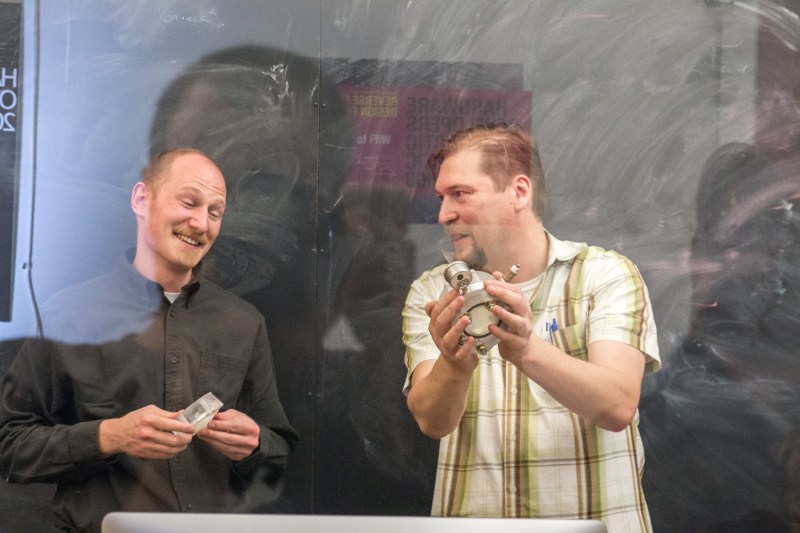
[Brian Benchoff] poses with Othermill hardwareOthermill is located in the SF area. They produce a desktop milling machine which is spectacular at routing PCBs. The little wonder isn’t limited to that though. Above you can see [Brian] holding up a milled wooden plaque which has milled mother-of-pearl inlays. The table is also strewn with other examples in wax, metal, wood, and more.
Cocktail Hour
The rest of the evening was devoted to conversation on all topics. Get enough hardware geeks in one room and they’ll solve the world’s problems, right? That’s a conversation for another post.
Couldn’t make it to this one but still in the San Francisco area at least occasionally? We held this at the Supplyframe office. They host a ton of great events like the Hardware Developers Didactic Galactic.
Maybe you are an elite hax0r. But probably not. Maybe you feel like you should know more about how systems are compromised, and we’re all about that. You can’t keep the black hats out if you have no idea how they go about breaking in in the first place. That’s why war-gaming sites sprouted up in the first place. We find this one in particular to be delightfully engaging. OverTheWire’s Wargames teach you a little about security while the uninitiated also learn about simple concepts like SSH and, well… Linux!
On-the-job training is the best way to learn, and this is pretty close to it. Instead of providing an artificial avenue of learning the creators of OverTheWire have used the real thing to illustrate poor online security. You don’t “play the game” on an artificial web interface, you do it on legitimate platforms. The very first level (appropriately named Level 0) starts by figuring out how to connect to a system using Secure Shell (aka SSH). From there you’re prompted to use Linux command line tools to figure out where to go next.
Even veteran Linux/Security users should find this offering entertaining. The early stages are both quick and simple to navigate as an experienced admin while providing a welcoming learning platform for those who aren’t quite there yet. Work your way through a few different “servers” and before long your own knowledge will be tested. This isn’t a new platform, mentions of the site in Hackaday comments go back to 2010. But if you haven’t given it a try, Wargames is well worth adding to your weekend entertainment list.
Bryan is a computer neophyte (he needs help turning his computer on), but he has a basketball story. His team was playing in a crucial basketball playoff game at the club. They were down by two late in the game and he just couldn’t get one of his players to play defense. This player was a great shooter and that is about it — burying a three that put the team up for the first time. After sinking it he just stood there admiring his masterpiece while Bryan screamed at him to get back on defense (he rarely played D and he didn’t that game either). Instead, he flat lined and went down on his face– heart attack!
Of course that player was me and that was an awful day. But I’m still around to tell the story… as a hardware designer years before I didn’t know that I’d bet everything on one particular project.
If you own a quadcopter chances are you own more than one. It’s kind of an addictive thing in that way. So dig out that dinged up model and build something awesome around it. We’d suggest making it look exactly like a Millenium Falcon. Okay, to be fair this is built around a custom quadcopter originally designed to carry a camera and GPS but removed for this project. We’re not sure if stock models have enough extra umph to lift a fancy fuselage like this (maybe you’ll weigh in on that in the comments?).
As with any great build this started with a scale drawing. The drawing was printed for use as a cutting template for the expanded polystyrene. Part of what makes it look so fantastic is that the fuselage isn’t 2-dimensional. There is depth in the places that matter and that’s all because of near-mythical foam cutting/shaping skills on [Olivier’s] part.
Final touches are LEDs on front and to simulate the curved engine on the tail. You can almost see this thing picking up a handless [Luke] below Bespin’s floating city. This Falcon flies like… a quadcopter (what did you expect? The Kessel Run in 12 parsecs?), which you can see in the videos after the break. The second clip shows how easy it is to remove the foam body from the quad frame, yet another nice touch!
This Thursday a bunch of us are going to be in San Francisco. Come join in for some after-work drinks!
Part of the crew that builds the Hackaday.io platform is located in San Francisco and we’re in town working with them. This happens to be just about the time that the 2014 Hackaday Omnibus will start shipping. Come celebrate with us! We’ve been inviting people on social media and are ecstatic about the guest list. We don’t want to call everyone out since this is a casual thing. But for instance, [Brian] somehow got connected with [Dave Grossman] who co-wrote The Secret of Monkey Island and he’s giving one of the lightning talks. You don’t want to miss this!
Leave a comment below using a valid email and we’ll send you an invite with the details.


![[David Grossman]](https://i0.wp.com/hackaday.com/wp-content/uploads/2015/02/mvi_4675-1.jpg?w=276&h=156&ssl=1 "MVI_4675-1")
![[Chris McCoy]](https://i0.wp.com/hackaday.com/wp-content/uploads/2015/02/img_4709.jpg?w=276&h=184&ssl=1 "IMG_4709")
![[Emile Petrone]](https://i0.wp.com/hackaday.com/wp-content/uploads/2015/02/img_4694.jpg?w=516&h=344&ssl=1 "IMG_4694")
![[Elecia White]](https://i0.wp.com/hackaday.com/wp-content/uploads/2015/02/img_4686.jpg?w=530&h=353&ssl=1 "IMG_4686")
![[Jonathan Foote]](https://i0.wp.com/hackaday.com/wp-content/uploads/2015/02/img_4665.jpg?w=262&h=175&ssl=1 "IMG_4665")
![[Priya Kuber]](https://i0.wp.com/hackaday.com/wp-content/uploads/2015/02/img_4652.jpg?w=262&h=174&ssl=1 "IMG_4652")
![[Sophi Kravitz]](https://i0.wp.com/hackaday.com/wp-content/uploads/2015/02/img_4634.jpg?w=396&h=264&ssl=1 "IMG_4634")
![[Mike Szczys]](https://i0.wp.com/hackaday.com/wp-content/uploads/2015/02/img_4600.jpg?w=396&h=264&ssl=1 "IMG_4600")
![[Brian Benchoff] poses with Othermill hardware](https://hackaday.com/wp-content/uploads/2015/02/img_4672.jpg?w=800)