Fail Of The Week: Secret Agent-Style Book Hideaway

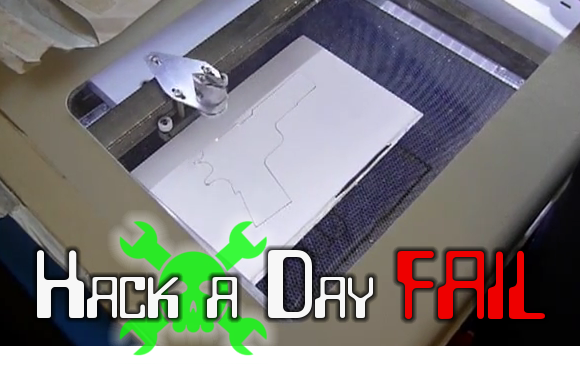
Ah, the movies are an inspiration for so many projects. How many times have you seen a spy movie where a cutout in the pages of a book are hiding something? This was the inspiration which led [Paul] and his crew to try using a laser cutter to remove a handgun-shaped cutout from the pages. The fail began before the project even got started. The sacrificial book they had chosen was too thick to cut directly so they tore it in thirds for the cutting process.

The hijinks are portrayed well in the clip after the break. The infectious giggling as this first trace of the laser cuts the outline makes the video worth watching. As they try to go deeper, the success falls off rapidly. This makes for a great Fail of the Week discussion: Why can’t you cut through multiple layers of a book with a laser cutter? Is this merely a focal length issue that would be solved with a higher-end cutter or is there something else at play here. Let us know what you think by leaving a comment below.


Continue reading “Fail Of The Week: Secret Agent-Style Book Hideaway”

Retrotechtacular: The Magic Of Making Cars In The ’30s

retrotechtacular-manufacturing-chevrolet

We usually shy away from calling things ‘magic’ in our features because, you know… science. But in the case of this Chevrolet manufacturing reel from 1936 the presentation is nothing short of an industrialized version of The Sorcerer’s Apprentice. Well, not in the sense of mischief, but in that there is almost no explanation and the way the footage is laced together you get the strong feeling that, at the time, this type of industrialization was magic; a modern marvel. The techniques and skills of each worked passed down from a master to an apprentice but virtually unknown to the general public.

The clip, which is also embedded below, starts off in the machine shop where mold makers are getting ready to go into assembly line production. From there it’s off to the foundry for part casting and then into the stamping plant where white-hot (perhaps red-hot, but black and white film) metal is shaped by man-mangling presses. The image above follows the cast, stamped, and machined parts onto the assembly line. We like seeing a room full of pistons being QA checked by hand using a width gauge and micrometer.  The film continues through to the finished vehicle and we think you’ll agree there’s more than enough voyeuristic video here to overcome that lack of narration.

Continue reading “Retrotechtacular: The Magic Of Making Cars In The ’30s”

First Stab At Motion Sensor To Disconnect A Car Charger

motion-sensing-car-charger


[Pixel] just sent in this automotive hack which disconnects his car charger when the vehicle stops moving for at least 10 minutes. Why would you need such a thing? The 12V outlet in his vehicle isn’t disconnected when the ignition is turned off. If he leaves a charger plugged in when parking the car, he often returns to a drained battery.

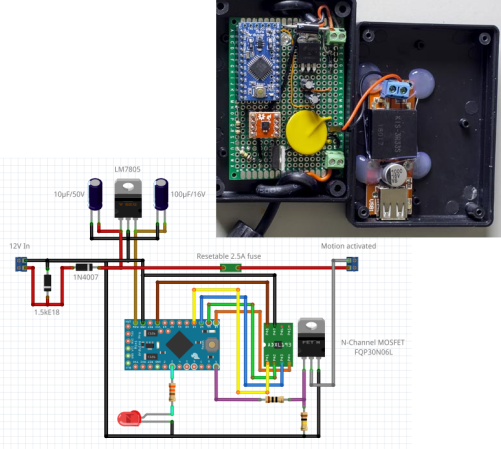
The fritzing diagram tells the story of this hack. He’s using a 7805 to power the Arduino mini. This monitors an ADXL362 accelerometer, starting the countdown when motion is no longer sensed by that chip. At the 10-minute mark the N-channel MOSFET kills the ground side of the outlet. Good for [Pixel] for including a resetable fuse on the hot side. But it was the diode all the way to the left that caught our eye. Turns out this is part of a filtering circuit recommended in a forum post. It’s a Zener that serves as a Transient-Voltage-Suppression diode.

Another comment on that thread brings up the issue we also noticed. The 7805 linear regulator is constantly powered. Do you think putting the uC into sleep and leaving the linear regulator connected is an adequate solution? If not, what would you do differently?

Bookworm Playing Bot Tests Programmer’s OCR Skills

bookworm-bot

Check out this brainy bot with [Jari] whipped up to dominate the Bookworm Deluxe scoreboard. The bot runs on top of a win32 machine, pulling screenshots to see the game board and simulating mouse clicks to play. The video after the jump shows that it plays like a champ, but it took some doing to get this far and [Jari] took the time to share all of the development details.

The hardest part of writing these types of bots is recognizing the game pieces. Check out all of the animation that’s going on in the still shot above… a lot of the tiles are obscured, there are different colors, and the tiles themselves shift as the bot spells and submits each word.

After some trial and error [Jari] settled on an image pre-processor which multiplies pixel values by themselves four times, then looks at each pixel with a 1/6 threshold to produce a black and white face for each tile. From there a bit of Optical Character Recognition compares each tile to a set of known examples. This works remarkably well, leading into the logic and dictionary part of the programming challenge.

Do you think this was easier or harder than the Bejeweled Blitz bot. That one was looking for specific pixel regions, this one is basically a focused roll-your-own OCR script.


Continue reading “Bookworm Playing Bot Tests Programmer’s OCR Skills”

Embeded Sieve Of Eratosthenes: Hunting Primes On ARM

Embeded Sieve of Eratosthenes

I ended up with just enough time over the weekend to pull together a quick project. I implemented the Sieve-of-Eratosthenes on an ARM chip.

If you haven’t heard of the Sieve of Eratosthenes then you really need to work your way through Project Euler. That’s where I first learned about this method of finding prime numbers. You begin with a list of all numbers, find a prime, then remove all multiples of that prime from the list. The real trick with doing it on a microcontroller is to figure out how to store a large list of numbers in a limited space. The gist of my method was to use a boolean array (I call it a bit-packed array but that may be the wrong way of saying it). The details are found in my project linked at the top.

‘Why?’ is almost always the wrong question to ask around here. But in this case, I did this because I wanted to try out the Bit Banding functionality of the ARM core. These chips have alias addresses that map to a single bit in the SRAM and also some of the peripheral registers. This allows read or write access for a single bit using a single instruction. Turns out that one side effect of 32-bit architecture is having addresses to burn.

Hackaday Links: March 23, 2014

hackaday-links-chain

[Jack] sent us a link to a Metropolitan Museum of Art video showing off a mechanized desk that plays music and has a ton of hidden compartments. Furniture makers of yore built hidden compartments in furniture all the time. After all, there weren’t credit cards back in the day and you had to keep important documents, cash, and everything else on hand. What strikes us is that this mates woodworking of the highest caliber with precision mechanics.

Before you get rid of that old box spring, ask yourself if you need to store dimensional goods. If you rip off the outer fabric, the network of wire inside makes a reasonable lumber rack.

And since we’re talking trash, we enjoyed seeing this water bottle wire spool minder which [Daniel] sent our way.

You know those portable DVD players you can hang from a headrest to entertain the kids on long trips? Well [John’s] broke, and like chasing the dragon, once you’re hooked on watching videos during car trips there’s no going back. Luckily he was able to throw a Raspberry Pi at the problem. He now has a portable OpenElec XBMC device controlled via a smartphone.

[Jaromir] posted some breakout board footprints that you can use. It’s not the footprints that impress us, but the idea of using them to fill up board space when spinning a new PCB. [Thanks Sarah]

LEGO Gachapon. Need we say more? Okay, truth be told we had to look it up too; Wikipedia says it’s spelled Gashapon. These are coin-operated machines that dispense toys inside of plastic capsules. This one’s made of LEGO and it’s awesome.

[Mikhail] actually built his own ballast resistors for some HeNe laser tubes. This is a bit easier than it might sound at first, as they are much lower power than the tubes used in cutters. But none-the-less an interesting, and successful, experiment.

Fluke Issues Statement Regarding Sparkfun’s Impounded Multimeters

fluke-reponds-to-sparkfun-dmm-impounding

Fluke just issued a response to the impounding of multimeters headed for market in the United States. Yesterday SparkFun posted their story about US Customs officials seizing a shipment of 2000 multimeters because of trademark issues. The gist of the response is that this situation sucks and they want to do what they can to lessen the pain for those involved. Fluke is providing SparkFun with a shipment of genuine Fluke DMMs which they can sell to recoup their losses, or to donate. Of course SparkFun is planning to donate the meters to the maker community.

Anyone with a clue will have already noticed the problem with this solution. The impounded shipment of 2k meters will still be destroyed… eh. The waste is visceral. But good for Fluke for trying to do something positive.

Before we sign off let’s touch on the trademark issue for just a moment. We can’t really blame Fluke too much for this. The legal crux of the matter is you either defend your trademark in every case, or you don’t defend it at all. In this case it was the border agents defending the filing, but for ease of understanding we’ll not go into that. On the other hand, speaking in general business terms, the way things are set up it is advantageous to acquire a trademark specification that is as broad as possible because it helps to discourage competitors from coming to market. So trademark is good when it keep hucksters from trying to rip off consumers. But it is bad if applied too broadly as a way of defending a company’s market share.

Where does Fluke come down in all of this? Who knows. There is literally no right answer and that’s why the discussion around yesterday’s post was full of emphatic arguments. A Fluke meter is a cream-of-the-crop device and they have the right (and obligation) to ensure that reputation is not sullied. SparkFun serves a market that probably can’t afford a Fluke at this time but may some day in the future. And this is the reason we can feel okay about this outcome.

[via Twitter]