Fubarino Contest: Single PCB Synth

fubarino-contest-synth

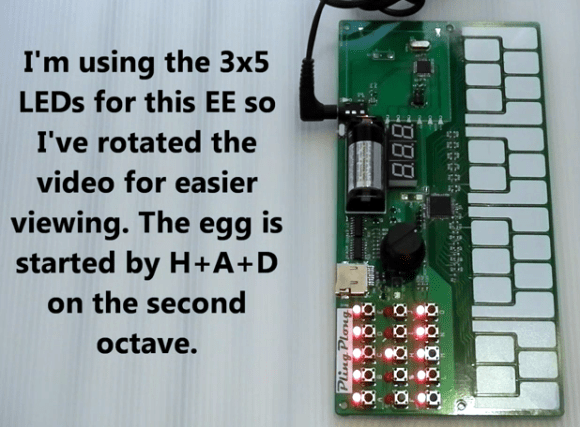
Here’s a musical entry for the Fubarino Contest that turned out to be rather delightful. First, [Mats] shows off his musical knowledge by using the notes H, A, and D to play the chord that unlocks the Easter eggs. What’s that you say? There’s no H on your keyboard? You’re wrong. In the German music tradition B natural is known as H. This is what allowed Bach to write a tune that spells his name.

[Mats] is hacking on his PlingPlong synthesizer. The first Easter egg—which you can see in the clip after the break—launches with the H-A-D chord in the lower octave, spelling out our URL on the 7-segment displays. But we prefer the second egg, launched with the chord in the upper octave, which is shown above. It uses the 3×5 LED grid to scroll out the address; in this still image an H is displayed.


This is an entry in the Fubarino Contest for a chance at one of the 20 Fubarino SD boards which Microchip has put up as prizes!
Fubarino Contest: Network Nodes, Door Lock, And Smoker Controller

fubarino-contest-nodes-lock-smoker

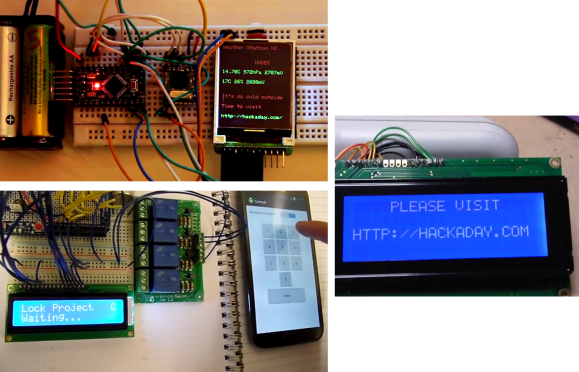
Here’s a round-up of three different Fubarino Contest entries; a video of each is available after the break.

On the upper left are the beginnings of a network node monitoring system developed by [Stephane]. When the network checks the weather, it may determine that it’s far too harsh outside and time to go in to see what’s new on Hackaday. There’s only sparse information available on the hardware. Each node uses an ATtiny84 and an RFM12B—different sensors connected to each are used to build up the network’s data collection capabilities.

In the lower left is [Brett’s] Bluetooth door lock controller. The Arduino, a cheap Bluetooth module, and a relay board make up the base station which will eventually connect to an electronic lock. [Brett] uses a smart phone to punch in the access code, and entering “1337” four times in a row unlocks the Easter egg, displaying our URL on the character LCD. Here’s the code repository for his project.

To the right is the display for [Andy’s] smoker controller used for cooking. He already had some hidden features on the controller used to calibrate the thermocouple. For the contest, he simply added an additional button to extend the original menu access method.


This is an entry in the Fubarino Contest for a chance at one of the 20 Fubarino SD boards which Microchip has put up as prizes!

Continue reading “Fubarino Contest: Network Nodes, Door Lock, And Smoker Controller”

Hackaday Links: December 22, 2013

hackaday-links-chain

[Korben] is using a picture frame as a Bluetooth speaker (translated). He hacked a Rock’R² for this project. It’s a device that has a vibrating element which can be used to make any hollow item into a speaker.

Entertain yourself over the holidays by mastering the Apollo Guidance Computer simulator. It’s a JavaScript version of the computer used in the modules of the Apollo moon missions.  [Thanks Gregory and Paul]

Here’s a little mirror attachment that lets you use your laptop as an overhead projector. [Ian] calls it the ClipDraw. Affix it to the webcam and use the keyboard as the drawing surface. Since it’s simply using the camera this works for both live presentations and video conferencing. What we can’t figure out is why the image doesn’t end up backward?

This guide will let you turn a Carambola board into an AirPlay speaker.

Those who suck at remembering the rules for a game of pool will enjoy this offering. It’s some add-on hardware that uses a color sensor to detect when a ball is pocketed. The Raspberry Pi based system automatically scores each game.

We spend waaaay too much time sitting at the computer. If we had a treadmill perhaps we’d try building [Kirk’s] treadmill desk attachment. It’s made out of PVC and uses some altered reduction fittings to make the height adjustable. It looks like you lose a little bit of space at the front of the belt, but if you’re just using it at a walking pace that shouldn’t matter too much.

You can have your own pair of smart tweezers for just a few clams. [Tyler] added copper tape to some anti-static tweezers. The copper pads have wires soldered to them which terminate on the other end with some alligator clips. Clip them to your multimeter and you’ve got your own e-tweezers.

Fubarino-Contest: 1980’s CD Player With MPD

fubarino-cd-shelf-player

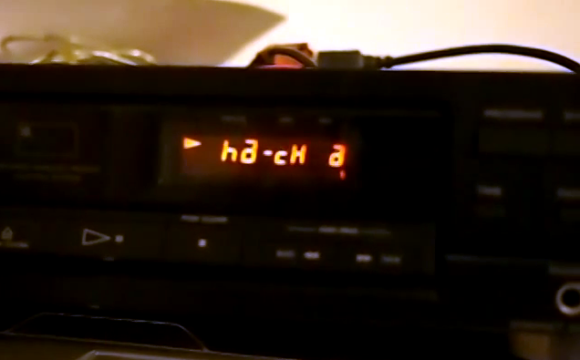
[Ronald] had to scramble to get his submission in, but we’re glad he did. His demo video shows the display of a 1980’s CD player working with Music Player Daemon. It’s really just the original display itself that works, but the project is not yet finished. However, is far enough along to show our URL when a track reaches the 22:00 mark.

The display is driven by an ATmega32 chip which uses a USB connection to receive commands from the computer running MPD. [Ronald] had troubles figuring out how to send int values over USB so he hacked his own protocol that just uses the LSB of each byte coming over the bus. After the break you can see the video, and read the description which he included with his submission. There is also a code package available here.


This is an entry in the Fubarino Contest for a chance at one of the 20 Fubarino SD boards which Microchip has put up as prizes!

Continue reading “Fubarino-Contest: 1980’s CD Player With MPD”

Fubarino Contest: Persistence Of Vision Clock

propellerck5

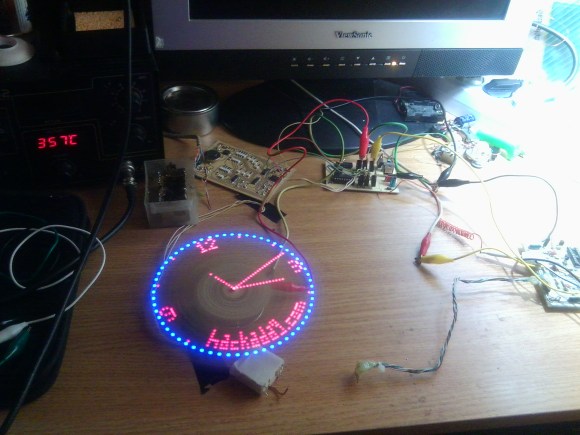
The best part of these contests is that we get people to actually show off what they’ve been working on! Check out the POV clock which was sent in by [Taciuc]. He doesn’t have a webpage for it, but he did send a video which you can see after the break.

The project is a home-etched PCB with a long row or surface mount LEDs. The board is spun by a stepper motor which takes a little while to stabilize. But once it does it’s a twirling package of awesomeness. A PIC 16F628 drives the device, with a separate RTC chip to keep time. There’s also an IR receiver to facilitate user control. Our URL is displayed on the clock face itself and we think it’s always shown. But there is an easter egg in the code itself. If you try to dump the firmware from the chip you’ll see our web address in the hex output. Here’s his project archive if you want to the HEX, ASM and DipTrace schematic.


This is an entry in the Fubarino Contest for a chance at one of the 20 Fubarino SD boards which Microchip has put up as prizes!
Continue reading “Fubarino Contest: Persistence Of Vision Clock”

Staff Update And Philanthropy

staff-update-and-philanthropy

It is my pleasure to welcome two new members of the Hackaday team. [Kevin Darrah] and [Kristina Panos] both have electronics backgrounds, and following in the tradition of the entire team they are long-time readers of Hackaday. Both are already hard at work. You can learn a bit more about them on the Staff Page.

While I have your attention the writers, editors and I would like to thank our parent company. We frequently refer to them as the “Evil Overlords” (actually, they started it!) but it’s turning out to be a really great relationship. I asked them to make a donation to Wikipedia in Hackaday’s name and they were happy to do so. Not only do we often link to Wikipedia in our articles, our writers use it constantly when researching for posts. Thanks SupplyFrame!

Fail Of The Week: Baby Monitor Hack Ends In Facepalm

fotw-baby-monitor-repaired-the-hard-way

Editor’s Note: This was the last Fail of the Week tip we had stored up. If you want to see the series continue on a weekly basis we need help finding more documented fails! Please look back through your projects and document the ones that didn’t go quite right. We also encourage you to send in links to other fails you’ve found. Just drop the links in our tips line. Thanks!

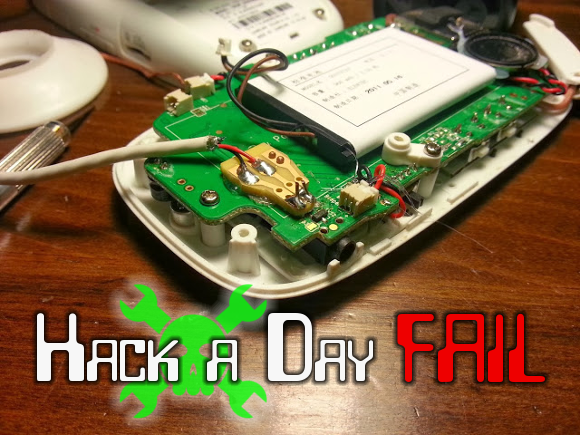
Now on with business. This is a baby monitor which [Eric] cleverly repaired, only to realize that he more than likely did it the hard way. The monitor was broken and went unused until his son figured out how to climb out of the crib, so he figured it was time to start monitoring again. Pulling the unit from the brink of the parts bin he set to work repairing the broken power connector.

Further inspection of the power adapter showed that it was spec’d to put out 5V at 1A. This falls in line with USB power, so he clipped the end off of a USB-B cable and used a hunk of proto-board to inject the 5V lines into the device. It was when it came time to reassemble the case that he flipped the board over and discovered an existing USB-B port. He could have just cut a hole in the case to get at the connector and plugged the un-altered cable in directly. Oh well… we’re sure it was fun figuring out his own custom solution!


2013-09-05-Hackaday-Fail-tips-tileFail of the Week is a Hackaday column which runs every Wednesday. Help keep the fun rolling by writing about your past failures and sending us a link to the story — or sending in links to fail write ups you find in your Internet travels.