Make The World Takes On Crowdsourcing Prosthetics

adafruit-make-the-world-prosthetics

Tonight marks the launch of a new program from Adafruit focused on improving the availability of prosthetic designs. The program will be highlighted in four Google+ Hangouts over the coming month. Mark your calendars for 8pm Eastern Time to join in on the one-hour launch.

We’ve seen a fair number of prosthetic hacks over the years, and every time one is featured we try to drive home the importance of sharing information in order to build upon the advances of others. The power of this is clear, shown in a $150 3D printed hand for a child, hackers that are replacing their own limbs or digits, and the sharing of diy fabrication techniques to help bring prostheses to the developing world. So get excited, get involved, and get hacking!

How This Power Racing Series Car Got On A Plane To WMF

pwrc-on-a-plane

You really should check out the monthly meetings at your local hackerspace. It’s an excellent opportunity to hear the most interesting stories. Like the tale of how the guys from Sector67 got this electric vehicle on the plane with them. Not only did it go up in the air, but they did zero planning ahead of time on how they would actually pull it off.

[Bob Baddeley] posted an album of the PRC experience at World Maker Faire. There are captions that somewhat tell the tale, but we’ll fill you in as best we can on the rest of the story behind this second car from the hackerspace — lovingly known as the Lamebourghini.

Continue reading “How This Power Racing Series Car Got On A Plane To WMF”

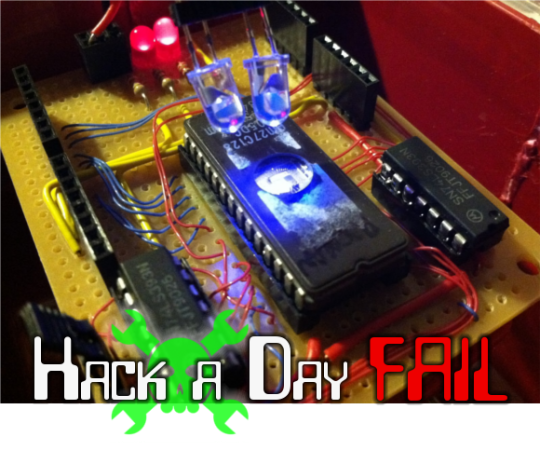
Fail Of The Week: EPROM Reading And Erasing

It may be a failure but it sure does look cool. [Scott Lawrence] had a fair number of EPROM chips on hand and decided to get rid of the traditional eraser and programmer in order to play around with the concepts using his own hardware. He was met with disappointment at several steps in the process. No worries though, each of these upsets sent him back to the drawing board and he learned way more than he ever would have if it had actually worked. It’s fair to say this failure was highly successful.

Continue reading “Fail Of The Week: EPROM Reading And Erasing”

Making A Bathymetric Book By Hand And Searching For An Easier Way

We first saw this Bathymetric Book at our local hackerspace, Sector67, quite some time ago. [Caroline Rose] gave a seven minute presentation on the project as part of the monthly meeting which is open to the public. You can get a pretty good feel for the book that includes a to-scale depth representation of Crater Lake in the introductory post which she recently published. Each page makes up one topographical ring of the lake. Put them all together and you’ve got a really amazing way to explore the watery depths of the deepest lake in the United States.

The book you see above is hand made. She downloaded the depth data from the US Geological Survey, then put it through some processing in order to print one elevation level on each page. That’s when the work really began. She cut out every page by hand! The four-plus hour task was grueling. And just for a bit of added punishment she even made a second book. But at Tuesday night’s follow-up presentation she said never again.

[Caroline] developed a much faster and still accurate technique for producing the bound-book depth maps. She is using a laser cutter and a different binding technique. By using folded packets of paper, rather than individual pages, she is able to cut out three double-sheets at once — including holes for the binding thread and the outline of the finished pages themselves. This cuts the process down to about four minutes of laser cutter time.

For now you’ll have to settle for a time-lapse video of the hand-cutting process (embedded below). But we hope to post an update when she makes more information about the laser-cut version available.

Continue reading “Making A Bathymetric Book By Hand And Searching For An Easier Way”

Retrotechtacular: Building BART

Sometimes it’s fun to take a step back from the normal electronics themes and feature a marvelous engineering project. This week’s Retrotechtacular looks at a pair of videos reporting on the progress of the Bay Area Rapid Transit system. Anyone who’s visited San Francisco will be familiar with the BART system of trains that serve the region. Let’s take a look at what went into building the system almost half a century ago.

Continue reading “Retrotechtacular: Building BART”

Hackaday Links: September 29, 2013

hackaday-links-chain

We would be remiss if we didn’t mention that all of SparkFun’s open source hardware is now on Upverter.

Not wanting to tie up an iPad as a mini-gaming cabinet [Hartmut] hacked an Arcadi cabinet to use EUzebox instead.

Time travel happens in the bedroom as well. But only if you have your very own Tardis entrance.  [AlmostUseful] pulled this off with just a bit of word trim and a very nice paint job. [via Reddit]

[Pierre] tricks an iPhone fingerprint scanner by making a replica out of hot glue.

Some of the guys from our parent company were over in Shanghai on business. [Aleksandar Bradic] made time to visit the Shanghai hackerspace while in town and wrote about the experience over on their engineering blog.

[Gregory Charvat] is a busy guy. In fact we’ve got a juicy hack of his saved up that we still need to wrap our minds around before featuring. In the mean time check out the Intern-built coffee can radar that he took over and tested on a  multi-million dollar Spherical Near Field Range.

And finally, everyone loves coffee hacks, right? Here’s what [Manos] calls a Greek style instant coffee machine.

Headphone Hack Makes Wireless An Option

headphone-wireless-option

If you have a favorite pair of over-the-ear headphones you may want to consider upgrading them with a wireless option. The key word here is “option” because these still retain their functionality as a wired headphone. This is nice if you only want to deal with battery life when you’re actually roaming around.

Of course the thing that makes this type of hack work is the extra room inside the body of the earpieces. [Tony] cracked them open and decided there was just enough room to fit the internals of a Bluetooth audio adapter. It has it’s own Li-ion battery (boasting 12 hours of use) which is why there is an added charging port. To fit the board he had to remove some of the aluminum body from the enclosed part of the headphones. He also wired up a tactile switch to act as the power button for the Bluetooth module.

Details are scarce on how the speakers are wired between the module and the jack. But we think he simply wired them in parallel rather than using a switched jack. You can see a quick demo after the break but it really doesn’t augment the build details at all.

Continue reading “Headphone Hack Makes Wireless An Option”