Cheap Guitar Amp Repaired By Replacing The Distortion Circuit

cheap-amp-distortion-repair

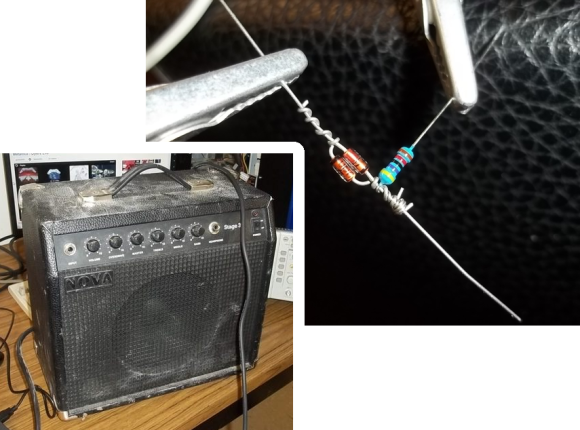
It’s an understatement that [Troy] is not impressed with the distortion circuitry built into this guitar amp. He picked it up for $40 on Kijiji (basically local classified ads run by eBay) so he wasn’t afraid to get elbow deep in its inner workings to see what was going on. It only took him a few minutes to solder together the distortion circuitry that fixed it. Figuring out what needed fixing is another story.

[Troy] uses some colorful language and metaphors to illustrate his disdain for the sound of the overdrive option. He hooked it up to an oscilloscope and his trained eye immediately tells him that it’s not working as it should. After studying the PCB and working out a schematic he reworked the circuit with this pair of diodes and a resistor. It still uses a bit of filtering on the board, but does away with all of the other cruft. What remains is a cheap amp, but one that actually functions.

 

Machining An Orrery

What in the heck is an Orrery? If you’re looking at the image above we’re sure you’ve already figured it out (kudos to the big brains that knew the word). For those that don’t get it, an Orrery is a mechanical device that represents the movements of planets and moons. We never thought of building one ourselves. After seeing the machining process for what’s shown above we’re not sure if we’re excited, or scared off by all the work that went into it.

You might want to bust out the Chromecast and hit the sofa for this one. There are dozens of YouTube videos showing the build. From cutting sheet stock into round slugs, to making teeth, teeth, teeth, and more teeth it’s not just the gears that go into this one. You’re also going to needs the orbs themselves.

We have fond (perhaps scary) memories of the first time we saw an Orrery as a part of the set in The Dark Crystal.

Continue reading “Machining An Orrery”

Antares: One Bare Metal Build System To Rule All Microcontrollers

antares-build-system

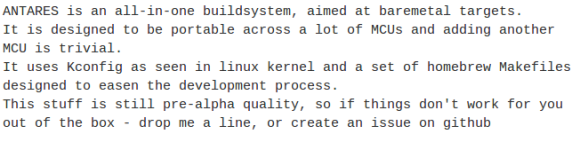
[Andrew Andrianov] has the same itch we do when it comes to the variety of inexpensive dev boards out there. They put hardware in your hands but when it comes to the IDE it tends to be a very mixed bag. Some offer hobbled copies of proprietary software, but in most cases you’re on your own for any kind of open source development environment support. He and a couple of friends are working to change that. What they’ve come up with is Antares: a single build system which can compile code for multiple microcontrollers.

The idea is to make the coding environment agnostic from the compile/burn process. This serves a few purposes; it lets you use the IDE you’re most comfortable with, be it Eclipse or emacs. It also seeks to ease the pain of writing libraries that will work with multiple different chips. So far the package supports several of the usual suspects: AVR, msp430, STM32 ARM chips, as well as AT89,and STC variants of 8051. Other chips can be added as more hands make light work (in other words, roll up your sleeves and help these guys out!). Right now development targets Linux dev platforms but OS X has been shown to work with some patches.

The link above is a rather daunting readme from the Github repo. If you need a better overview before diving in hit up the RC1 announcement on [Andrew’s] blog.

[Kenneth Finnegan’s] EPIC Burning Man Slideshow

kenneth-at-burning-man

Whether or not you manged to attend this year’s Burning Man festival we’re dead certain you’ll enjoy reading [Kenneth Finnegan’s] show and tell about the event. This was his first time attending. Aside from his noobish excitement (which is really the only way to approach writing something like this) we’d never know he wasn’t a seasoned veteran. From what he and friend [Marcel] packed along with them, to the attractions he visited, he did Burning Man right!

The two snapped a selfie in the truck on their way to Black Rock City, the community that sprouts up in the Nevada desert every year for Burning Man. Bumper-to-bumper traffic is a surprise in the middle of nowhere, but when you find out that BRC boasted about 68,000 residents this year it’s no wonder. [Kenneth] spends some time talking about the camp they set up, including more than enough solar power, and an amateur radio setup that came in handy in lieu of phone service. This flows into his collection of cool art he came across, most of it massive in scale. There’s even an airport, which is how he was able to snap the aerial photo above.

We think the coolest part of his recollection is the view of ‘city life’. There are night clubs, bowling alleys, radios stations broadcasting live interviews and hosting talk shows, cafés, and much more. Hanging out in the desert at the end of August may not sound like your thing, but reading about [Kenneth’s] odyssey makes us think Burning Man is like Disneyland for Hackers.

Fail Of The Week: GPS Module Design

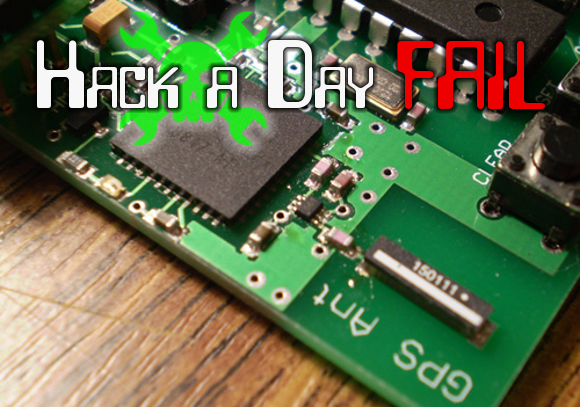
GPS is really fun to play with in your projects. But when [Trax] decided to build a GPS chip into his design the fun ended abruptly. Above you can see the section of the board devoted to the hardware. Unfortunately this PCB fails to provide any GPS location data whatsoever.

Continue reading “Fail Of The Week: GPS Module Design”

Git With Eagle: Add Meaning to Diff

a-glimpse-of-git-with-eagleWe love Git. We know everyone has their favorite version tracking tools. But even those that don’t care for Git should see the value of getting meaningful Diff data from tracking Eagle layout files.
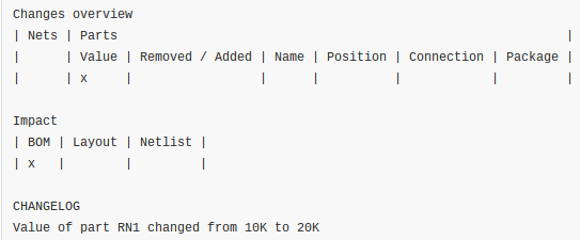
Was that last sentence just gibberish to you? Let’s take a step back. A few years ago it was impossible to use version control with Eagle at all because the schematic and PCB layout software used to save its files as binaries. But then Cadsoft transitioned to saving Eagle files as XML. This opened the door for things like scripting to rename parts en masse and to track the files under version control. One problem with the latter has been that performing a Diff on two different versions of a file results in XML changes that are probably not human readable. [Patrick Franken] wrote this script to add at least a glimmer of meaning.

We’d love to see some kind of side-by-side highlighting on the schematic or board renderings themselves. But that’s quite a ways off if we ever actually see it. For now his script will take the Diff and print out the tables seen above denoting which types of changes were made from one version to the next. It’s a start, and we hope it inspires even more work in this area.

Retrotechtacular: 6CH Industrial Robot

retrotechtacular-6ch-robot-arm

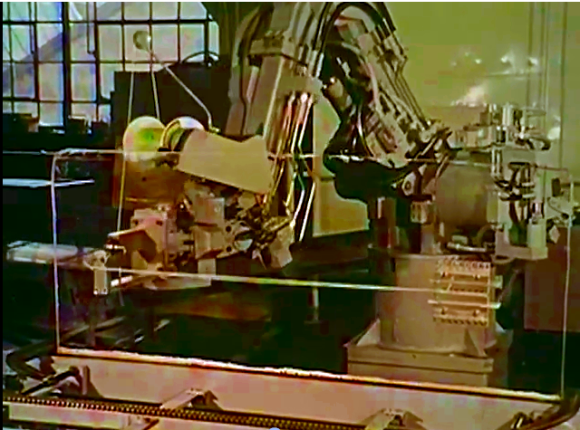
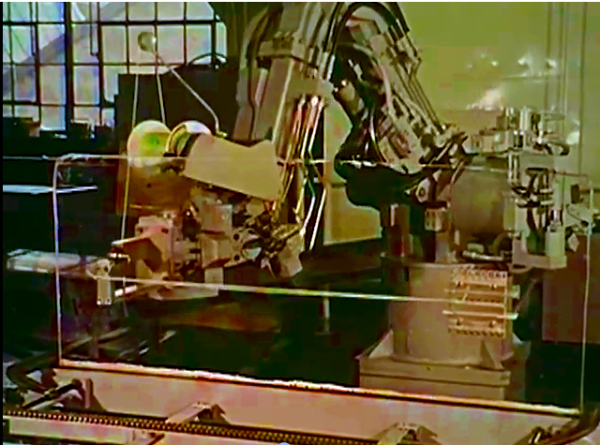
With this robotic arm demo video from 1975 the future really is now. Think about it, there are entire factories full of the descendants of this technology where the human workers simply feed the beast and fix it when it breaks.

We’re pretty impressed by what’s shown off below. Not because we see something we didn’t know was possible, but because the technology was so advanced nearly forty years ago. Here the arm is laying out a wiring harness on a jig. We wonder if using a single color of wire is going to make it a major pain when they add the connectors?

Obviously the mechanics were solid. Time has brought further advances in precision, reduced costs that make robots available for even small factories (often palletizing products is done by a machine similar to this), and improvements in how tasks are programmed. After all, the ability to print a hard copy of the program as a punch tape isn’t quite cutting edge for this decade.

What does that mean for you? If you look hard enough you might be able to find an older generation robot arm to hack on.

Continue reading “Retrotechtacular: 6CH Industrial Robot”