Hackers In Africa Are Building Their Own Aircraft

hacked-heli

While you’re trying to come up with an idea for your next project this guy’s been building his own helicopter from whatever parts he can find. He’s just one of the aeronautical hackers featured in a story in the Daily Mail. The article’s narrative leaves us with many questions, but there’s enough info to make it worth a look.

In addition to the heli seen above there are also a couple of airplane builds to gawk at. Africa has already produced a couple of very ingenious hacks like [William Kamkwamba’s] projects which improved his village infrastructure. He gained enough notice from his work to land a scholarship to continue his education and that opportunity has also been afforded the creators of these aircraft.

At first we figured this helicopter project was possible because of lack of air traffic regulation in this part of the world. That’s not the case as [Onesmus Mwangi] — who makes his living as a farmhand — has been forbidden to fly the craft by local police. There may be another opportunity for him to fly later in life. He’s received funding to study aircraft maintenance abroad.+

Unfortunately we couldn’t find any video of this thing in action. If that’s unacceptable to you try getting your fix from this human-sized octocopter.

[Thanks Brandon]

Astrosmash Style Video Game As Sony SmartWatch Firmware

sony-smartwatch-native-video-game

Here’s a firmware hack that brings a video game to the Sony SmartWatch. It’s pretty impressive considering the limited screen real estate and the fact that it has to be shared with the touch input. But we find it equally impressive that a game of this quality followed so quickly on the heels of Sony announcing the ability to make your own firmware for the watch. The speedy development is thanks partly to the community driven effort to hack the Arduino IDE to load sketches on the watch.

The advent of this IDE hack means that taking your Arduino sketch writing abilities to this hardware now has a fairly low learning curve. And reading through [Asier Arranz’s] game code will make it even easier. He calls his game Star Wars but it reminds us more of Astrosmash. There’s a little green semicircle which is your ground-based defense vehicle. You need to fire the laser to shoot falling items out of the star-strewn night sky while also collecting power-ups that fall to the ground. Game play video is below.

Just remember, if you come up with a cool firmware app for the SmartWatch we want to hear about it.

Continue reading “Astrosmash Style Video Game As Sony SmartWatch Firmware”

Atari 2600 Has A Raspberry Pi Hiding Under The Hood

raspberry-pi-2600

Seriously, the drawer pull on this Atari 2600 is not stock. Don’t they know this voids the warranty? The thing is, you won’t actually find any of the original internals anyway. When building this portable emulator housed in a 2600 case [Linear Nova] was careful to ensure that everything could be restored to its original condition (except for two hinges mounted on the back) sometime down the road. That’s a good goal to set for yourself. We think the build is the fun part of most projects and often wonder what to do with them when they’re done and our interest has waned.

A seven-inch LCD screen was attached to the underside of the lid using Velcro. When tilted up it’s at a nice viewing angle for the player. [Linear] prefers to use a Wii remote as the control this portable video game emulator. It connects to the Raspberry Pi over Bluetooth using a USB dongle. The advantage of this is that you just throw the remote inside the case too. For now there are two power cords, one for the RPi and the other for the LCD screen but he plans to add a power hub in the future to narrow this down to one. We wonder it that would also be a good time to add his own rechargeable battery pack option? There should be enough room for an RC style pack.


ShapeOko Build Log — It’s A CNC Mill In A Box

shapeoko-build-log

We’re not blatantly trying to promo this product. It’s just that the build log covering a ShapeOko assembly process taken on by [Anool] is like crack for those of us who have yet to acquire our own desktop CNC mills.

Like the title says, this thing is basically a mill in a box. But [Anool] decided to order the version of the kit that doesn’t come with any motors or control electronics. He also planned for future upgrades by ordering additional extruded rail to increase the size of the ShapeOko. After assembling the frame his decision to source stepper motors locally bit him as they were out of stock. But there was still plenty to do preparing control electronics during the wait. He based his system on a Raspberry Pi which talks to an Arduino to address the motors and monitor the sensors.

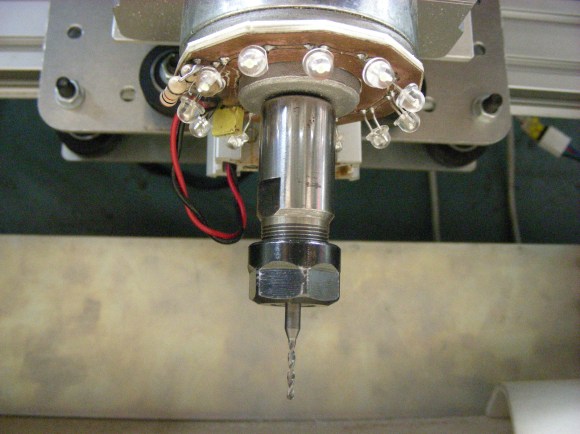
Once all the parts were finally accounted for he tested the rig as a pen plotter. The pen was eventually replaced with the router motor and that ring light PCB seen above was the first thing he milled with it.

[Thanks Justin]

Prototyping A Maglev Train Using LEGO

lego-maglev

Serious research using not-so-serious equipment? We don’t know about that. What’s wrong with using LEGO as a research platform for a Maglev? This team has been doing so for quite some time and with great results.

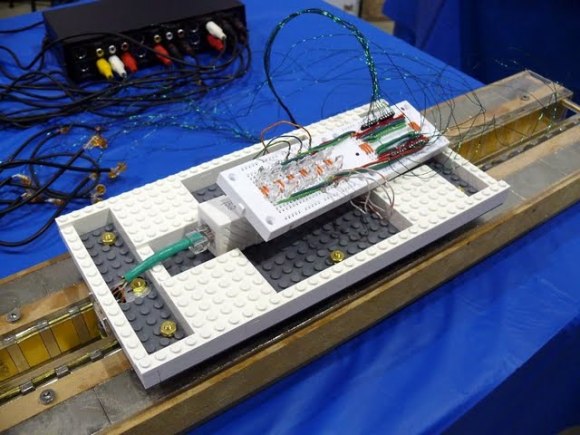
A Maglev is a vehicle based on the principles of magnetic levitation. Similar poles of magnets repel each other and this concept can be used to create a friction-less track system. But this raises the problems of braking and locomotion. The build log linked above covers the conception in what is the eighth iteration of the research project. But the video below offers the most concise explanation of their approach to these issues.

The researchers are using magnets positioned in trench of the track as a kind of magnetic gear to push against. A series of electromagnets on the Lego vehicle ride in that track. The can be energized, working as a linear motor to push against those permanent magnets. But how do you know which direction of travel this will cause? That problem was solved by adding a hall effect sensor between each electromagnet. Before switching on the coil the hall effect sensors are polled and a timing scheme is selected based on their value. This is used to push the train up to speed, as well as slow it down for braking.

Continue reading “Prototyping A Maglev Train Using LEGO”

Chest Freezer Kegerator Conversion Has Six Beers On Tap

keg-freezer-conversion

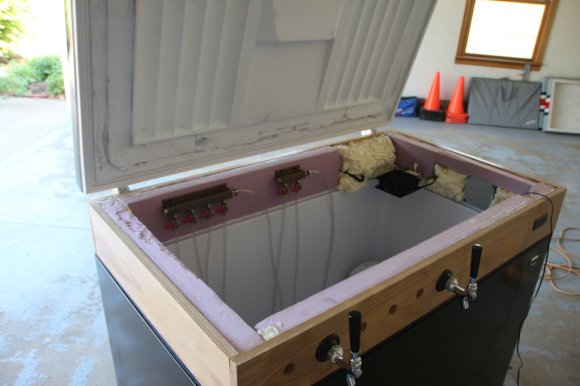
Drawing a pitcher of frosty cold beer out of your own keg fridge is a liberating feeling which [Danodemano2] can enjoy all the time since he pulled off this 6-tap chest freezer conversion. You won’t have to kill yourself to get it done, this image shows the custom cuff sitting between the chest freezer body and lid which is where all the added hardware is anchored.

Chest freezers are popular because they’re efficient. And let’s face it, if you’re going to devote an appliance to storing cold beer you better make certain it doesn’t drive up utility bills. That’s the reason for the rigid foam insulation around the ring, with the spray foam to ensure energy isn’t lost around the openings in the wooden frame.

This design goes above and beyond the functionality from the last offering we looked at. That one had a pretty nice tile job, but the finished wood contrasts the black freezer very nicely on this one. It’s the PC fan used for circulation and the properly terminated wiring that we really like. The one thing we wonder about is the feasibility of fitting all six corneilus kegs and the carbon dioxide tank into this beast.

[via Reddit]

Life Sized Katamari Damacy Ball Controls Game But Isn’t Sticky

life-sized-katamari-damacy

If you haven’t ever heard of Katamari Damacy we highly recommend you unite a copy of the game with that PlayStation 2 console that’s been collecting dust and then kiss the rest of your summer goodbye. The quirky game, driven by remarkably catchy background music (Na Naaaaah na na…), revolves around a ball that attracts objects of every kind to it. As you accumulate more stuff the ball goes from the size of a mouse to that of a house and then some. Perhaps the biggest appeal of the game is playing it with groups of people and that’s where this hack hits the mark. It brings the game outdoors to a festival in London with video projected on a wall and this life-sized ball as the controller.

The project uses the same electronics laid out by the original work coming out of NYC Resistor back in 2009. That project originally wanted to use a 36″ yoga ball but they couldn’t quite hit the mark. This attempt did make it happen. The ball was decorated in the style of the game (also note the presenters are in costume). Guts from an optical mouse detect the motion. This is processed by an Arduino board which then uses a digital potentiometer to mimic the joystick movements on a PS2 controller.

Continue reading “Life Sized Katamari Damacy Ball Controls Game But Isn’t Sticky”