Modeling Squid Cells In Code Foregoes Connecting Voltage To Animals

[Kemper Smith] built a little piece of nature in Processing. He was inspired by a biology experiment that excited squid cells using electricity. The result is an interactive display that mimics that biology.

Last August we saw a peculiar experiment that forced Cyprus Hill music on the color changing cells of a squid. The cells make colors by stretching sacs of pigment; the larger they get the more of that color is shown. Normally this is used for camouflage. The image on the left is the reaction from connecting headphone wires while music is being played.

But we can’t all get our hands on this type of wet-ware — especially if life far inland. So [Kemper] got to work writing some Processing code. The result is seen on the right. It does a good job of replicating the motion and color palette of the original. He’s put together a web-based demonstration which you can interact with using your mouse cursor. But we also saw him demonstrate a Kinect based version at our local hackerspace.

Continue reading “Modeling Squid Cells In Code Foregoes Connecting Voltage To Animals”
Building A Blink Based Input Device

OLYMPUS DIGITAL CAMERA

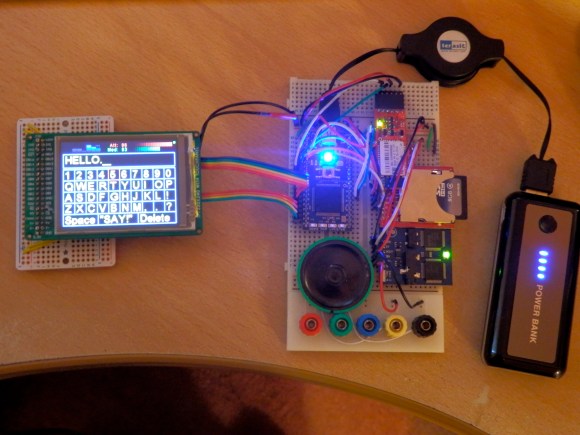
Fans of the AMC show Breaking Bad will remember the Original Gangsta [Hector Salamanca]. When first introduced to the story he communicates by ringing a bell. But after being moved to a nursing home he communicates by spelling out messages with the assistance of a nurse who holds up a card with columns and rows of letters. This hack automates that task, trading the human assistant for a blink-based input system.

[Bob Stone] calls the project BlinkTalk. The user wears a Neurosky Mindwave Mobile headset. This measures brainwaves using EEG. He connects the headset to an mBed microcontroller using a BlueSMiRF Bluetooth board. The microcontroller processes the EEG data to establish when the user blinks their eyes.

The LCD screen first scrolls down each row of the displayed letters and numbers. When the appropriate row is highlighted a blink will start scrolling through the columns until a second blink selects the appropriate character. Once the message has been spelled out the “SAY!” menu item causes the Emic2 module to turn the text into speech.

If you think you could build something like this to help the disabled, you should check out thecontrollerproject.com where builders are connected with people in need.

Continue reading “Building A Blink Based Input Device”

Using An Angle Grinder As A Bench Grinder

angle-grinder-bench-grinder

[Saeid Momtahan] made a couple of attachments that let him use his angle grinder as a bench grinder. It may be better to refer to it as a bench motor, as he uses both a grinding wheel and a wire brush while showing off his project.

The attachments come in two parts. The first is a piece of square tube that runs parallel to the body of the grinder on the side opposite the handle. This doubles as a larger gripping area when using it as an angle grinder, as well as giving him something to clamp in his bench vise. The second attachment serves as a rest for the work piece. Above you can see him brushing some rusty stock clean with the wire attachment.

It’s nice to have the option of doubling up a tool’s tasks rather than buying yet another item that may not get used all that much. We also love the idea of building your own tools. If you don’t have a welding rig to fabricate these add-ons here’s a li-ion battery based system to get you thinking.

Continue reading “Using An Angle Grinder As A Bench Grinder”

PBX Blade For Multiple Extension Home Telephony

home-pbx-blade

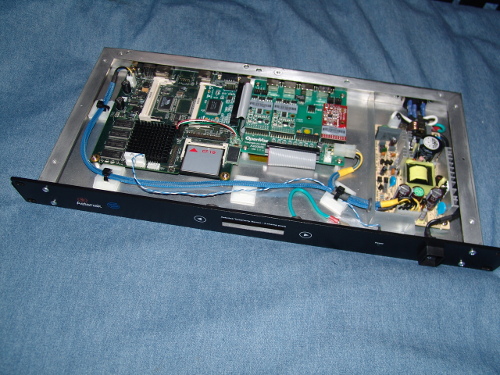
It looks like a consumer good, but this PBX server blade was built by [Benoit Frigon] over the last couple of years. It brings multiple telephone extensions to his home service.

The device runs Asterisk open source PBX software. Because it will be on all the time he wanted something that doesn’t draw a lot of power. The 500 Mhz system seen on the left has just a half a gig of ram. It’s enough to do the job and at 10 Watts it’s not going to break the bank when it comes to paying the electric bills. The board in the middle is used to interface the analog handsets with the land line. From the look of it he’s got it rigged for two extensions.

That’s all somewhat par for the course with PBX rigs, but the enclosure is where he really shines. [Benoit] used 22 gauge aluminum sheet to fabricate the enclosure which is designed to blend in with the rest of his home’s rack mount hardware. To provide control at the rack he added his own LCD and touch-sensitive button interface to the front of the case based on a PIC 18F2520. The system can also be accessed via the web thanks to a custom interface he coded.

Crystal Oven Temperature Sensor Reads 0.01F Resolution

crystal-oven-temperature-sensor

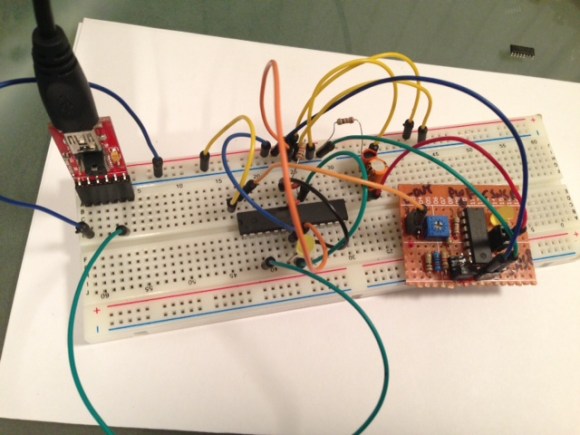
[Scott Harden] continues his work on a high precision crystal oven. Being able to set a precise temperature depends on the ability to measure temperature with precision as well. That’s where this circuit comes in. It’s based around an LM335 linear temperature sensor. He’s designed support circuitry that can read temperature with hundredth-of-a-degree resolution.

Reading the sensor directly with an AVR microcontroller’s Analog-to-Digital Converter (ADC) will only yield about 1-2 degrees of range. He approached the problem by amplifying the output of the sensor to target a specific range. For the demonstration he adjusts the swing from 0-5V to correspond to a room temperature to body temperature range.

Of course he’s using analog circuitry to make this happen. But before our digital-only readers click away you should view his video explanation. This exhibits the base functionality of OpAmps. And we think [Scott] did a great job of presenting the concepts by providing a clear and readable schematic and explaining each part slowly and completely.

So what’s this crystal oven we mentioned? It’s a radio project that goes back several years.

Continue reading “Crystal Oven Temperature Sensor Reads 0.01F Resolution”

Brushless Gimbal 3D Printed And Bolted To Quadcopter

IMG_20130602_004802

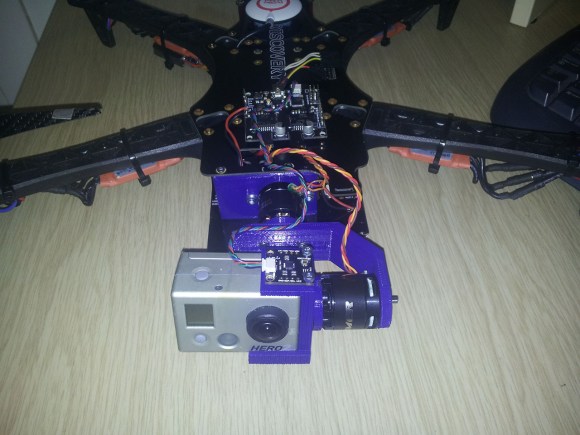
A handful of 3D printed parts, some brushless motors, and a bit of control hardware add a flair of cinematography to this quadcopter.

[Sean] sent in a tip about his work after seeing yesterday’s feature of a brushless gimbal being used to improve image stability with a shoulder mounted camera. That rig was designed to be used with a quadcopter, and this hacks shows why. It’s obvious from the demo footage that the gimbal — which is mounted directly to the frame of the TBS Discovery quadcopter — does a great job of keeping the image steady. The panning and tilting in directions contrary to the physics of flight make for a much more interesting video experience. Watch the inset video which is a live feed from the aircraft to the pilot. As the quadcopter makes very sharp banking turns you wouldn’t even be able to tell the pitch or roll have changed in the HQ version.

You can see a pair of images detailing the 3D printed parts and the assembled gimbal below.

Continue reading “Brushless Gimbal 3D Printed And Bolted To Quadcopter”

Best Robot Demos From ICRA 2013

best-robots-from-2013-ICRA

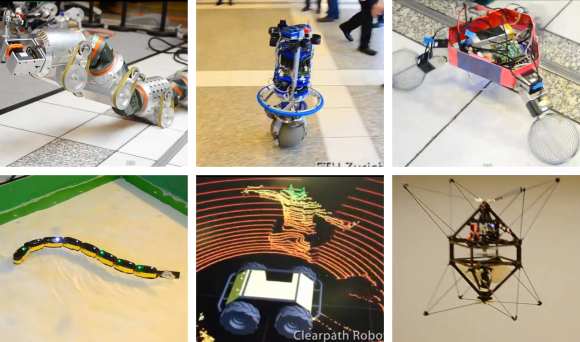
The 2013 IEEE International Conference of Robotics and Automation was held early in May. Here’s a video montage of several robots shown off at the event. Looks like it would have been a blast to attend, but at least you can draw some inspiration from such a wide range of examples.

We grabbed a half-dozen screenshots that caught our eye. Moving from the top left in clockwise fashion we have a segmented worm bot that uses rollers for locomotion. There’s an interesting game of catch going on in the lobby with this sphere-footed self balancer. Who would have thought about using wire beaters as wheels? Probably the team that developed the tripod in the upper right. Just below there’s one of the many flying entries, a robot with what looks like a pair of propellers at its center. The rover in the middle is showing off the 3D topography map it creates to find its way. And finally, someone set up a pool of water for this snake to swim around in.

Continue reading “Best Robot Demos From ICRA 2013”