Quick And Easy Wildlife Camera

This wildlife camera is really easy to put together. You should keep it in mind if you’re ever tying to figure out what’s eating the heads off of all of your tulips. [Revoltlab] put it together, and although there’s one fatal flaw in this particular system, the concept is quite sound.

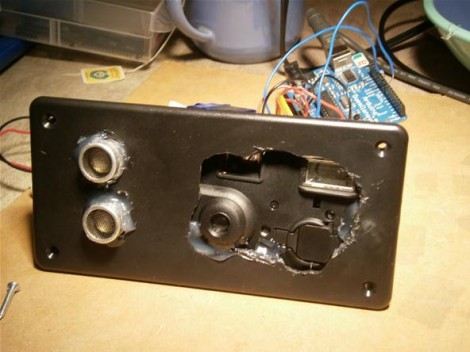
The build uses a camera, paired with an ultrasonic range finder. When something passes within the pre-set distance for the sensor, a servo motor clicks the shutter button on the camera. It’s all driven by an Arduino and powered from a 9V battery.

If you watch the video after the break you’ll discover the flaw we mentioned. This is a disposable film camera and requires winding between pictures. That hasn’t been implemented yet. But we’ve got an old digital camera with a broken LCD screen which would be perfect for the job. We’d have to do a bit more work to turn the camera on before taking the picture though.

There are a couple of possible upgrades to the idea. [Revoltlab] mentions removing the IR filter from the camera and adding an infrared flash for night-vision shots. But we would also recommend ditching the servo motor for a simple remote shutter solution as a way to avoid scaring the wildlife with the motor noise.
Continue reading “Quick And Easy Wildlife Camera”

Inconspicuous Guitar Hack Adds A Lot Of Control To Max/MSP

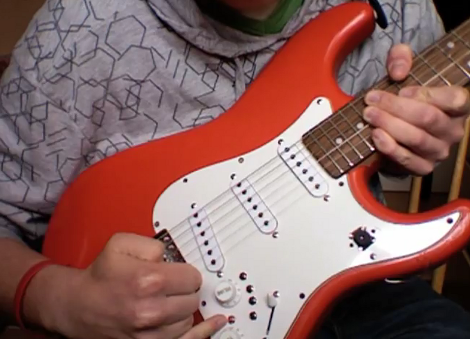
[Sam] is working on his Interactive Technology Degree and he made some alterations to this guitar as a class project. It doesn’t look much different, but closer inspection will reveal a handful of extra buttons, and a camera module. He actually added a Wii remote to the guitar which is used to control Max/MSP.

His pinky is pointing at one of the buttons. That one is red and triggers the Bluetooth sync function for the Wii remote. The other four buttons are wired to the up, down, A, and B buttons. In the video after the break [Sam] talks about the Max/MSP front-end which is used to connect the remote to the computer. Once communications are established the accelerometer sensor data is continuously streamed to the software, and the other four buttons are used for controlling the patches.

The camera module that is mounted in the guitar can be used to stream video but it appears to have no effect on the sound. In fact, the live video feed can be mixed with a waveform generation. Sound characteristics like volume affect the cross-fade between the two video signals. [Sam] talks about this feature, but when the playing demo starts about 6:10 into the clip we don’t seen any of the live video on the projection screen.

Continue reading “Inconspicuous Guitar Hack Adds A Lot Of Control To Max/MSP”

Signal Sniffing Some Laundry Pay Cards

It seems that [Limpkin] was up to no good this weekend. He decided to snoop around inside a smart-card laundry machine. He posted about his larceny  adventure and shared the details about how card security works with this machine.

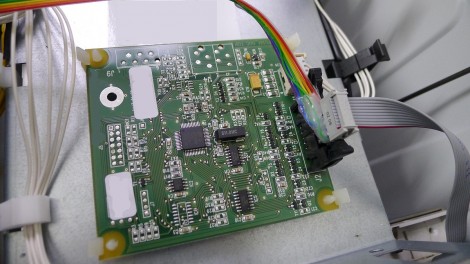
We’re shocked that the control hardware is not under lock and key. Two screws are all that secures the panel to which this PCB is mounted. We know that machines using coins have a key lock, but perhaps there isn’t much need for that if there’s no currency to steal. [Limpkin] made a pass-through connector for the ribbon cable coming in from the card reader. That’s the rainbow cable you can see above and it’s being fed to his logic sniffer. He used the ‘card detect’ signal as a trigger and captured enough data to take back to his lair for analysis. Using what he found and a Bus Pirate to test the smart card he laid bare all the data that’s being sent and received by the controller.

LED Clock Lights Up A Dead Mac Mini

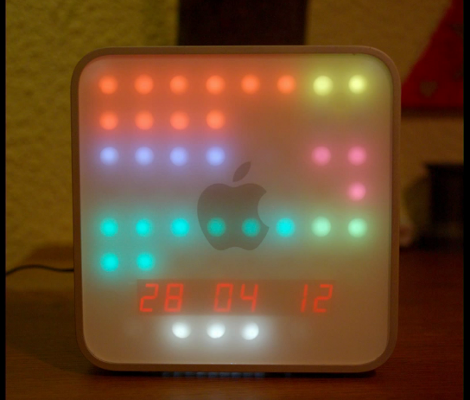
[Professor Shadoko’s] Mac Mini died. But since the case designs on Apple products are half the reason to buy them, he decided to reuse the enclosure by turning it into this clock (translated).

As with the binary clock we saw yesterday, this one uses a bunch of LEDs to display the time, but it does it in a way that’s a bit more readable if you know what you’re looking for. The face has been divided up into two columns. On the left is hours, then minutes and seconds in increments of five. To the right is AM/PM, with minutes and seconds in increments of one. If we’re doing this right, the time seen above is 10:23:42 PM on April 28th, 2012. The white LEDs below the date act as a digital pendulum, scrolling left and right as the seconds tick by.

The display uses two MAX7219 LED drivers to control the grid which is build on a big hunk of protoboard. An Arduino ties the whole system together with a Chonodot for accurate time keeping. There’s even an ambient light sensor which adjusts the LED intensity to make this readable in direct sun, or the dark of night. See a demo clip embedded after the break.

Continue reading “LED Clock Lights Up A Dead Mac Mini”

Land ROV Is Internet Connected And Packed Full Of Stuff

[Blair Kelly] has always been interesting in the concept of Remote Operated Vehicles. As soon as he got his hands on an Arduino he began his endeavor to turn an RC vehicle into a land-based ROV. What he’s done so far is incredible.

Here he’s showing off features of the build using a PS3 controller. But it can also take commands from an Xbox 360 controller or an arcade-style steering wheel. We like the latter the best, which is shown off at about six and a half minutes into the video (embedded after the break). Since there’s a webcam on board, this ends up being a virtual cockpit for the pint-sized car. But it gets better. That webcam is mounted on a servo motor, and [Blair] included controls that pan the camera. This lets the driver ‘look’ left and right. On the front of the vehicle there’s an accelerometer. Data is collected by the Arduino and sent via the WiFly module. This adds rumble to the controller if you’re using one that has that ability.

It’s a big project already, but it sounds like [Blair] has not end of ideas for future versions. Right now he’s planning to increase the overall size which will let him explore places that aren’t as flat as his livingroom.

Continue reading “Land ROV Is Internet Connected And Packed Full Of Stuff”

Iron Casting In The Parking Lot

Here’s one good thing about the bitter cold Midwestern winter, it helps keep you from overheating when working around a hot furnace. Back in February this iron pour happened in the parking lot of the Madison, Wisconsin based Sector67 Hackerspace. Look, they’re making iron hearts!

Now this isn’t just a bunch of members who got together and decided to do some casting. As you can tell in the video after the break the team knows what they’re doing. The event was a collaboration with FeLion Studios, a custom cast-iron art boutique. But the Hackerspace participants did get to take part in the process of building the cast, watching the pour, and cleaning up the rough results.

One of the people from FeLion Studios just appeared on the Martha Stuart Show, along with a 550 pound cast-iron frying pan United States map.  [Chris] from Sector67 tells us the New York frying pan that [Martha] is hold was a product of the parking lot pour.

Continue reading “Iron Casting In The Parking Lot”

Build Your Own Radar System

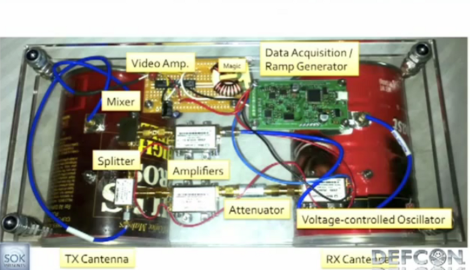
How we missed this one is anybody’s guess, but one of the presentations at DEFCON last year covers a DIY radar build. [Michael Scarito] talks about the concepts behind radar, and then goes on to show that it’s not too hard or expensive to build a setup of your own. We’ve embedded his 45 minute talk after the break.

The two large pieces of hardware above should look familiar. They’re descendents of a favorite hacking project, the cantenna. The can-based long-range antenna is most popular with WiFi applications, but we’ve seen it used for Bluetooth as well and it’s not surprising to see it here. The rest is a lot of sensing hardware and enough math crammed into the coding to make your ears droop.

If you make it far enough (exactly 39 minutes into the talk) [Michael] shares some links for more information on the build. We think living vicariously is enough for us, but if you manage to build your own setup don’t forget to post a project log!

Continue reading “Build Your Own Radar System”