Open Sourcing Everything… There’s An App For That

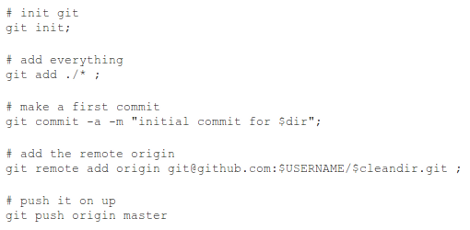
What happens if you’re a prolific developer and decide to release all of the source code from your work? Well, you should get a huge pat on the back from all interested parties. And so we say thank you to [Hunter Davis] for releasing the source code for his 70+ Android apps. But just making the decision isn’t the end of things, you’ve got actually get the code out there. And herein lies the hack. Instead of archiving and posting all of those projects he wrote a script to crawl, init, and push his projects to Github automatically.

This process is made pretty easy because of the Github API. Looks like he used version 2 for his script but you’ll want to check out version 3 if you’re looking to write your own script. His script takes the API key and username as command line arguments, then traverses his local source tree. Along the way it uses some text manipulation to sanitize the directories for use as the name of the repository. Once that’s established it steps into the directory, creates a repository, adds and commits all the files, then pushes them to Github.

Following [Hunter’s] example makes it really easy to share your code. We hope more will follow suit, putting their work out there for others to learn from and build upon.

We’ve seen some hardware hacks from [Hunter] as well. He did a bunch involving the ZipIt, as well as some work with playing games with a Dockstar.

[via Reddit]

Conway’s Game Of Life In HD

We’re going to have to take [Mike’s] word for it that he built Conway’s Game of Life with high-definition video output. That’s because this screenshot is his only proof and it looks a bit fuzzy to us. But we are interested in the project which used an FPGA to generate a 1080p VGA output of the classic programming challenge.

One of the biggest benefits of using an FPGA for this application is the hardware’s parallel processing ability. For every frame of the game, the area around each living cell must be analyzed to produce the next evolutionary step. Most of the time this means processing all of the pixels in the playing area, which is the case here. [Mike] is using VHDL to program a Papilio Plus which has a Spartan 6 chip on it. He separated his code into the different components when writing about it. This makes it easy to find the chunks relating to the game if that’s what you’re interested in. If you just want to see how he implemented the VGA interface that’s well documented as well.

If you’re not familiar, Conway’s Game of Life has simple rules regarding when a cell will live, die, or be reborn. As [Mike] points out, every programmer should give it a shot at some point. We’ve seen many iterations from the very large to the very small.

Poking At The Femtocell Hardware In An AT&T Microcell

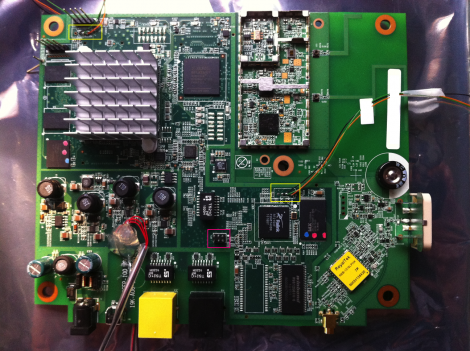
Here’s a picture of the internals of an AT&T Microcell. This hardware extends the cellular network by acting as its own cell tower and connecting to the network via a broadband connection. So if you don’t get service in your home, you can get one of these and hook it up to your cable modem or DSL and poof, you’re cellphone works again. [C1de0x] decided to crack one open and see what secrets it holds.

On the board there are two System-0n-Chips, an FPGA, the radio chip, and a GPS module. There is some tamper detection circuitry which [C1de0x] got around, but he’s saving that info for a future post. In poking and prodding at the hardware he found the UART connections which let him tap into each of the SoCs which dump data as they boot. It’s running a Linux kernel with BusyBox and there are SSH and ROOT accounts which share the same password. About five days of automated cracking and the password was discovered.

But things really start to get interesting when he stumbles upon something he calls the “wizard”. It’s a backdoor which allow full access to the device. Now it looks like the developers must have missed something, because this is just sitting out there on the WAN waiting for someone to monkey with it. Responses are sent to a hard-coded IP address, but a bit of work with the iptables will fix that. Wondering what kind of mischief can be caused by this security flaw? Take a look at the Vodafone femtocell hacking to find out.

Infrared Hides Code Combination On Geocache Puzzle

[AJ] and [Brian] are making sure the geocache challenges they set up take some ingenuity to solve. They’ve just rolled out a two-part cache which uses a code hidden in infrared light.  (Editor’s note from the far future: link wend dead.  Have a look in the Wayback Machine.)

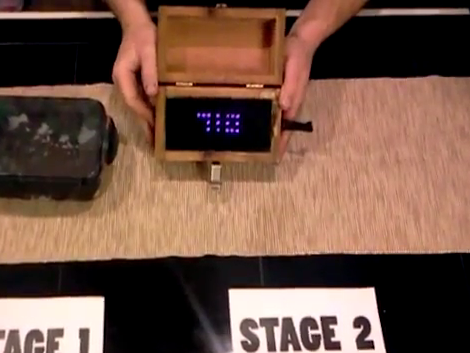
The first part of the cache is a box (the black one on the left) which contains a mysterious hand crank and a smaller box that has a combination lock on it. The second stage is the wooden box on the right. It’s got a hole in the side to receive the hand crank. This connects to the dynamo inside, letting you build up some electricity as it spins. Inside the case you’ll see two red lights blink as the crank is turned, but when you push the button on the outside of the box nothing will happen. That is, unless you’re looking through a camera which can pick up infrared light. The code (710 in this case) is displayed in an array of IR LEDs, and is used to open that combination lock. We wonder if there’s any clues about using a camera or if you have to figure this out on your own.

Don’t miss the video after the break for a full demo of the system.

Continue reading “Infrared Hides Code Combination On Geocache Puzzle”

Floppy Drive As An Audio Sampler

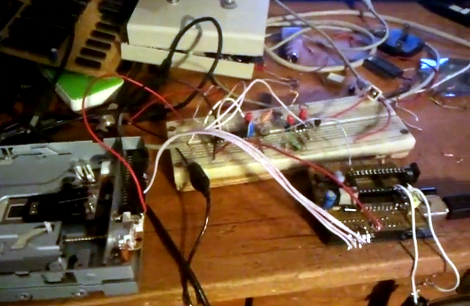
Here’s a floppy drive which is being used as an audio sampler. At first glance we thought this was another offering which drives the stepper motor at a specific frequency to generate that characteristic sound at a target pitch. But that’s not what’s happening at all. The floppy is actually being used as a storage device (go figure).

From what we can tell, it’s being used almost like an 8-track tape. A PWM signal is stored on one circular slice of the disk, then the head can be moved back to that same “track” to play back the wave form. The head doesn’t move during playback, but just keeps reading the same track of bits. To the right you can see an Arduino board. This allows for MIDI control of the track selection. [Alexis] shows off some keyboard control in the video after the break. There’s a buffer chip on the breadboard which allows the audio output to be quickly switched off as the floppy drive head is moved. This keeps garbage out of the sound until the new track can be read.

Continue reading “Floppy Drive As An Audio Sampler”

Building A Game Clock For Go Or Chess

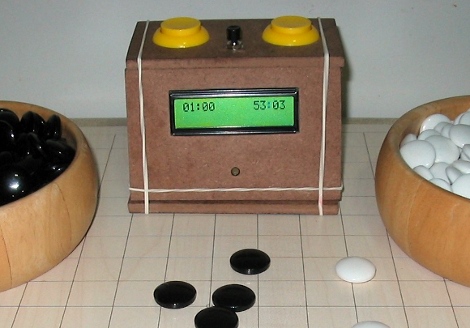
[Matias] is just getting into hobby electronics and decided to push the limits of his skill by building this game clock (site dead try Internet Archive). He comes from a software design background and that really shows through in the UI design seen in the video after the break. We enjoy the journey through his prototyping process which started with an Arduino and a breadboard, and ended with this standalone timer.

After building the first working prototype with four buttons and a character LCD, he migrated to a plastic ice cream container as an enclosure. This worked well enough, but the flimsy case needed an upgrade. As he looked toward the next version he decided to move to an Arduino Nano board to save on space. The rest of the components were soldered to some protoboard, with a pair of pin headers to receive the Nano. The finished board is the same length as the Nano and only about twice as wide.

The box was modeled on the computer (it looks like SketchUp to us be we could be wrong) then cut from pieces of Masonite. It hosts the character LCD with a pair of arcade buttons for each player to shift the time burden to his or her opponent. The middle button pauses the game, and there’s a trimpot on the back to adjust the screen contrast. [Matias] managed to include a surprising number of settings which will make this little box useful for a wide range of game types.

Continue reading “Building A Game Clock For Go Or Chess”

Board Lets You Know When To Hold ’em; Know When To Fold ’em

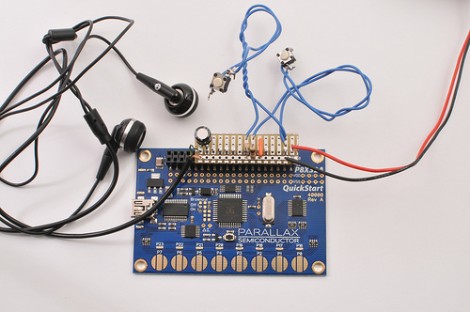
Don’t mind me, I’m just listening to some tunes during our poker game. Well, that and getting some electronic coaching about poker odds. This board lets you wiggle your toes to input the upcards, and those in your hand. After each entry the gadget will tell you your odds of winning the hand. Take it easy with this kind of stuff, if Rounders was at all realistic, getting caught cheating is a painful mistake.

The thing we find interesting about the system is that it doesn’t use a stored odds database. Instead, the Propeller chip runs a simulation of 1000 hands of poker based on the cards you have entered and uses the results to calculate the odds. [Nick] says that this runs quickly because he’s using multiple cores for the calculations, and it cuts down on the data that the device needs to have on board. Right now the feedback uses a text-to-speech generated voice, but you can customize the audio clips if you’d like. Check out a demo of the device in the clip after the break.

Not looking to get the beat down for cheating? Here’s a poker tournament timer that we assure you is on the up-and-up. Continue reading “Board Lets You Know When To Hold ’em; Know When To Fold ’em”