The Put-put Golf Course Every Hackerspace Must Build

Ever played a mini-golf course that includes a vacuum powered tube transport and Wii Nunchuk controlled labyrinth? We’d bet the answer is no on both counts, unless you’re friends with [Tom Scott]. He enlisted his local hacker friends to build a uniquely geeky mini-golf course to help him celebrate a milestone birthday — 10k days on this Earth. Last month we looked in on one of the Portal themed holes, but the finished course is almost unbelievably larger and more amazing.

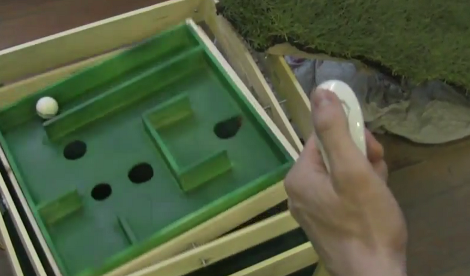
Our count puts the course at twelve holes. We’re already familiar with the Companion Sphere Incinerator hole, but joining in that theme is a Turret Hole (whith lasers!), and a clever hack that uses hidden balls to simulate a portal jump. The image above shows the Real Turf hole which starts with a put up some living sod into the indoor/outdoor carpet lined labyrinth. The Twin Looper hole will suck a well placed putt through thirty meters of tubing. And of course there’s the Minecraft hole which includes a Creeper and TNT block.

Don’t miss the clip after the break which shows off the course. And if you’d like to hit these links yourself they’ll be making an appearance at the Derby Maker Faire (in the UK) on June 3rd. Continue reading “The Put-put Golf Course Every Hackerspace Must Build”
Racing With Dyson’s Spare Parts

When it comes time to unwind at the Dyson design facility these engineers know how to do it right. Recently, the company challenged their engineers to a grown-up version of the Pinewood Derby in which they raced their own cars powered by a Dyson motor.

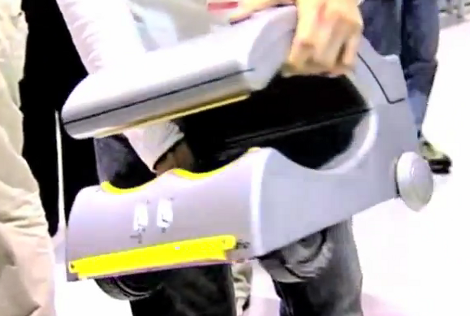
The video after the breaks shows a large collection of these time trials on a track made from upturned wooden pallets. Most of the vehicles are made from parts which we don’t recognize. But some of them are very familiar like our favorite hand dryer ever (seen above) and the iconic goldenrod manifold from the Dyson ball vacuum cleaner.

The course ends abruptly, as you can see in the last run of the video. There is one entry that included a human rider and he seems to be going nearly as fast as the riderless carriages are. The video cuts away before he hits the wall, but we can’t image he had the time to include brakes in that design.

Continue reading “Racing With Dyson’s Spare Parts”

Those USB TV Tuners Used For SDR Can Also Grab GPS Data

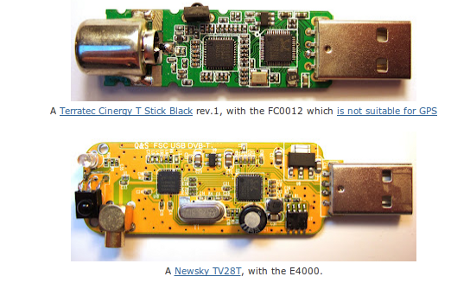
Talk about versatile hardware. These inexpensive TV tuner dongles can also grab GPS data. You may remember seeing this same hardware used as a $20 option for software defined radio. But [Michele Bavaro] decided to see what other tricks they could pull off.

Would it surprise you that he can get location data accurate to about 20 centimeters? That figure doesn’t tell the whole story, as readings were taken while the dongle was stationary for three hours, then averaged to achieve that type of accuracy. But depending on what you need the data for this might not be a problem. And [Michele] does plan to implement real-time GPS data in his next iteration of the project. He plans to use an SDR acquisition algorithm to measure doppler shift in accounting for the slow clock speed of the dongles compared to standard GPS receivers. We can understand how that would work, but we’re glad he has the skills to actually make it happen because we’re at a loss on how the concept could be implemented.

[via Reddit]

Stair Accent Lights Made From Cheap LED Strips

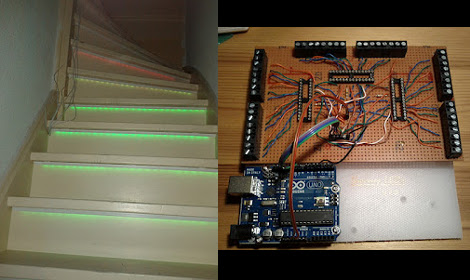
We really like [Geert’s] take on accent lighting for his stairs. He built his own LED channels which mount under the bullnose of each step. The LED strips that he used are actually quite inexpensive. They are RGB versions, but the pixels are not individually addressable. This means that instead of having drivers integrated into the strip (usually those use SPI for color data) this strip just has a power rail and three ground rails for the colors. Ten meters of the strip cost him under forty dollars.

He did want to be able to address each step separately, as well as mix and match colors, so he designed the driver board seen above to use a set of TLC5940 LED drivers. These are controlled by the Arduino which handles color changing and animations. It will eventually include sensors to affect the LEDs as you walk up the stairs. Each strip is mounted in a piece of angle bracket, and they’re connected back to the driver board using telephone extension wire.

Free Formed Circuit Protected By A Brick Of Crystal Clear Resin

The look of this crystal clear resin brick is pretty amazing. [Rupert Hirst] decided to encase his amplifier circuit in a block of polyester resin. We just hope he got everything in his circuit right because there’s no way to replace any of those parts now!

He deserves a lot of credit for working out a visually pleasing way to mount each component. There wasn’t any type of substrate used, but a few lower gauge wires were picked as the rails and they add some mounting stability. Before casting, he took the case of each of the three jacks apart and sealed the seams with some of the casting resin to prevent the final pour from filling them up.

Eagle CAD was used to design the mold. He printed it out on some card stock, then used a hobby knife to cut the pieces out and super glue to assemble them. A second layer of super glue was run on each seam to ensure they’re water tight. After the casting was made [Rupert] spent plenty of time sanding, routing, and polishing the brick to achieve this look.

This makes us wonder about heat dissipation. Do you think it will be a problem? Tells us what your opinion by leaving a comment.

Add A Train Horn To Your Hoopty (earplugs Not Included)

[TheChadster] was kind enough to explain that the air horn he attached to his bicycle is not actually as loud as a train horn. This one can only be heard from a half a mile away. But we’re sure the ringing in your ears will seem the same… the video after the break proves this thing is way too loud.

You don’t need much for this, just a pair of air horns and a source of compressed air. [Chad] has a ten gallon air tank strapped onto the luggage rack on the back. We’d bet he can lay on the horn for quite a while before depleting that reservoir. The hardest part of the build (other than sourcing the parts without breaking the bank) is going to be attaching everything to the bike. This is why he recommends using a cruiser bicycle because they often already have a rack on the back. For the horn holder [Chad] found a leather cup holder worked almost perfectly.

We think he needs to turn this around and add some compressed combustibles for a fiery and noisy flame boost.

Continue reading “Add A Train Horn To Your Hoopty (earplugs Not Included)”

Arduino MIDI Sequencer Displays A Lot Of Data

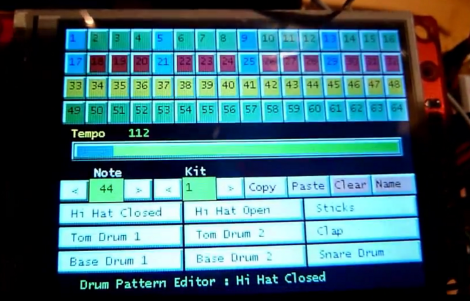
This Arduino MIDI sequencer has no shortage of ways to display loop info. The screen above is a touch-sensitive interface that acts as the user input. But if this screen is not visible, you can still see which tracks have activated samples for each beat and what effects are being used. That’s thanks to the collection of display boards which are shown in the video after the break.

The setup acts as the MIDI front end, relying on other hardware to generate the samples. It presents all of the options through several pages on the 320×240 touch screen display. The Ardunio Mega is responsible for monitoring the UI data, crafting and sending the MIDI commands, as well as updating the LED-based display boards. These include bar graphs for the various effects, a four row by sixteen pixel beat pattern display, and 7-segment displays to track the current location within the loop. All in that’s 368 LEDs driven by 18 shift registers.

Update: Link to a gallery can be found after the break as well.

Continue reading “Arduino MIDI Sequencer Displays A Lot Of Data”