Increasing A Digital Servo Motor’s Range Of Motion

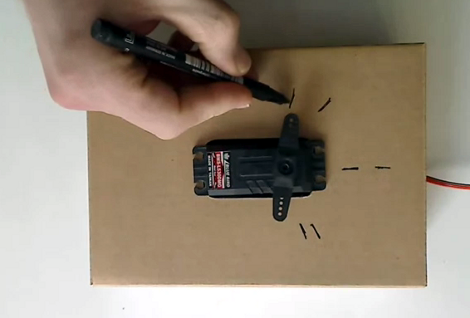
Unhappy with the 120 degree range of movement for this digital servo motor [Malte] set out to expand its flexibility. He settled upon a hack that alters the feedback potentiometer in order to give the motor a wider range (translated).

The test video (embedded after the break) shows tick marks for before and after his alterations. You can see that the wider tick marks get much closer to the 180 degree range he’s interested in. The control method is no different than it was before, the internal circuitry is still listening for a control signal with pulses between 1 and 2ms to establish the position of the servo horn. [Malte] added resistors on the two outside legs of the feedback potentiometer. This is what that control circuit measures in order to judge the position of the servo horn. He’s using 1.6k Ohm resistors in this demonstration. But he didn’t just drop them in willy-nilly. His writeup discusses the calculations he used to determine the target voltage for the motor position he wants.

Continue reading “Increasing A Digital Servo Motor’s Range Of Motion”
From Reference Design To USB Sound Card

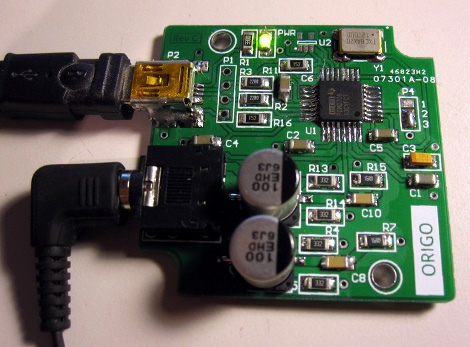
[Entropia] decided to try his hand at rolling is own sound card. He picked out a DAC chip, started his prototyping by studying the reference design from the datasheet, then went through several iterations to arrive at this working model.

He chose to base the board around the PCM2706. It’s a digital to analog converter that has built-in USB support; perfect for his needs. It’s got a headphone amplifier, but is also capable of putting out S/PDIF signals for a digital amplifier to pick up and use. Not bad for a part that can be had for right around eight bucks.

The first PCB he designed had a few electrical and footprint errors. But he was able to get it to run by adding some point-to-point jumpers, and bending the legs of his capacitors to fit the board area. With those issued accounted for he ordered a second batch of boards. These went together nicely, but the headphone output was incredibly loud. Turns out the filtering circuit had the wrong resistor and capacitor values. Changing them around, and swapping the audio output so that the correct channels were patched to the audio jack brings it to the first release version seen above.

A Better Dust Skirt For Your CNC Mill

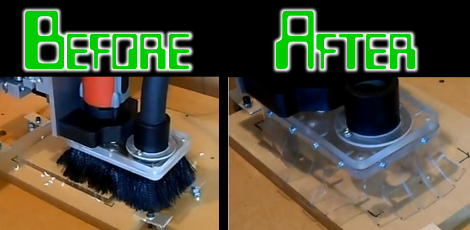
[Joshendy] wanted to get a better look at the cutting head on his CNC mill when it was running. The problem is that the rotating blades throw up a lot of junk which you don’t want flying around the shop so they’re usually surrounded with a shroud connected to a shopvac. He just milled is own transparent dust skirt to solve the problem.

The original dust skirt uses black bristle brushes to contain the waste from the cut. In addition to obscuring your view of the cutter this didn’t do a very good job of containing bits and pieces. The solution seen on the right uses clear, flexible PVC as the skirt. The video after the break details the build process. [Joshendy] cut out a replacement plate which is then fitted with magnets to connect to the cutter. The skirt is affixed to that plate with a series of screws, making it easy to replace if it ever wears out.

Continue reading “A Better Dust Skirt For Your CNC Mill”

“Machining” Copper Parts Using Cupric Chloride

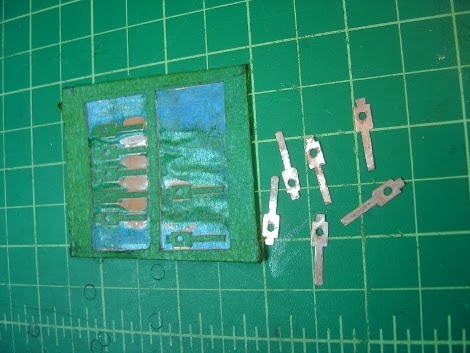
[Ben Ardwin] was asked by a friend to help fix an old motor. It needed a new set of brushes. They’re just thin pieces of copper that mount on the motor housing and contact the commutator. The metal is so thin he thought he’d try fabricating replacements by dissolving copper stock.

This is not copper clad board; the raw material used in PCBs that has a copper-covered fiberglass substrate. It’s just thin sheets of copper stock. [Ben] started by covering top and bottom with painter’s tape. This will act as a resist for the chemical etchant. He headed over to the laser cutter to remove the tape mask around the outline of the parts. From there it’s into the Cupric Chloride for about two hours.

The etched parts are a bit rough around the edges so he cleaned them up by hand using a file. When writing to us about the process he suggests a few improvements. The tape used for masking wasn’t ideal and he would try a different method. He would also remove less area around the parts to help speed up the process.

This technique is a really becoming popular as a home-fabrication tool. Recently we’ve seen etched copper used to make a faceplate for an enclosure, and a translucent template for a clock.

Robotic Doodle Clock

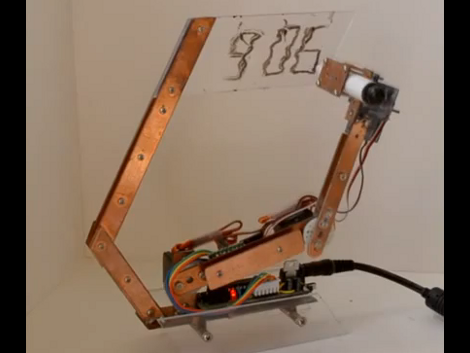
This clock has a robotic twist to it. It will show you the time by drawing it in dry-erase marker. There’s a bit of play in the arm joints and some loose motor precision which results in a wavy font that prompted [Ekaggrat] to name his project the Doodle Clock.

The shape and building material used here really make the timepiece look great. We think if the arm holding the acrylic writing surface had been at right angles this would not look nearly as pleasing. The video after the break shows the bot in action, at first flexing its wrist to switch back and forth between marker and eraser. From there it starts to draw the time, tracing the segments of each digit multiple times to achieve a readable number. The entire thing is driven by an Arduino compatible board mounted on the base of the clock.

This reminds us of that felt-tipped Turing Machine. A variation on that would also make a really nice clock display.

Continue reading “Robotic Doodle Clock”

Fine-pitch SMD Soldering With Minimal Tools

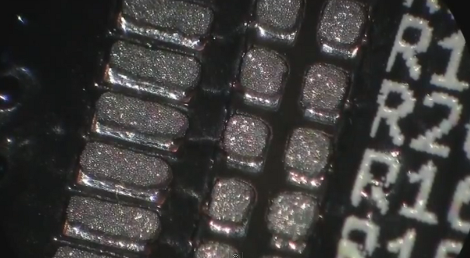
We try to stick to the 0805 parts because they’re still big enough to solder by hand. But [Scott] shows us that it doesn’t take too many special tools to reflow fine-pitch components at home. In this case he’s using 0402 resistors, a footprint that we consider functionally impossible to solder using an iron.

The two parts of the equation that he spent some money on are professionally produced PCBs and a solder stencil. The stencil is laser-cut from Kapton, which is heat-resistant so it doesn’t warp during the cutting process. An acrylic frame holds the PCB in place, and he just tapes the stencil over it and uses a chunk of acrylic as a squeegee to evenly apply the solder paste. Splurging on the PCB and stencil means you’ll achieve tolerances which lead to success.

The next issue is placing the components. [Scott] shows off some vacuum tweezers he built using an aquarium pump. Watch the video after the break to see how small those 0402 parts are when he extracts one of the resistors from the tape packaging. With the board manually populated (check everything twice!) he moves the board to a completely unaltered toaster oven for reflow. We have seen a lot of projects which add controllers to these ovens, but he really makes the case that you don’t need it. Instead, he uses a thermocoupler read by a multimeter just to let him know what’s going on with the temperature. He uses a smart phone as a timer, and switches the oven on and off to match the solder’s heat profile. Continue reading “Fine-pitch SMD Soldering With Minimal Tools”

Carabiner Helps You Hone Your Milling Skills

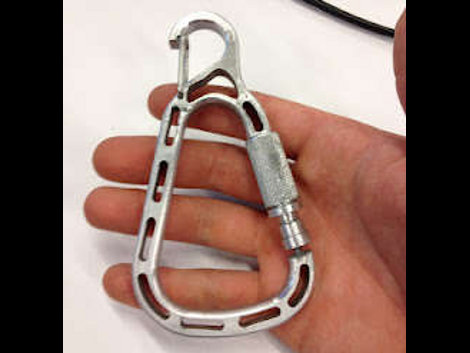
[Christian] is learning to use the metal milling tools at what we assume is his local Hackerspace. We love this about the communal spaces, they provide so many opportunities to delve into new fields. He embarked on a voyage that included visits to most of the machinery in the shop as he build his own carabiner with a magnetic gate. He’s not going to be hanging off the side of a mountain from it. But his keys or a water bottle will find a happy home thanks to the device.

It all started with some sketches to establish the shape of the overall design. From there he spent some time modelling the frame of the carabiner in CAD. He’s lucky enough to have access to a water jet which took the SolidWorks files and cut out the aluminum frame for him. That left a part with very sharp edges, so he used a wood router with a carbide bit to round them over.

The next part is adding the gate. He used an end-mill to add a mounting area on the frame. The locking ring for the gate was textured using a knurling tool, and the rest is milled with a simple cutting tool. This gate uses a magnet to center itself, with the knurled ring as the only mechanical latching mechanism. [Christian] does a good job of demonstrating the completed carabiner in the clip after the break.

Continue reading “Carabiner Helps You Hone Your Milling Skills”