Hackday Links: March 16, 2012

Shamrock hat

[Josh] whipped up a shamrock themed hat by adding an outline of green LEDs to this bowler. Just remember, don’t drink and solder. Happy St. Patrick’s Day everyone!

Battery-powered Xmas lights can be more useful

[Karl] took a string of mostly useless battery-powered Christmas lights and found a good use for them. He replaced the stock board with a boost convert and uses the two AA batteries as a 5V power supply when mains power isn’t handy.

3D printed appliance repair

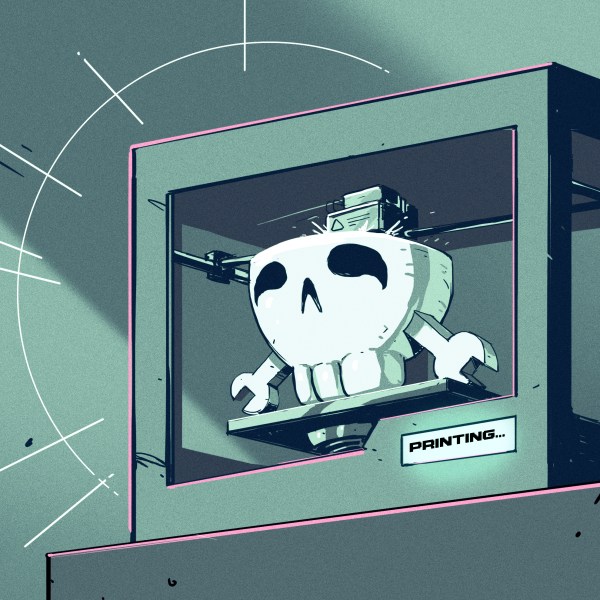
The broken plastic piece seen here keeps a dishwasher closed while running. The part couldn’t be sourced by a repairman but the best solution turned out to be printing a perfect replacement part.

Generating labels for resistor storage
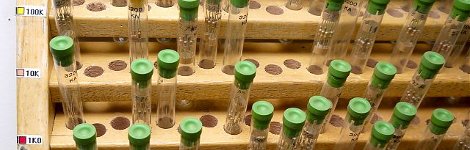
[Darrell] picked up a surplus test-tube rack to use as resistor storage. It’s a great system, but his Ruby script that uses LaTeX to generate color-coded labels is a really nice touch as well.

DeLorean quadcopter build log

No, it’s not a dupe. [Alp_X] found the link to a build log for the DeLorean quadcopter that headlined our last Links post. It’s in Russian but the machine translation should help a bit.
CRT Vector Graphics Arcade Game Built From An FPGA Board

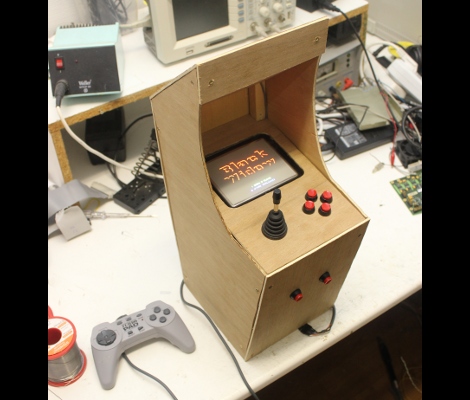
[Sprite_TM] wanted to challenge his VHDL skills, and there’s no more satisfying way of doing this than making something that will be playable when you’re done. He decided to try his hand at creating a vector-based CRT arcade. The distinction here is that vector-based games take control of the magnetic ring that guides the electron path toward the screen. This technique allows point-to-point graphic generation rather than the pixel-based scanning that CRT televisions use.

He had a small color CRT on hand and decided to grab a VHDL version of asteroids from the Internet to see if he could get it to work. But upon further inspection of the source he found that it had a chunk of code which rasterized the vectors for use with a scanning monitor. After removing that chunk, and giving it a spin he had enough confidence that he knew what he was doing to start implementing his own game. The choice of what title really came down to the hardware the original arcade cabinets used. He was not interested in implementing a soft-process for the math chips used in games like Star Wars and Tempest. In the end he got a version of Black Widow up and running, and even built a miniature cabinet for the thing. Check out some of the gameplay in the clip after the break.

Continue reading “CRT Vector Graphics Arcade Game Built From An FPGA Board”

Analog Clock Display Uses A Nipkow Disk

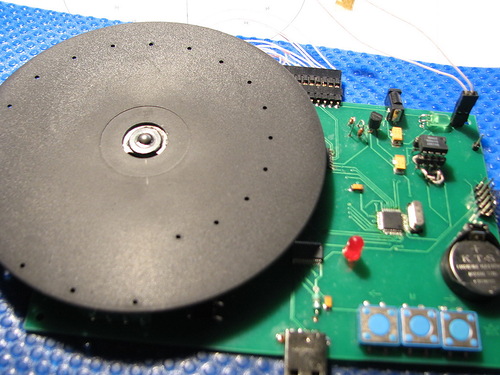
Although [Serokoy] is not thrilled with the outcome of his Nipkow disk clock (translated), but we really enjoy it. It uses the Persistence of Vision concept to create a light display from a rotating disk.

We’ve come across a lot of rotating disk clocks. Several were based off of the platters of a hard drive, using a slit, or series of slits to make up the display. This Nipkow disk uses a similar technique but in a more general way. The series of holes arranged in a spiral pattern allows a grid of concentric rings to be used as pixels when the disk is spinning. The bottom portion of the disk is used as the display area. Each pixel is illuminated at just the right time by LEDs below in order to freeze that pixel in the viewer’s eye. The demo is a bit rough, and [Serokoy] mentions that the precision of the hole layout makes all the difference. He drilled these by hand in a CD which was spray painted matte black. Even though he used a computer to lay out and print a template, it took four tries to get a suitable disk.

[Thanks Svofski]

Color Changing Coaster Has A Built-in Drink Detector

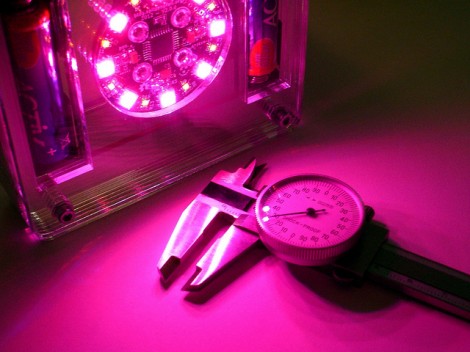
[Robert] put together his own illuminated coasters that know when they hold a drink. They look fantastic, thanks to professionally produced PCBs and a layered, laser-cut acrylic case. They’re much like the pagers given to restaurant-goes who are waiting for tables, but this version is much fancier (and doesn’t include the vibrating/paging feature).

The RGB-LED board is a previous project which was developed using eight surface mount RGB LED modules around a circular board. It uses an ATmega168 paired with an MBI5168 constant-current LED sink driver. The coaster enclosure gave him room for a few more items, like the pair of AA batteries which work in conjunction with a boost converter to power the device. It also houses an IR reflectance sensor which is used to detect the presence of a drink on the coaster. This is important since an on-occupied coaster looks like it would be blindingly bright if there wasn’t a glass to diffuse the intensity of the LEDs.

He mentions that incandescent light bulbs mess with the IR reflectance sensor. But there must be some way to account for ambient conditions with the code, right?

Twiddling An LED Using The BeagleBone’s Embedded Linux

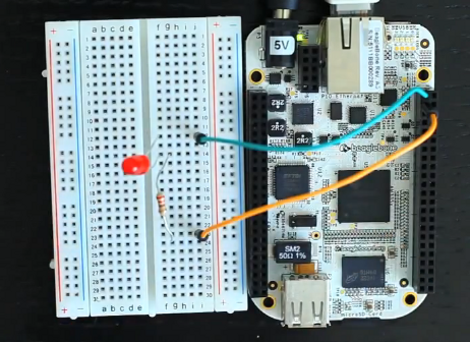
If you comfortable working with 8-bit microcontrollers, the thought of moving to a hardware platform running embedded Linux may be a bit daunting. After all, there’s a lot going on between you and the chips on a board like the BeagleBone seen above. But [Matt Richardson] shows how easy it can be to get at the pins on this device. He put together a primer on hardware control from the embedded shell.

You will remember that the BeagleBone is the newest generation of the BeagleBoard. The ARM processor and other goodies make it a powerful tool, and those already familiar with Linux will be able to get up and running in no time. Just connect the board to your network and SSH into it to get started. [Matt] outlines this setup process in the clip after the break. He then hits the reference manual to find the pinout of the female headers on either side of the board. Each available I/O pin is mapped to the /sys directory and can easily be controlled by echoing your commands to the appropriate files. But [Matt] went a step further than that, writing his own Python library that implements Arduino-style syntax like the digitalWrite() function.

This example should give you enough of a shove to start porting your own libraries over for use with the device. Don’t forget to document your projects and tip us off about them. Continue reading “Twiddling An LED Using The BeagleBone’s Embedded Linux”

RFID Playlists Plus A QR Code Concept

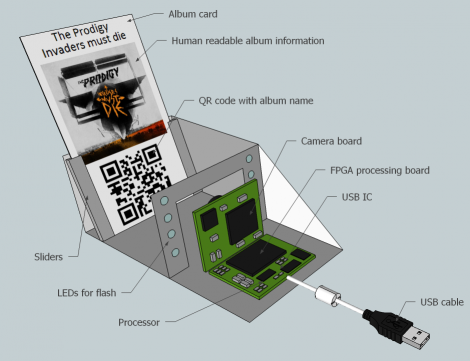
Here’s another audio playback hack that uses physical tokens to choose what you’re listening to. It uses Touchatag RFID hardware to control iTunes. The concept is very similar to the standalone Arduino jukebox we saw on Wednesday except this one interfaces with your computer and the tags select entire albums instead of just one song. A shell script processes the incoming tag ID from the reader, populates a playlist with all the tracks from the associated album, then executes an AppleScript to launch that playlist. Check out the short demo after the break.

But what really caught our eye is the QR-code reader concept which [Janis] hopes to implement at some point in the future. The computer side of things doesn’t need to be changed, but we love the challenge of putting together an FPGA-based camera to recognize and decode the QR image. Looks like a perfect use for that $10 camera module and it’s FPGA driver!

Continue reading “RFID Playlists Plus A QR Code Concept”

RFID Jukebox For The Kids

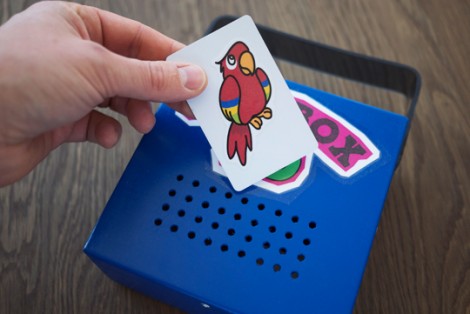
[Dominik] built a fun musical toy for his daughter [Anna]. It’s a jukebox that lets her play her favorite tunes using RFID tags to select between them.

The project is simple, yet robust. The enclosure is a wooden craft box that you can pick up for a couple of bucks. Inside there’s an Arduino with a Wave Shield which handles the audio playback. An RFID reader takes input from the set of card-tags he procured. An internal Lithium battery powers the device, with a USB port for charging.

Sure, those guts have some cost involved in them. But there’s no LCD which can be broken, and we thing the boards will hold up well to abuse if mounted correctly. Plus there’s a lot of future potential here. When we saw the cards we thought of those toys which make the animal sounds (“what does the cow say… mooo”). This could be used for that with really young children. Then repurposed into this jukebox as they get a bit older. If you put the guts in a new enclosure it will appear to be a brand-new toy, right?

See a demo of the project in the clip after the break.

Continue reading “RFID Jukebox For The Kids”