Laser Trip Wire – The Bare Essentials

[Gordon] sent us a tip about this simple laser trip wire system after reading yesterday’s post on a more complicated laser security unit. That build did a lot to provide functionality, such as a system to disarm the trip wire, and a robust light detection circuit. This time around there’s more happening with smoke and mirrors than with electronics.

[The Timmy] built this simpler version based on a laser trip system from Afrotechmods (video of that one is embedded after the break). He had a bag full of small square mirrors which he attached to a wall with some poster putty. A laser module shines a beam of light onto a cadmium sulfide sensor after it bounces around the optical network for a while. That CdS sensor controls an N-channel MOSFET, switching it off when light is detected and on when the intensity of the laser is absent. This example just turns an LED on and off, but since it uses logic-level voltages you can choose to add a microcontroller to the mix if you have other plans in mind.
Continue reading “Laser Trip Wire – The Bare Essentials”

Simple FM Transmitter That Shows Off Its Own Circuitry

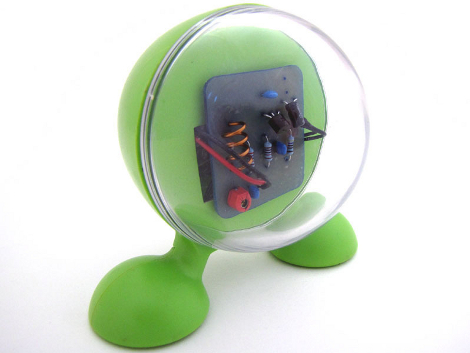
[Sean Michael Ragan] built this FM transmitter which shows off its circuitry via a clear plastic dome. The device is electrically identical to one we looked at in September. That version championed a construction method that used small squares of copper clad as solder points which were each super-glued to a large copper-clad platform serving as a ground plane. [Sean] is using a printed circuit board that was laid out by Sonodrome. You can check out their own glass-jar transmitter build where the board artwork is available for download.

One of the tips we enjoyed from [Sean’s] step-by-step build is the coil wrapping. He used the threads of a 1/4-20 bolt to guide copper wire as he wrapped a total of four turns. Once the bending is done, just unthread the bolt to separate it from the coil and gently stretch the wire for a 12mm distance between the two leads. Not only is this visually pleasing, but it will help with transmission clarity.

Powering Vehicles With Aluminum

Pop a few aluminum bits into this little RC racer and you’ll have power for around forty minutes. This concept, which has been patented, is the result of a college research project. It uses a chemical reaction between aqueous Sodium Hydroxide and aluminum. The result of that reaction is hydrogen, which is gathered and directed to a fuel cell that drives the car.

Novel? Yes. Interesting? Absolutely. But you should be raising an eyebrow at the dubious choice of fuel that is aluminum.

If you don’t know what we’re talking about let us paint you a picture. Aluminum is a metal that is refined from bauxite ore. It takes an immense amount of electricity to smelt the metal. This is usually justified because aluminum is one of the most recyclable substances on earth, capable of being melted down and reformed countless times. But dissolving it in drain cleaner breaks it down and then it’s gone. So what we have here simply must be the least efficient disposable battery so far developed. It’d probably use less resources to grow and harvest lemons as a power source.

Continue reading “Powering Vehicles With Aluminum”

EagerFeet Lets You Scrape Your Nike+ Data From The Web

Runners that wear shoes with the Nike+ system can upload GPS data about their runs to the proprietary website. If you’ve been using this for a while you may be reluctant to switch to another service that works with the hardware because you don’t want to lose the historical data. Faced with this issue, [Robert Kosara] developed some software that can scrape Nike+ data. Not only did he write the code, but he also threw up a website that shows how well it works. EagerFeet lets you copy and paste your Nike+ ID for mapping on Google Maps.

Data is scraped from Nike+ and assembled as GPX files, which are backups of GPS data. From there you can use it for whatever you like. Since the code is available in a Git repository it’s easy to depend on it with your own projects, and still get updates if the scraping system needs to be changed in the future. Even if you don’t want to use the GPX files in your own projects, they can be imported on some third party exercise tracking sites if that’s what you’re interested in.

Of course you could try to pull the data straight off of your iPod.

Cellphone Battery Mouse Modification

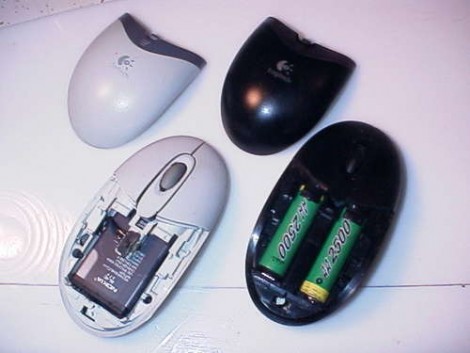
Ever wanted to increase the battery performance in your wireless mouse? [Davetech] shows you the way with this guide for converting a mouse from AA to lithium batteries. We were delighted by his hack-tacular approach that seems to have a nice little work-around at each step in the process. He grinds down the plastic battery housing that is molded into the original mouse body, then uses an old Compact Flash card connector as a set of spring terminals for a Nokia cellphone battery. This battery has more capacity and recharges faster than non-Lithium AA cells. But unfortunately the spring terminals didn’t quite reach the recessed batter contact. No problem, he just builds up solder on the battery to bridge the gap.

[Davetech] manages to fit the entire battery inside the mouse and the pointing-device still works. Your mileage may vary by model (both battery and mouse). It is necessary to take the battery out of the mouse for recharging, but since this only happen about every couple of weeks thanks to the extended capacity it’s not too much of a hassle. Perhaps someone could carry this to the next level by adding a USB port and the necessary charging circuitry?

Build A Spinning POV In A Day

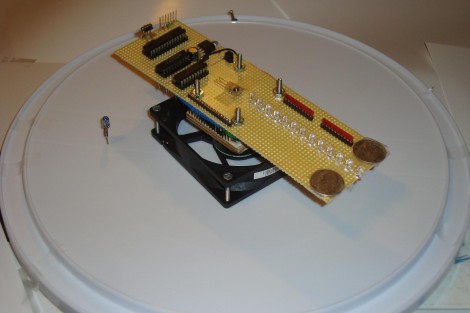
We love spinning POV displays but have yet to build one to call our very own. This project might be the one that we end up building. It’s looks good and it’s the only persistence of vision display that comes to mind which can be built in twelve hours.

The spinning is taken care of by a PC fan. This actually helps with some of the calculations as this fan spins at a know RPM. That information, along with a bit of geometry, can be used to calculate the timer interrupts for syncing the display. A reference point for this device is provided by an IR receiver/emitter pair which is easy to wire up since you already need a voltage source for the fan itself. The rest of the hardware is pretty common: a battery holder is centered on the axis for proper weight distribution and protoboard houses the components such as a PIC 18F252, 74LS373 data latches, and the LEDs themselves. The circuit is wire-wrapped, and works like a charm as evidenced in the clip after the break.

Continue reading “Build A Spinning POV In A Day”

Hacking Gets A Cover Story

We do see hacking in mainstream print media from time to time, but you know the movement must be gathering steam when a collection of hacks gets the cover story in a local paper. This week’s issue of The Isthmus – the premiere free newspaper here in Madison, WI – features the local hackerspace and a handful of green hacks.

The man seen riding the pedal-powered plow above is [Kevin Blake], a mechanical engineer for Trek Bicycles which is headquartered in Waterloo, WI. He built the rig with the chassis of a riding lawnmower, adding shovel blades in a V-shape on the front, with cranks and other parts salvaged from bicycles.

The article goes on to feature the local hackerspace, Sector67, by interviewing its founder, [Chris Meyer]. The paper tracked down some other local hackers (and Sector67 members) who have been prototyping wind turbines.

The largest feature in the story goes to [Ben Nelson’s] Geo Metro electric vehicle conversion. The self-employed video producer picked up the diminutive car for about $500 and dropped in a forklift motor which he picked up at a garage sale ($50 + $50 for new brushes makes for a steal at $100). But here’s the best part of the project: after ripping out the unneeded parts for the car he sold them for $550. Anyway, all said and done he’s got about $1300 invested in the project and now has an all-electric car that gets up to 45 mph with a range of twenty miles in between charges. Maybe a big tail cone would help extend that reach.

This is the most interesting stuff we’ve read in the newspaper in years. Maybe you should contact your local journalists for a feature in your area? If they’re not receptive, don’t fret… we’re always looking for great builds to feature here at Hackaday.