Squishy Circuits For Tiny Tinkerers

squishy_circuits

Getting kids interested in electronics at a young age is a great idea. Feeding their developing minds via creative projects and problem solving is not only rewarding for the child, it helps prepare the next generation of engineers and scientists. University of St. Thomas professor [AnnMarie Thomas] along with one of her student [Samuel Johnson] have put together a winning recipe for getting kids started in electronics tinkering at a very young age.

While some 5-year-olds can wrangle a soldering iron just fine, some cannot – and younger kids should probably stay away from such tools. This is where the the team from St. Thomas comes in.

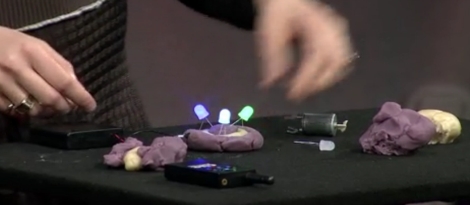
They scoured the Internet looking for Play Dough recipe clones, testing the resistance and useability of each before settling on two formulas. The first formula incorporates salt, and has a very low resistance. The second contains sugar and has about 150 times the resistance of the first formula. If you use them together, you have very simple conductor and insulator substrates that can be manipulated safely by tiny hands.

As seen in the demo video below, a small battery pack can be wired to the conductive putty easily lighting LEDs, turning small motors, and more. We can only imagine the delightful smile that would emerge from a child’s face when they power on their putty circuit for the first time.

While only two different types of putty have been made so far, we would be interested to see what other materials could be integrated – how about homemade peizo crystals?

[Thanks, Spence]
Continue reading “Squishy Circuits For Tiny Tinkerers”

Variable Super Capacitor Battery Provides Power On The Go

super_cap_battery

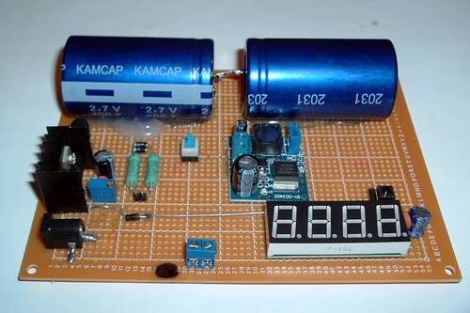
Instructable user [EngineeringShock] got sick of buying batteries for his devices all the time and has instead opted to build himself a super capacitor bank that can be used to power common household items.

His “forever” rechargeable capacitor bank is made of two large super capacitors rated at 400 farads apiece. It is charged through a LM317-based charging circuit that is adjustable to allow for slow or fast charging, the latter of which he admits, is slightly dangerous.

Since the super caps are only rated at 2.7 volts, they are wired through a DC-DC booster circuit that allows him to adjust the output voltage from 4.3 v to 34 v. The adjusted voltage is then passed through a digital display that allows him to see what the output voltage is at any time.

He says that the super cap bank can power his computer’s speakers for about two hours before requiring a recharge, which takes just a few short minutes, depending on how he is charging them.

While it’s not exactly cheap, the capacitor bank could be useful for those requiring quick portable power for relatively short periods of time. If we were to build one ourselves, we would likely fit all of the components into a small project box to protect the caps from accidental discharging, and top it off with a couple of solar cells to charge it for free during the day.

Keep reading to see a quick video demonstration of his super cap “battery” in action.

Continue reading “Variable Super Capacitor Battery Provides Power On The Go”

Quick & Dirty USB Phone Charger

usb_phone_charger

Hackaday forum member [Dan Fruzzetti] wrote in to share a simple, yet useful hack he built just the other day. He and his wife both have Evo 4G smartphones and they were pretty disappointed in the lack of portable charging solutions available.

Instead of buying something and modifying it to his needs, [Dan] decided to build a quick and dirty charger instead. His ghetto-mintyboost was built into a cheap project box he found at Radio Shack, which is stocked with a set of four D-cell batteries. The batteries were wired in series and connected to a pair of salvaged USB ports mounted on a small piece of protoboard.

Knowing that most portable devices get 5.7v from their chargers already, he was not worried about hooking his phones straight into the 6v battery pack he built. He says that the phones actually charge pretty quickly, and that he estimates he should be able to get about 50 charges out of the box before he needs to swap the batteries.

This is not a complex hack by any means. It is quick & dirty, solves an annoying problem, and it’s dead simple to build. That’s exactly why we like it.

Save Boatloads Of Cash By Building Your Own Laser Cutter

diy_laser_build

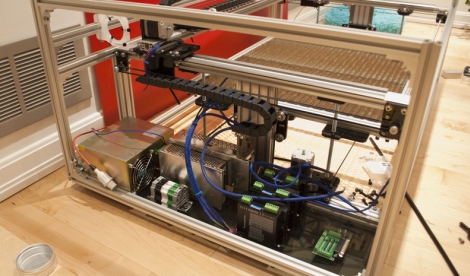
Have a bunch of time on your hands, and about $2,500 sitting around? Why not settle in and build yourself a laser cutter?

That’s exactly what Buildlog forum member [r691175002] did, and he told us about it in our comments just a few moments ago. Laser cutters can be pretty cost prohibitive depending on what you are thinking of picking up. The cheapest Epilog laser we could find costs $8,000, and you know what can happen when you try buying a cheap laser online.

Instead of going for a ready-made cutter, he purchased an open-source kit from Buildlog, documenting the highlights of the build process online. The build log walks through a good portion of the construction starting with the frame and motor mounts, continuing through wiring up the electronics as well as some of the finishing touches. If you happen to head over to take a look around, you will find that there are plenty of pictures from various stages of the construction process to keep you busy for awhile.

With everything said and done, [Ryan] is quite happy with his laser. After going through the build process, he offers up some useful construction advice, as well as tips on sourcing cheaper hardware. He estimates that if he built the laser today, he could probably cut the costs nearly in half.

There’s no doubt about it – a $1300 laser cutter sounds pretty darn good to us.

turbografx_clone

FPGA-based Turbografx 16 Clone

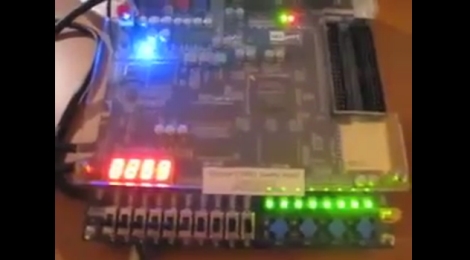
[Gregory] wrote in to share his most recent project, an FPGA clone of the PC Engine/Turbografx 16 console. You may remember him from last year, when we talked about his SEGA Genesis FPGA clone. He just couldn’t leave well enough alone, and decided to resurrect yet another 16-bit machine in FPGA form.

He has been working on the project for about three months now, but he has been making very quick work of getting everything up and running. As of a few weeks ago, the project was in a pretty unstable alpha stage, but after pounding away at some bugs, he is now able to render any game he pleases.

The clone uses an Altera DE1 board just like his previous builds, and he has been able to emulate all three if the main chips that make up the Turbografx logic board. He has yet to work on the Programmable Sound Generator, but that is slated for the near future. While the FPGA currently stores ROMS in its flash memory, he has plans to add the ability to load games from an SD card.

Keep reading to see a pair of videos showing his console clone in action, it’s impressive.

Continue reading “FPGA-based Turbografx 16 Clone”

Doorbell Hack Makes Coworkers Less Annoying

doorbell_wav_player

Hackaday reader [Sprite_tm] works in an office building that used to house several businesses, and as a remnant of the previous configuration, a doorbell sits in the hallway just outside his office. Several of his coworkers get a kick out of ringing the doorbell each time they enter the office. While not annoyed at the practice, he was getting tired of the same old “ding-dong” and decided to shake things up a bit.

He wanted to modify the doorbell to play random sounds when triggered, but he was pressed for time as it was March 31st, and he wanted to get it installed for April Fools’ Day. Without any real plan or bill of materials in mind, he pieced things together with whatever he happened to have sitting around.

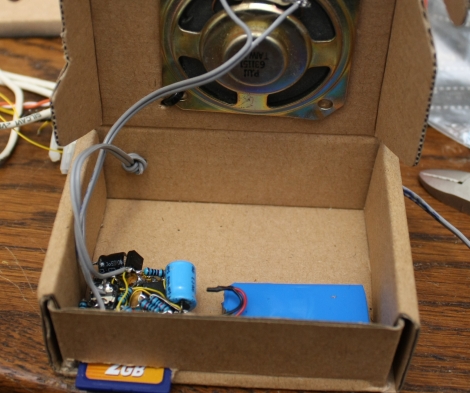
He used a design borrowed from Elm-chan in order to play wav files from an SD card with an ATTiny85, and used an L293 H-Driver as an improvised sound amplifier. After sorting out some power-related problems, and configuring the circuit to be as stingy with its battery as he could, he declared the project complete. He originally aimed to deadbug everything on the metal sleeve of the SD card socket (which is awesome), but considering the size of the speaker and the battery he selected for the project, he ended up stuffing everything into a cardboard box.

We don’t care too much about how he packaged it, we just wanted to know what his co-workers thought of his doorbell augmentation. In the end, they loved it, but we imagine this doesn’t do anything to discourage any of them from hitting the doorbell multiple times a day.

Stick around to see a quick video of his doorbell hack in action.

Continue reading “Doorbell Hack Makes Coworkers Less Annoying”

knex_plotter

K’nex Whiteboard Plotter

[Jerry] has been wanting to put together a whiteboard plotter for some time and just recently got around to building one.

The plotter draws pretty much about anything he can imagine on a white board measuring just shy of 2′ x 3′. The design first started off with a Basic Stamp board at the helm, which he sourced from another project he no longer had any use for. The Stamp worked for awhile, but eventually he ran into problems due to the board’s limited 128 bytes of program space. Needing a more robust micro controller, he switched to an Arduino mid-project, which he says runs the plotter far faster than the Stamp ever did.

The plotter uses a pair of stepper motors mounted on a horizontal platform situated above the whiteboard. Much like this large-format printer we featured earlier this week, the steppers vary the length of a pair of fishing lines, moving the pen precisely across the board.  As you can see in the image above, [Jerry] has been able to create some pretty intricate patterns with his plotter, and we imagine they will only get better with more refinement.

Be sure to check out his site for more details on his build process as well as several additional samples of the plotter’s capabilities.