Researchers Discover That Cars Can Be Hacked With Music

car_dash

In 2009, [Dr. Stefan Savage] and his fellow researchers published a paper describing how they were able to take control of a car’s computer system by tapping into the CAN Bus via the OBD port. Not satisfied with having to posses physical access to a car in order to hack the computer system, they continued probing away, and found quite a few more attack vectors.

Some of the vulnerabilities seem to be pretty obvious candidates for hacking. The researchers found a way to attack the Bluetooth system in certain vechicles, as well as cellular network systems in others. Injecting malicious software into the diagnostic tools used at automotive repair shops was quite effective as well. The most interesting vulnerability they located however, was pretty unexpected.

The researchers found that some car entertainment systems were susceptible to specially-crafted MP3 files. The infected songs allowed them to inject malicious code into the system when burned to a CD and played. While this sort of virus could spread fairly easily with the popularity of P2P file sharing, it would likely be pretty useless at present.

The researchers say that while they found lots of ways in which it was possible to break into a car’s computer system, the attacks are difficult to pull off, and the likelihood that they would occur in the near future is pretty slim.

It does give food for thought however. As disparate vehicle systems become more integrated and cars become more connected via wireless technologies, who knows what will be possible? We just hope to never see the day where we are offered an anti-malware subscription with a new car purchase – at that point, we’ll just ride our bike, thanks.

[Picture courtesy of Autoblog]

Laser Light Show Features Full XY Control Via Homemade Galvanometers

[Rich] over at NothingLabs has put together a really cool laser light show that you really must see in an effort to win a laser cutter from Instructables.

His walkthrough discusses the mechanics of laser light shows – specifically how galvanometers are typically used to precisely aim mirrors in order to draw images and write text. Commercial galvanometers tend to be pretty expensive, so he opted to build his own, using relatively cheap and easy to find parts.

The galvanometers were constructed using a pair of old speaker woofers, a few Lego bricks, and some acrylic mirror squares. The mirrors were mounted on the speakers, which were then wired to an Arduino. He removed the batteries from a cheap red laser pointer and permanently wired it to the Arduino, which it now uses as a pulsed power source. Once he had everything built, he positioned the laser using a fog machine for guidance.

As you can see in the video below, the laser show is quite impressive. His homemade galvos provide a somewhat rough quality to the final projected image, and we like that a lot. It looks almost as if all of the text and images were hand drawn, which is a pretty cool effect.

Just as [Rich] mentions, we hope to see some cool hacks based off his work in the future.

If you are interested in some of our previous laser features, check these out.

Continue reading “Laser Light Show Features Full XY Control Via Homemade Galvanometers”

Ladyada To Be Featured In WIRED Magazine

ladyada_wired_cover

If you haven’t seen the news already, prolific maker [Limor Fried/Ladyada] is set to grace the cover of WIRED magazine in the upcoming April edition.

Not only is it a great day for the hacking/maker community as it puts a bright spotlight on the things we do every day, it’s a big day for female engineers as well. While WIRED has been around for 18 years as of this past January, this is the first time a female engineer has been featured on the cover. [Phillip Torrone] put it pretty well when he said, “She’s one of the most talented people in the world, she works harder than anyone else I know, she puts more value in the world than she takes.” – We couldn’t agree more, nor can we think of a better spokesperson to represent the community and inspire budding hackers around the world.

We would like to congratulate [Limor] on her accomplishment, and we encourage everyone to pick up a copy (or at least leaf through it at the bookstore) when it comes out.

If you’re still unconvinced as to how awesome she is, take a gander at some of her work we have featured in the past:

Kinect Open Source driver bounty

Non-lethal weaponry

The Wave Bubble

Minty Boost

RoboTouch Adds Physical Game Controls To The IPad

robotouch

[ProtoDojo] wanted to play a racing game on his iPad, but he was not a big fan of using the touch interface for this particular title. Instead, he put together a pretty neat little hack that allows him to play games on his iPad using an old NES controller.

He built a set of custom conductive arms which he mounted on three micro servos. The servos were attached to the iPad screen using small suction cups in the locations where it expects to receive button presses. They are also wired to an Arduino that interprets button presses from the attached NES controller. When the Arduino senses that the D-pad or buttons have been pressed, it triggers the servos, which in turn press the virtual buttons on the screen.

In the video below, you can see that after adjusting the servo positions, the setup seems to work pretty well. You might expect to see some sort of lag with a setup like this, but we didn’t notice any. The [ProtoDojo] web site is currently down due to heavy traffic, but you should be able to find some more build details there, once it becomes functional again.

Continue reading “RoboTouch Adds Physical Game Controls To The IPad”

Giving “sight” To The Visually Impaired With Kinect

NAVI

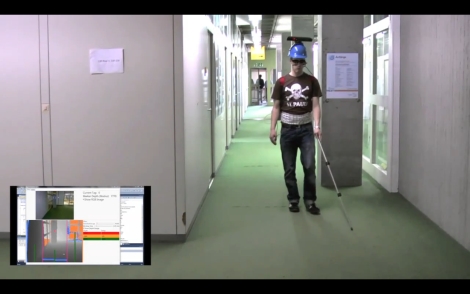
We have seen Kinect used in a variety of clever ways over the last few months, but some students at the [University of Konstanz] have taken Kinect hacking to a whole new level of usefulness. Rather than use it to control lightning or to kick around some boxes using Garry’s Mod, they are using it to develop Navigational Aids for the Visually Impaired, or NAVI for short.

A helmet-mounted Kinect sensor is placed on the subject’s head and connected to a laptop, which is stored in the user’s backpack. The Kinect is interfaced using custom software that utilizes depth information to generate a virtual map of the environment. The computer sends information to an Arduino board, which then relays those signals to one of three waist-belt mounted LilyPad Arduinos. The LilyPads control three motors, which vibrate in order to alert the user to obstacles. The group even added voice notifications via specialized markers, allowing them to prompt the user to the presence of doors and other specific items of note.

It really is a great use of the Kinect sensor, we can’t wait to see more projects like this in the future.

Stick around to see a quick video of NAVI in use.

[via Kinect-Hacks – thanks, Jared]

Continue reading “Giving “sight” To The Visually Impaired With Kinect”

DsPIC-based Spectrum Analyzer

spectrum_analyzer

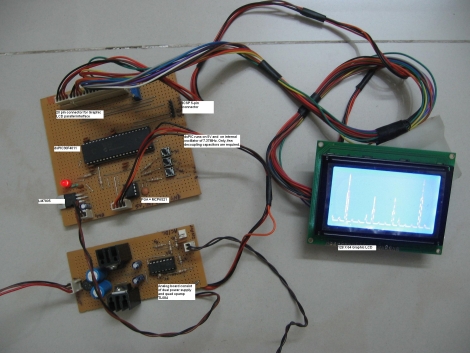
[Debraj] wrote to us describing a project he recently completed – a  simple, compact spectrum analyzer using a 16-bit dsPIC microcontroller.

The analyzer is fed an analog signal, which is passed through a large resistor followed by an opamp. A DC offset is then applied to the signal, after which it is passed through a software-programmable gain amplifier before being fed into the dsPIC’s analog input. A Fast Fourier Transform calculation is done using code provided by the PIC’s manufacturer once 128 samples have been collected. The results are then displayed on the attached LCD in real-time.

If you get a chance, take a look at the video embedded below for a walkthrough and demonstration of his analyzer. [Debraj] says that the analyzer was built to measure harmonics in his home power lines, but for demonstration purposes, he has used a simple function generator instead.

If you’re interested in seeing some other spectrum analyzers, be sure to check out these items we featured in the past.

Continue reading “DsPIC-based Spectrum Analyzer”

PWM-controlled LED Display Is Truly A Gift From The Heart

led_heart_panel

Instructables user [Simon] admits he addicted to electronics. Lucky for him, his wife of 15 years is pretty cool with, or at least tolerant of his need to fiddle with anything that plugs in. As a gift for their wedding anniversary, he decided it would be neat to combine his love for his wife with his love for electronics. The result is the the RGB LED “Love Heart” you see above. He built an RGB LED circuit controlled by a PIC12F683 microcontroller, which shines into a hand-etched plexi-glass panel.

The LED color is controlled using PWM, as you would expect. What you might not expect however, is the lengths [Simon] would travel to ensure nearly perfect color and brightness matching across the 5 LEDs he used in his project. Since RGB LEDs do not have a uniform output brightness, he used a Lux meter to precisely measure the white balance of each LED. He then plotted the results in Excel before coding the PWM driver. Now that’s devotion! Once the LEDs were settled, he went about constructing the rest of the LED panel.

If you are interested in building one for your sweetheart, [Simon] has you covered – he provides all of the schematics, templates, and source code required to get the job done.

Continue reading to see a video of his heart panel in action.

Continue reading “PWM-controlled LED Display Is Truly A Gift From The Heart”