Controlling A Counter Top Water Distiller With Salvaged Parts

distiller_power_off_timer

Hackaday reader [Kyle] wrote in to share a project he recently wrapped up, involving a counter top water distillation unit he uses at home.

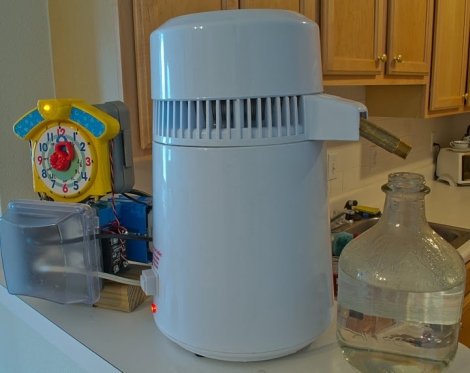
He lives in Atlanta, and hates both the taste and contaminants in the water, so using this distiller is an absolute must in his house. The problem with this cheap unit is that it waits until it is completely dry before shutting off the heating element. According to [Kyle] this brings up two huge problems.

First, letting the unit run dry simply vaporizes all of the contaminants that he was trying to remove, allowing them to re-condense and contaminate his fresh water. Second, the heating element reaches extreme temperatures once the water is gone, which causes premature failure of the distillation unit.

He originally used a timer to remind himself to turn off the unit before it ran dry, but the process became tedious. He found that he would often forget to turn off the distiller before it ruined his newly cleaned water.

Looking for another solution, he decided to automate the process using some components left over from an Arduino-based terrarium temperature/humidity controller he built a while back. A salvaged toy clock tower was used as an input dial, which sets the distillation time on the microcontroller. The Arduino in turn manages a set of relays that controls the power supply to the distiller.

While [Kyle] only sent us this information to us via email, he has made code and pictures available online. We’re sure he would be pretty open to answering any questions you might have related to his build, so fire away in the comments section.

[Update]
After seeing that his distiller made the front page, [Kyle] directed us to a write up he prepared, detailing some more specifics on the project.
Computer-controlled EL Wire Light Show

starlight_parade_float_el_wire

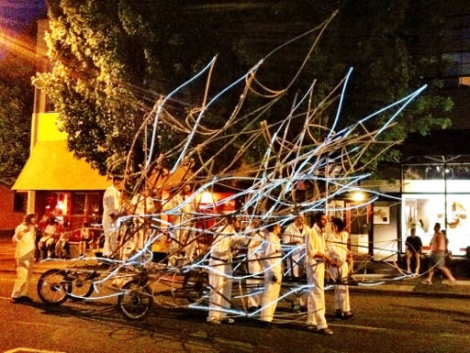
[Paul] wrote in to share a project he recently helped assemble, a huge rolling light sculpture with a ton of computer-controlled EL wire circuits. The sculpture recently featured as a float at the Starlight Parade held in Portland, Oregon.

Working alongside the folks from Hand Eye Supply, [Paul] helped design and build all 114 of the float’s electronic circuits. Almost 1000 feet of EL wire was used to light the massive float, all of which was controlled by 15 Sparkfun sequencer boards. The boards ran custom firmware he created in order to communicate with the lighting software that was chosen to run the show.

In the end, the float came out quite nicely, but it was not without its problems during the construction phase. [Paul] ran into tons of issues when using Sparkfun’s EL wire sequencers, and has put together a detailed list of corrections he made to the boards in order to get them working properly.

If you are interested in learning more about the project, you can check out this behind-the-scenes look at the float’s construction.

Running Android On Large Touch Screen Displays

32_inch_android_touch_screen_display

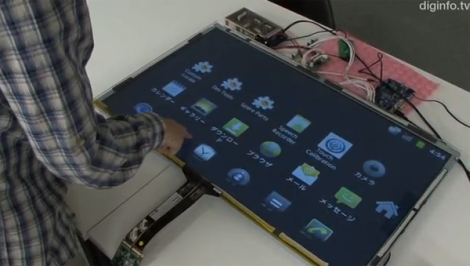
Forget Microsoft Surface, what do you think about having a 32-inch Android-powered touchscreen display in your living room? That possibility might not be too far off, thanks to the engineers over at SKR Technology in Japan.

Primarily a company that designs and builds digital signage, they were approached by several customers who wanted a large screen device that had multi-touch functionality similar to a smartphone. Since they frequently work with Windows, they tried building a solution around Windows 7, but it just didn’t function as smoothly as they would like. Instead they turned towards Android, but were disappointed to find out that none of their suppliers supported the OS.

Instead of scrapping the project, they build their own interface that allows an Android-powered device to interact with multi-touch displays. As you can see in the video embedded below the display works quite well, mirroring everything on the Android device’s screen.

While the product is not yet available commercially, we should see it come to market later this year. We hope to see an open source version sometime in the future as well, even if we can’t quite afford a 32” touch panel display.

Continue reading “Running Android On Large Touch Screen Displays”

DIY Clock Replica Is Better Than The Real Thing

diy_tix_clock

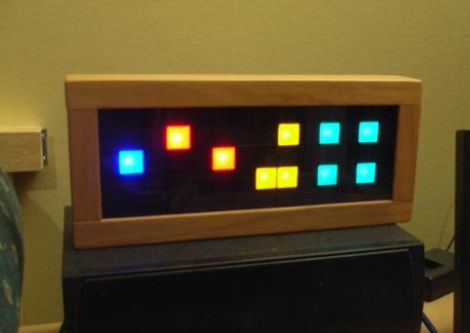
After seeing the TIX clock for the first time, [Gweedo Steevens] really wanted one, but wasn’t interested in paying the seemingly high asking price over at ThinkGeek. He figured it wouldn’t be too incredibly hard to build his own, so he decided to give it a shot.

The clock relies on 27 LEDs to display the time, which were multiplexed to make the most of his ATMega16 microcontroller’s available IO pins. Once he was happy with how things functioned on breadboard, he migrated the LEDs to a piece of perf board, and etched his own PCB for the controller circuit.

He used an office overhead lighting grate to separate the LEDs, providing nice uniform light segments. He put a piece of clear perspex on the front to cover the LEDs, but later switched it out for a much darker piece, for better daylight viewing.

The finished product is fantastic, and in our opinion looks even better than the retail version – awesome job!

[via HackedGadgets]

Scavenging Ambient Electromagnetic Energy

energy_harvesting_from_radio_waves

At this very moment, unseen radio waves are bouncing off almost everything that surrounds you. Emitted by everything from radio and TV stations to cell phone networks and satellites, these waves are full of unharnessed energy. That is, until now. Researchers at the Georgia Tech School of Electrical and Computer Engineering have been working diligently to harness this unused energy, and recently unveiled their new antenna technology at the IEEE Antennas and Propagation Symposium.

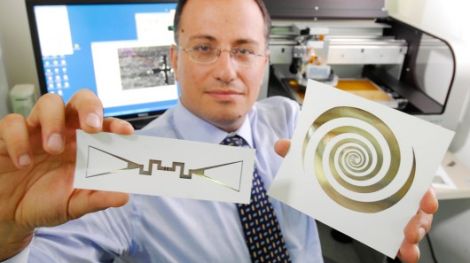
The team, led by professor [Manos Tentzeris] has been working to develop ultra-wideband antennas to tap into the energy all around us. Using printers filled with a specially-formulated ink compound, they have been able to print these antennas on paper and polymer substrates. The antennas can harness energy stored in radio frequencies ranging from 100 MHz all the way up to 60 GHz, depending on the printing medium.

The team can currently power temperature sensors using television signals, and is preparing a demo in which they will power a microcontroller simply by holding it up in the air. The technology is still in its infancy, but the list of applications is almost endless. We doubt you’ll be powering your TV with this technology any time soon, but it definitely holds promise for things such as wireless sensor mesh networks and the like.

[Thanks, morganism]

How To Build Your Own Pulsed Laser Pistol

build_your_own_pulsed_laser_gun

Self-declared Mad Scientist and Instructables user [Trevor Nestor] recently built a pulse laser pistol and decided to share his build process, so that you too can build a ray gun at home. The gun is made up of mostly scavenged components, save for the Neodymium:YAG laser head, which he purchased on eBay for about $100. He does say however, that you can score an SSY-1 laser from an old rangefinder, providing you hang out near a stockpile of decommissioned Abrams tanks.

[Trevor] walks you through the process of recycling old disposable cameras to get enough components for a capacitor bank, as well as how the charging circuit should be constructed. He also discusses how the laser head needs to be wired, before showing off the finished laser pistol in a cheeky video, embedded below.

While the gun lacks the finish of this laser pistol we showed you, it’s no less potent when shooting through plastics, wood, and thin metals. It’s a great starting point if you are looking to build a laser of your own, leaving room for improvements, such as a faster charging circuit.

Continue reading “How To Build Your Own Pulsed Laser Pistol”

Slick 16-segment POV Hard Drive Clock

pov_hdd_clock

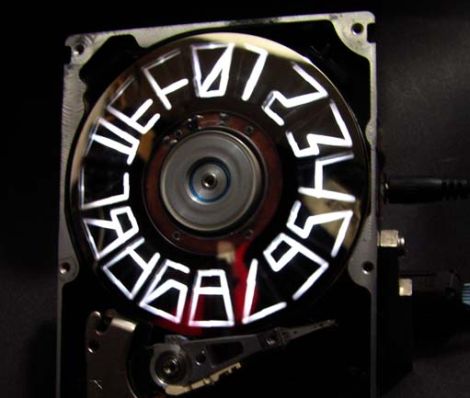
Hackaday reader [svofski] sent in a fantastic looking hard drive-based POV clock (Google Translation) created by a maker in the Sichuan province of China. The clock, like the one [svofski] built, relies on LEDs placed behind the spinning platter to create the POV effect.

Quite a few carefully placed cuts have been made to the platter, which make up the segments required to display both numbers and letters of the alphabet. This isn’t a simple 16-segment POV display however. The font uses a lot of sharp edges and odd segment lengths, so we’re guessing that quite a bit of care was taken in the production of this clock.

You can see a demonstration of the clock in the video embedded below, which shows off its ability to display numbers, text, as well as a handful of simple patterns. It looks like there are some details available on the designer’s site, however it is all in Chinese, and Google’s translation is questionable at best. If only we knew someone that could give us a hand with deciphering the inner-workings of this clock…

Continue reading “Slick 16-segment POV Hard Drive Clock”