Transforming Robot Is More Than Meets The Eye

transformer_copter

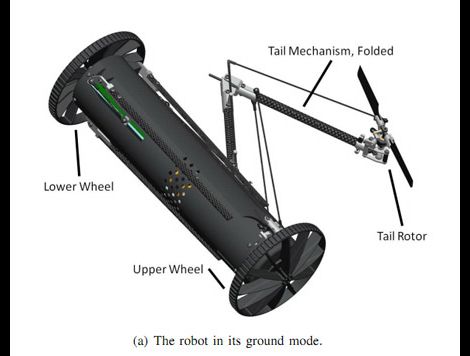
Let’s face it – building robust robots isn’t exactly easy. When designing them, builders often focus on a single method of locomotion in attempts to create a robust, reliable means of transportation. Whether it moves on the ground or in the air, there are always compromises to be made when designing a robot with the ability to travel over variable terrain. Looking to change that, researchers at the Center for Distributed Robotics have recently unveiled a robot that can travel on the ground with ease, then take to the skies in a matter of seconds.

The robot is rolls along the ground on a set of wheels mounted at either end. When it is time to fly, it pushes itself up onto one end before extending its rotors. As you can see in the video below, the transition occurs pretty quickly.

The current prototype is pretty fragile and carries quite the hefty price tag . More robust revisions are already in the works, so expect to see more in the coming months.

[Thanks Sandeep]

Continue reading “Transforming Robot Is More Than Meets The Eye”
Cheap And Reliable Portable Face Recognition System

faceaccess_portable_facial_recognition

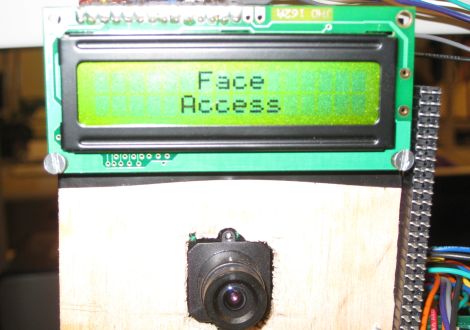
For their senior ECE 4760 project, engineering students [Brian Harding and Cat Jubinski] put together a pretty impressive portable face recognition system called FaceAccess. The system relies on the eigenface method to help distinguish one user from another, a process that the pair carried out using MatLab.

They say that the system only needs to be hooked up to a computer once, during the training period. It is during this period that faces are scanned and processed in MatLab to create the eigenface set, which is then uploaded to the scanner.

Once programmed, the scanner operates independently of the computer, powered by its own ATmega644 micro controller. Users enroll their face by pressing one button on the system, storing their identity as a combination of eigenfaces in the onboard flash chip. Once an individual has been enrolled, a second button can be pressed to gain access to whatever resources the face recognition system is protecting.

The students say that their system is accurate 88% of the time, with zero false positives – that’s pretty impressive considering the system’s portability and cost.

Stick around to see a quick demo video of their FaceAccess system in action.

Continue reading “Cheap And Reliable Portable Face Recognition System”

Making The Case For Cool Project Enclosures

luna_mod_case

Quite often, we see project boxes that seem to be constructed more as an afterthought than anything else. That’s not to say there is anything wrong with stuffing your latest creation into a nondescript black box, or even cardboard if it happens to fit your needs. Sometimes however, an enclosure embodies the spirit of a project, making it all that much cooler.

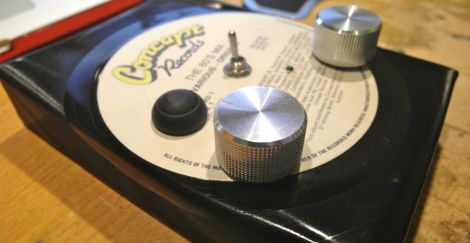
[Adam] recently picked up a copy of Make magazine and decided to build their “Luna Mod”, a sound effects generator and looper based on a PICAXE-08M. Aside from the micro controller the Luna Mod includes a couple of pots, a switch, and a few LEDs – nothing incredibly striking. Once he had everything assembled on a strip of protoboard, he started working on his enclosure.

The enclosure is made from an old record, which after some trial and error, [Adam] got just right. The record was heated and cut, then bent into shape. While it’s not necessarily a hack, we think it looks pretty slick. It really fits the theme of the Luna Mod and is far more attractive than a plain plastic box.

Stick around to see his sound generator in action.

Continue reading “Making The Case For Cool Project Enclosures”

Resurrecting The Optigan Disc Format

optigan

The Optigan and Orchestron were a pair of electronic organs built by Mattel in the 1970s which used swappable optical discs to store instrument information. The discs can still be found today, but the organs are extremely scarce, much to [Gan’s] dismay. After researching the organs for a bit, he decided he could probably build his own MIDI-compatible interface for the audio discs.

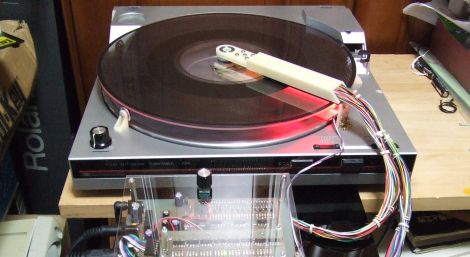
The discs have audio waveform data printed on them, which can be read using an LED on one side of the disc and an optical transistor on another. After successfully prototyping a reader that could interpret one of the disc’s audio tracks, he constructed a device to read all of the tracks simultaneously, just like the original organs.

His makeshift turntable was constructed on top of an old record player using acrylic discs and toy car wheels to keep things steady. Once the disc is placed on the turntable, he sets his reader in place, and via some custom circuitry, he is able to play the discs using his much more modern keyboard. It sounds pretty decent as you can see in the video below, though he does admit he would like to tweak a few things to make it sound even better.

[thanks Bryan]

Continue reading “Resurrecting The Optigan Disc Format”

Google ADK Project Shows Just How Easy It Is To Use

first_adk_project

[yergacheffe] was able to get his hands on a shiny new Google ADK board about a week before it was announced at I/O, and got busy putting together a neat project to show off some of the ADK’s features. His idea was to meld together the ADK and Google’s new music service, two items he says complement each other very well.

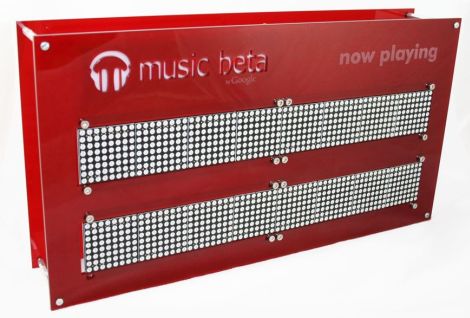
He had a handful of LED matrices left over from last year’s Maker Faire, which he decided to use as a Google music metadata display. The base of the display is made from laser-cut acrylic, with a few spare ShiftBrites lighting up the Google music beta logo.

He says it took literally just a couple lines of code to get his Android handset to talk with the display – a testament to just how easy it is to use the ADK.

Pretty much anyone can walk up, attach their phone, and see their current music track on the display with zero fuss, which you can see in the video demo below.

Continue reading “Google ADK Project Shows Just How Easy It Is To Use”

Stress Testing Robots…with Baseball Bats

robot_stress_test

When you are working on constructing the first Cyberdyne Systems Model 101 prototype a super-robust robotic arm, you’ve got to test it somehow, right?

You probably recognize the robot being abused in the video below, as we have talked about the construction of its hand once once before. The German Aerospace Center has been working on the DLR Hand Arm System for some time now, and are obviously really excited to show you how their design performs.

In case you are not familiar, the arm you see there uses 52 different motors, miniaturized control electronics, and a slew of synthetic tendons to behave like a human arm – only much better. The system’s joints not only provide for an incredible amount of articulation, they are specially designed to allow the unit to absorb and dissipate large amounts of energy without damaging the structure.

We think that any human would be hard pressed to retain their composure, let alone be able move their arm after suffering a blow from a baseball bat, yet the robot arm carries on just fine. It’s awesome technology indeed.

Continue reading “Stress Testing Robots…with Baseball Bats”

USB Geiger Counter Hack

usb_geiger

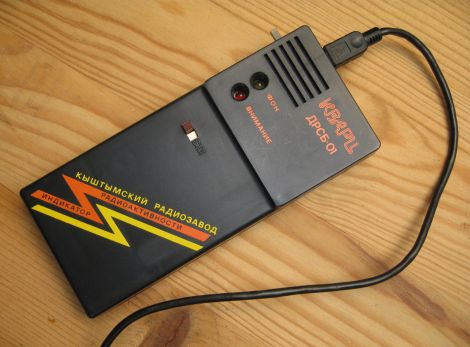
[Vic] bought a Kvarts DRSB-01 Geiger counter a few years ago, and recently dug it out of his electronics stash. The counter is a run of the mil no-frills unit. It lacks any kind of LCD display and it cannot be calibrated, so Sievert exposure ratings are out of the question. The unit essentially monitors background radiation and alerts the user to the presence of gamma and high-energy beta rays via audible clicks.

[Vic] wanted to make it a bit more useful, so he decided to interface it with his computer in order to take long-term radiation measurements. He dug up a schematic online and deadbugged a small circuit using an ATtiny44. The circuit allows him to enumerate the electrical pulses generated by ionizing particles striking the Geiger tube, passing them along to his PC over USB.

The counter seems to interface with the PC just fine, but [Vic] does say that he’s getting some odd readings. He thinks that he might have damaged the tube while messing around, but he’s all ears if you have any insight on the matter.