What Can We Do With These Patient Monitor Videos?

So we’ll admit from the start that we’re not entirely sure how the average Hackaday reader can put this content to use. Still, these simulated patient monitor videos on YouTube gotta be useful for something. Right?

Uploaded by [themonitorsolution], each fourteen-minute 1080p video depicts what a patient monitor would look like in various situations, ranging from an adult in stable condition to individuals suffering from ailments such as COPD and sepsis. There’s even one for a dead patient, which makes for rather morbid watching.

Now we assume these are intended for educational purposes — throw them up on a display and have trainees attempt to diagnose what’s wrong with the virtual patient. But we’re sure clever folks like yourselves could figure out alternate uses for these realistic graphics. They could make for an impressive Halloween prop, or maybe they are just what you need to get that low-budget medical drama off the ground, finally.

Honestly, it seemed too cool of a resource not to point out. Besides, it’s exceedingly rare that we get to post a YouTube video that we can be confident none of our readers have seen before…at the time of this writing, the channel only has a single subscriber. Though with our luck, that person will end up being one of you lot.

Continue reading “What Can We Do With These Patient Monitor Videos?”

Review: Beepy, A Palm-sized Linux Hacking Playground

In the long ago times, when phones still flipped and modems sang proudly the songs of their people, I sent away for a set of Slackware CDs and embarked on a most remarkable journey. Back then, running Linux (especially on the desktop) was not a task to be taken lightly. The kernel itself was still in considerable flux — instead of changing some obscure subsystem or adding support for a niche gadget you don’t even own, new releases were unlocking critical capabilities and whole categories of peripherals. I still remember deciding if I wanted to play it safe and stick with my current kernel, or take a chance on compiling the latest version to check out this new “USB Mass Storage” thing everyone on the forums was talking about…

But modern desktop Linux has reached an incredible level of majority, and is now a viable choice for a great number of computer users. In fact, if you add Android and Chrome OS into the mix, there are millions and millions of people who are using Linux on daily basis and don’t even realize it. These days, the only way to experience that sense of adventure and wonderment that once came pre-loaded with a Linux box is to go out and seek it.

Which is precisely how it feels using using the Beepy from SQFMI. The handheld device, which was formerly known as the Beepberry before its creators received an all-too-predicable formal complaint, is unabashedly designed for Linux nerds. Over the last couple of weeks playing with this first-run hardware, I’ve been compiling kernel drivers, writing custom scripts, and trying (though not always successfully) to get new software installed on it. If you’re into hacking around on Linux, it’s an absolute blast.

There’s a good chance that you already know if the Beepy is for you or not, but if you’re still on the fence, hopefully this in-depth look at the hardware and current state of the overall project can help you decide before SQFMI officially starts taking new orders for the $79 gadget.

Continue reading “Review: Beepy, A Palm-sized Linux Hacking Playground”

A Magnetohydrodynamic Drive In The Kitchen Sink

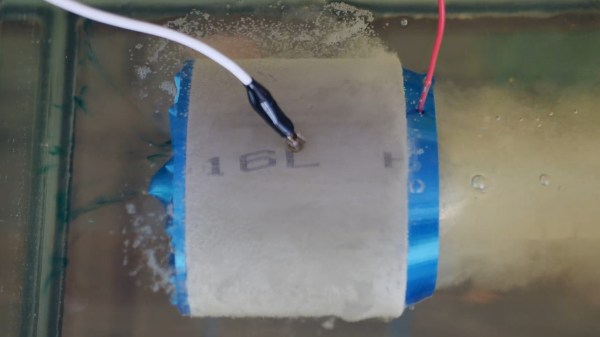
The magnetohydrodynamic (MHD) drive certainly sounds like something out of science fiction — using an array of magnets and electrodes, this high-tech propulsion technology promises to silently propel a craft through the water without any moving parts. As long as you can provide it with a constant supply of electricity, anyway.

Of course, as is often the case, the devil is in the details. Even with the obvious scientific and military applications of such a propulsion unit, scaling MHD technology up has proven difficult. But as [Jay Bowles] of Plasma Channel shows in his latest video, that doesn’t mean you can’t experiment with the concept at home. Even better, getting verifiable results is much easier than you’d think.

Continue reading “A Magnetohydrodynamic Drive In The Kitchen Sink”

Star Wars Pit Droid Has A Jetson Brain

In the Star Wars universe, pit droids are little foldable robots that perform automated repairs on spacecraft and the like. They were introduced in 1999’s The Phantom Menace, and beyond the podracing scenes, are probably the only good thing to come out of that particular film.

[Goran Vuksic] wanted a pit droid of his own, and reasoned that if he was going to go through the trouble of sanding and painting all the 3D printed components so they look like the real bot, he might as well add some smarts to it. While this droid won’t be fixing podracers anytime soon, its onboard Jetson Orin Nano Developer Kit does pack a considerable amount of processing under that dome.

A webcam mounted in the bot’s eye socket is connected to the Jetson, which is running an image detection and identification routine based on the example code provided by NVIDIA. The single-board computer uses a relay to blink some LEDs on and off when a human is detected, and a pair of servos pan-and-tilt the bot’s head towards whoever has caught its gaze.

It’s no surprise that [Goran] picked the Jetson Orin over competing SBCs for this task — in our review of the Orin Nano Developer Kit a few months ago, we found it was able to hit nearly 200 frames per second while performing this sort of real-time image analysis. So there’s plenty of room to grow should he want to integrate more complex image recognition tasks.

For example, he could follow in the footsteps of [Kris Kersey], and put a functional data overlay on top of the video to give his bot Iron Man vision.

Continue reading “Star Wars Pit Droid Has A Jetson Brain”

Hackaday Prize 2023: Green Hacks Finalists

Time and tide wait for no hacker, even if they happen to spend their spare time working on the sort of eco-friendly projects that qualified for the Green Hacks challenge of the 2023 Hackaday Prize. This environmentally conscious round ended last month, and after plenty of carbon-neutral debate, our panel of judges have settled on their ten favorite projects.

As a reminder, the following projects will not only receive a $500 cash prize, but will move on to the Finals. They’ll then have until October to put the finishing touches on their creations in an effort to claim one of the final six awards, which includes the Grand Prize of $50,000 and a residency at the Supplyframe DesignLab. Although there can only be ten finalists for each round of the Hackaday Prize, we’d like to thank everyone who put the time and effort into submitting their Green Hacks. We’ve only got one Earth, and we’re all going to have to work together if we want to make sure it stays beautiful for future generations.

Continue reading “Hackaday Prize 2023: Green Hacks Finalists”

Hackaday Podcast 230: Space Science, Superconductors, Supercaps, And Central Air

This week, Editor-in-Chief Elliot Williams and Managing Editor Tom Nardi start things off by tackling a pair of science stories, one that may or may not change the world, and the other that hopes to help us understand the very fabric of the universe. Afterwards they get to the important stuff: the evolution of Game Boy Camera hacking, the finer points of 3D print orientation, and mixing up electrically conductive concrete at home. From there the conversation shifts to a couple of 486 Turbo buttons, a quick yoke recipe, and a very handsome open source vacuum pickup tool. Stick around until the end to hear about the folly of humanoid robots, and the latest operating system to get the Jenny List treatment.

Check out the links below if you want to follow along, and as always, tell us what you think about this episode in the comments!

Or download it yourself in fantastic MP3 format!

Continue reading “Hackaday Podcast 230: Space Science, Superconductors, Supercaps, And Central Air”

Microsoft Now Offering Parts And Repair Guides For Xbox Controllers

We’re big fans of repairable hardware here at Hackaday, so much so that when we see a company embracing the idea that their products should actually be serviced rather than thrown in the trash, we like to call attention to it. Yes, that even includes when it’s Microsoft.

This community has had a mixed relationship with the Redmond software giant, to say the least. But we’ve still got to give them credit when they do something positive. Not only are they offering a full selection of replacement parts for both the standard and Elite Xbox controllers, they’ve also provided written instructions and step-by-step video guides on how to install your new parts.

For those of you who stopped playing console games when the controllers still only had two buttons, this might not seem like such a big deal. But considering a new Xbox Elite Wireless Controller will set you back a dizzying $180, it’s not hard to see why some folks would be excited about the possibility of swapping out the guts of the thing for $50.

Of course, these parts were already available from third party sellers, and iFixit naturally has repair guides for all the different flavors of Xbox controllers. Nothing about what Microsoft is doing here makes the Xbox controller fundamentally any easier to repair than it was previously. But the fact that the company isn’t treating their customers like adversaries is a step in the right direction.

Valve has been similarly open about the internals of the Steam Deck, though their presentation was a bit dramatic, and even Sony provided an official teardown video for the PS5. We’re not sure why these companies are willing to pull back the curtain when it comes to gaming hardware. Whatever the reason, we’re certainly not complaining.

Continue reading “Microsoft Now Offering Parts And Repair Guides For Xbox Controllers”