There’s the old joke about 10 kinds of programmers, but the truth is when it comes to programming, there are often people who make tools and people who use tools. The Arduino system is a good example of this. Most people use it like a C compiler. However, it really uses C++, and if you want to provide “things” to the tool users, you need to create objects. For example, when you put Serial in a program, you use an object someone else wrote. Python — and things like Micropython — have the same kind of division. Python started as a scripting language, but it has added object features, allowing a rich set of tools for scripters to use. [Damilola Oladele] shows the ins and outs of object-oriented Python in a recent post.
Like other languages, Python allows you to organize functions and data into classes and then create instances that belong to that class. Class hierarchies are handy for reusing code, customizing behavior, and — through polymorphism — building device driver-like architectures.
One of the most basic tools for tinkering with electronics is a multimeter. Today, even a cheap meter has capabilities that would have been either very expensive or unobtainable back in the 1970s. Still, even then, a meter was the most affordable way to do various tasks around the shop. Is this cable open? Are these two wires shorted? What’s the value of this resistor? Is the circuit getting power? Is the line voltage dropping? You can answer all those questions — and many more — with a basic meter. But there’s one thing that hasn’t changed much over the years: probes. That’s a shame because there are a lot of useful options.
The probes that came with your meter probably have much in common with the probes a 1970-era meter had. Yeah, the banana plugs probably have a little plastic cover, and the plastic itself might be a little different. Parts are small these days, so the tips might be a little finer than older probes. But if you sent your probes back in time, few people would notice them.
The Blinders Syndrome
One problem is that those probes are usually good enough. We’ve all clipped an alligator clip to a test probe. I’ve even fashioned super pointy probes out of syringes. Years ago, I bought an expensive kit with many attachments I rarely use, like little hooks and spade lugs. Then, I happened to go down the wrong aisle at Harbor Freight.
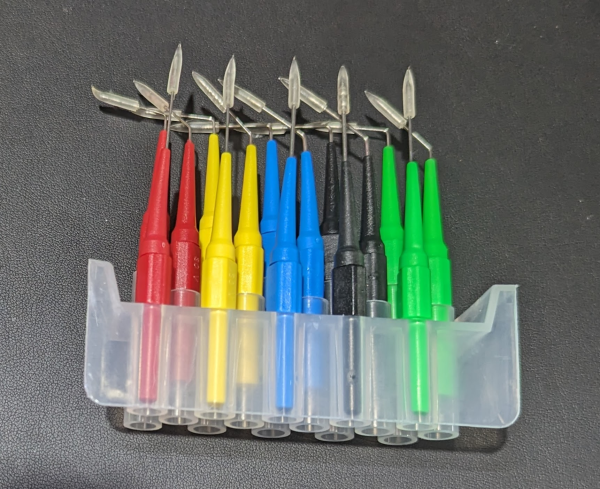
Back probes ready for action.
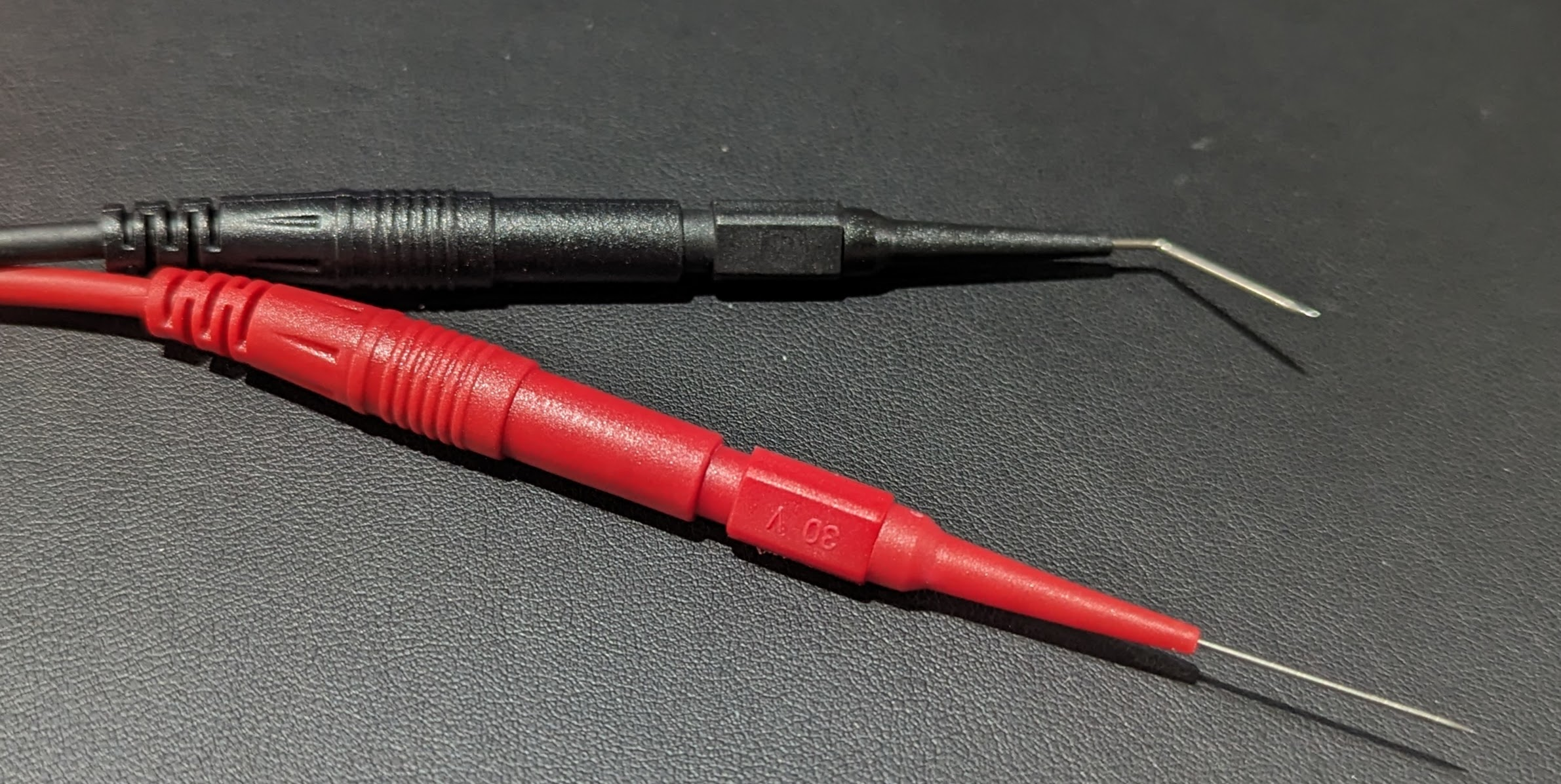
In the automotive section, I noticed a tidy plastic box labeled “22 pc. back probe kit.” I’d never heard the term “back probe,” but it was clearly some sort of wire. It turns out the kit has a bunch of very fine needles on banana jacks and some patch cables to connect them to your meter.
They are “back probes” because you can jam them in the back of connectors next to the wire. There are five colors of needles, and each color set has three items: a straight needle, a bent needle, and a 90-degree bend needle.
I’d never heard of this, and that started me down the rabbit hole of looking at what other exotic probes were out there. If you search the usual sources for “back probe,” you’ll see plenty of variations. There are also tons of inexpensive probe kits with many useful tips for different situations. Like everything, the price was much lower than I had paid for the rarely used kit I bought years ago. The only thing I really use out of that kit are the test hook clips and you can buy those now for a few bucks that just push over your probes.
Choices
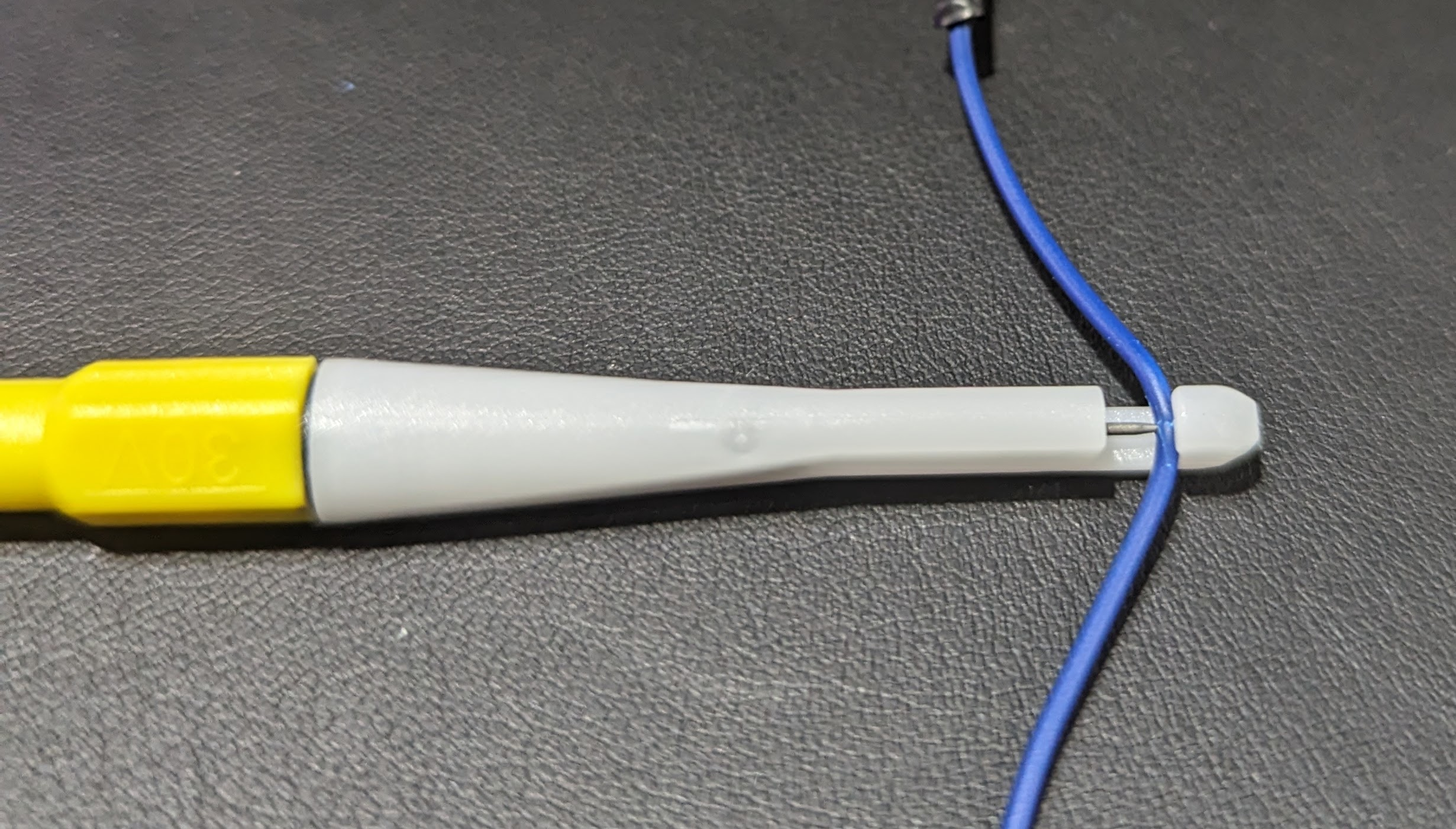
Wire-piercing probe works best for larger wires.
You could probably use the needles to stick through insulation, too. But if that’s your goal, they make piercing clip test probes specifically for that purpose. A little plastic holder has a hook for your wire and a needle that threads in to penetrate the wire.
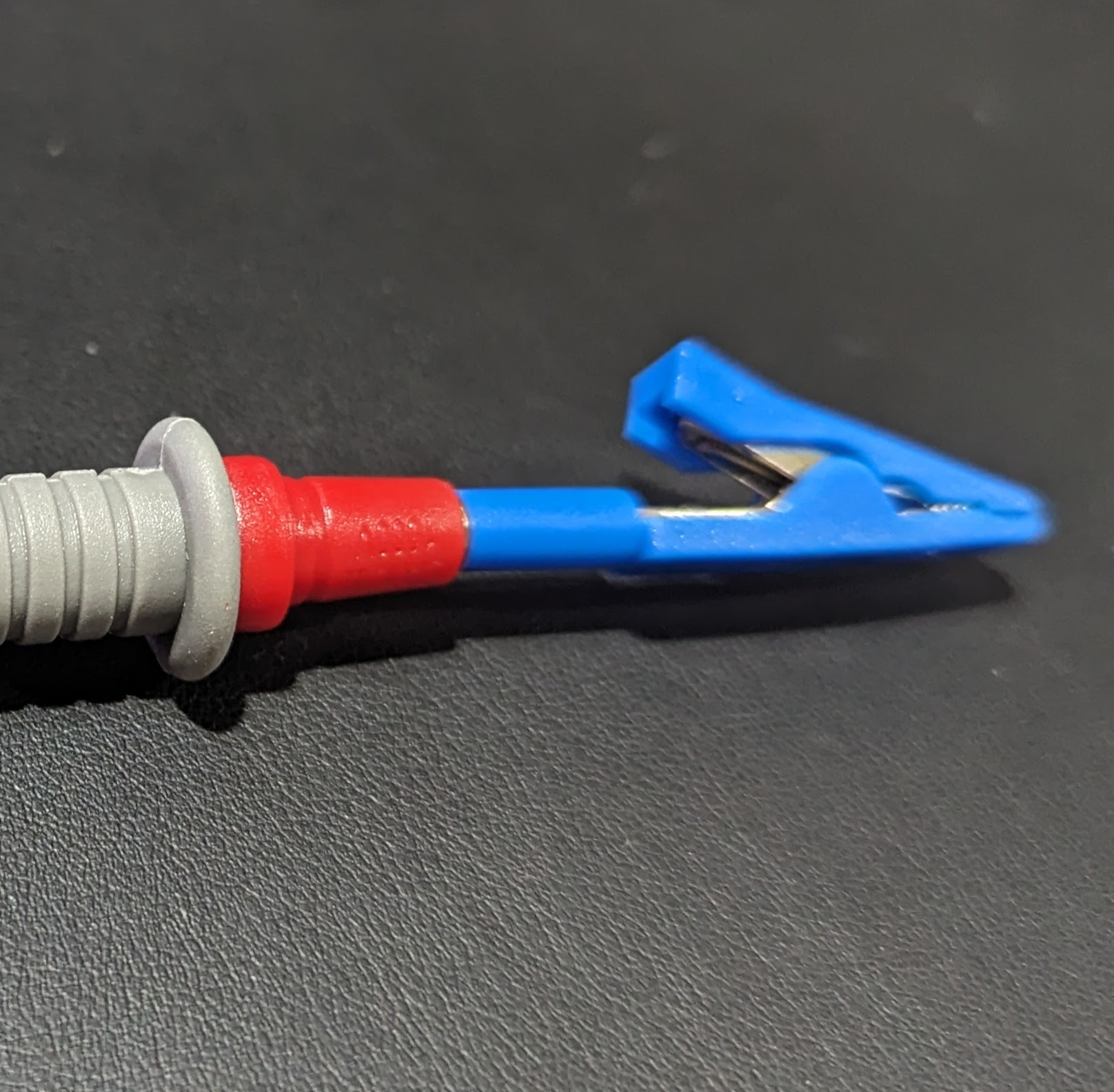
These alligator clips fit over most probes.
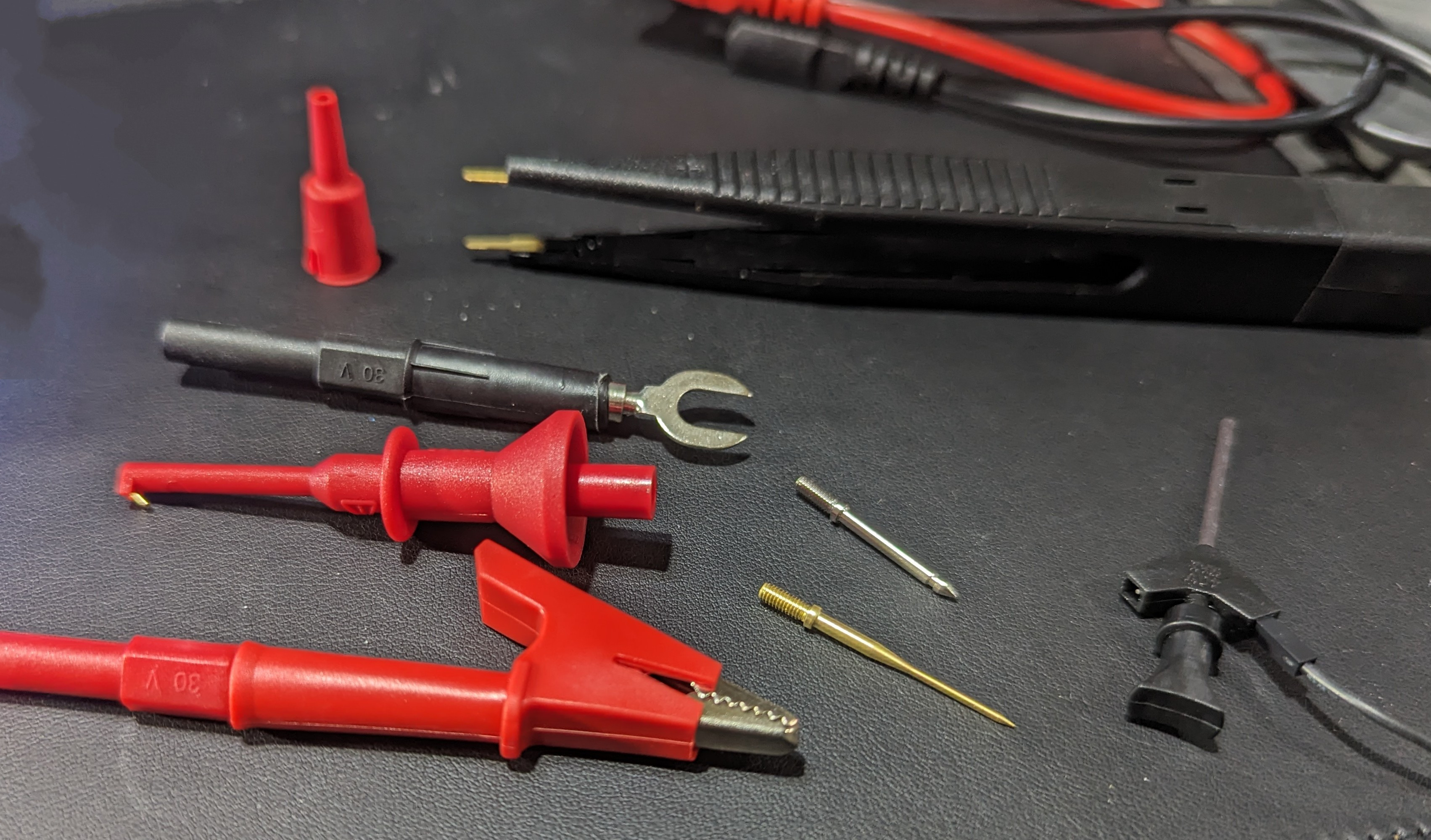
I also picked up some little alligator clips that slide over standard 2mm probe tips. These are very handy and prevent you from having to clip a lead to your probe so you can clip the other end to the circuit. However, if you look for a “test lead kit,” you’ll find many options for about $20. One kit had interchangeable probe tips, alligator clips, spades, SMD tweezers, and tiny hooks for IC legs. The alligator clips on the one I bought are the newer style that has a solid insulating body — not the cheap rubbery covers. They feel better and are easier to handle, too.
Breadboarding
Some of the accessories in the test probe kit.
Of course, you can make your own solderless breadboard jumpers, and you’ve probably seen that you can buy jumpers of various kinds. But if you search, you can even find test probes with breadboard wire ends. The other end will terminate in a test hook or alligator clips. You can also get them with banana plugs on the end to plug right into your meter. You can usually find versions with the male pin for a breadboard or a female receptacle for connecting to pins.
We were sad to hear that after 52 years in operation, iconic ham radio supplier MFJ will close next month. On the one hand, it is hard not to hear such news and think that it is another sign that ham radio isn’t in a healthy space. After all, in an ideal world, [Martin Jue] — the well-known founder of MFJ — would have found an anxious buyer. Not only is the MFJ line of ham radio gear well regarded, but [Martin] had bought other ham radio-related companies over the years, such as Ameritron, Hygain, Cushcraft, Mirage, and Vectronics. Now, they will all be gone, too.
However, on a deeper reflection, maybe we shouldn’t see it as another nail in ham radio’s coffin. It is this way in every industry. There was a time when it was hard to imagine ham radio without, say, Heathkit. Yet they left, and the hobby continued. We could name a slew of other iconic companies that had their day: Eico, Hammarlund, Hallicrafters, and more. They live on at hamfests, their product lines are frozen in time, and we’re sure we’ll see a used market for MFJ gear well into the next century.
Writing for Hackaday can be somewhat hazardous. Sure, we don’t often have to hide from angry spies or corporate thugs. But we do often write about something and then want to buy it. Expensive? Hard to find? Not needed? Doesn’t really matter. My latest experience with this effect was due to a recent article I wrote about the AM2900 bitslice family of chips. Many vintage computers and video games have them inside, and, as I explained before, they are like a building block you use to build a CPU with the capabilities you need. I had read about these back in the 1970s but never had a chance to work with them.
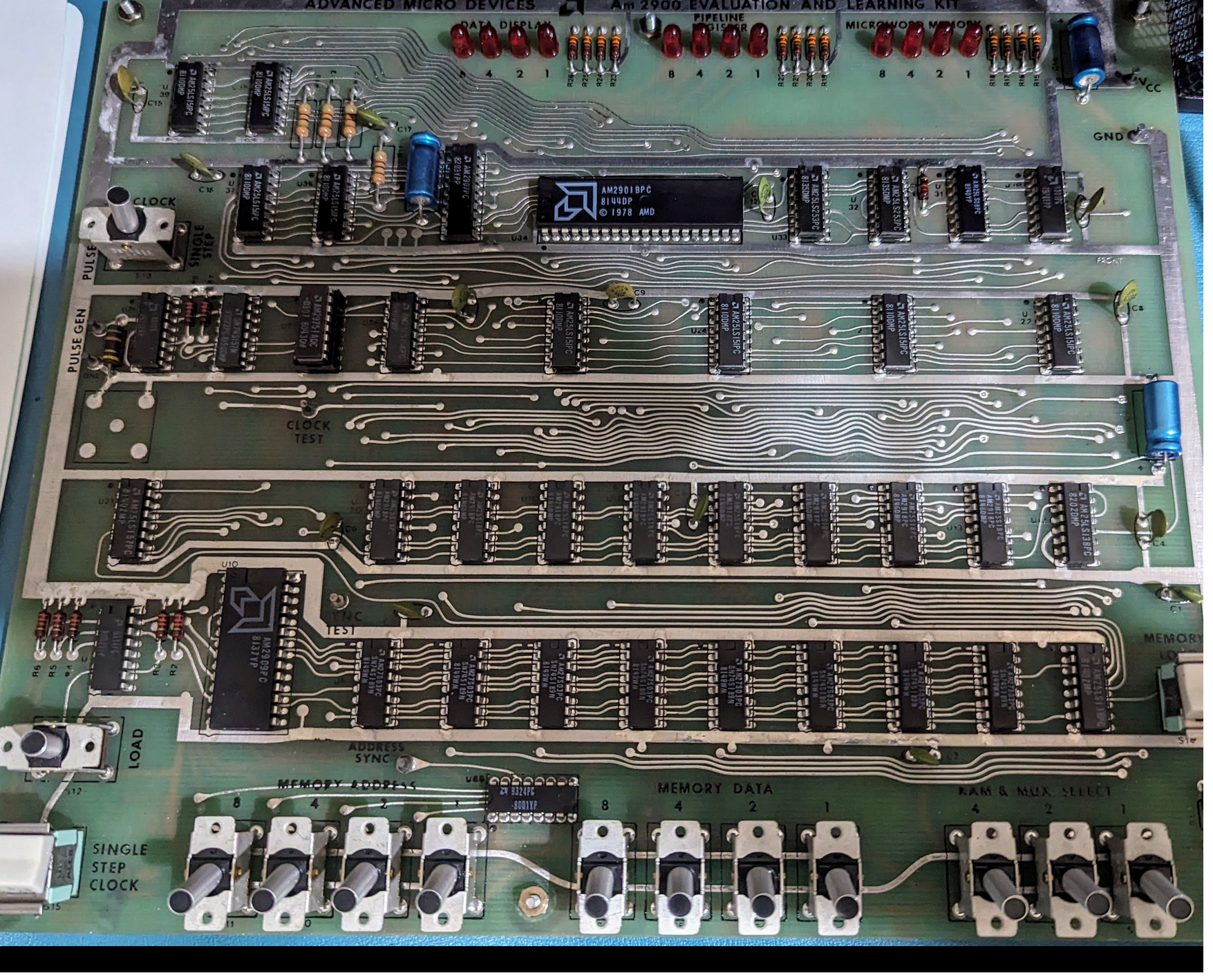
As I was writing, I wondered if there was anything left for sale with these chips. Turns out you can still get the chips — most of them — pretty readily. But I also found an eBay listing for an AM2900 “learning and evaluation kit.” How many people would want such a thing? Apparently enough that I had to bid a fair bit of coin to take possession of it, but I did. The board looked like it was probably never used. It had the warranty card and all the paperwork. It looked in pristine condition. Powering it up, it seemed to work well.
What Is It?
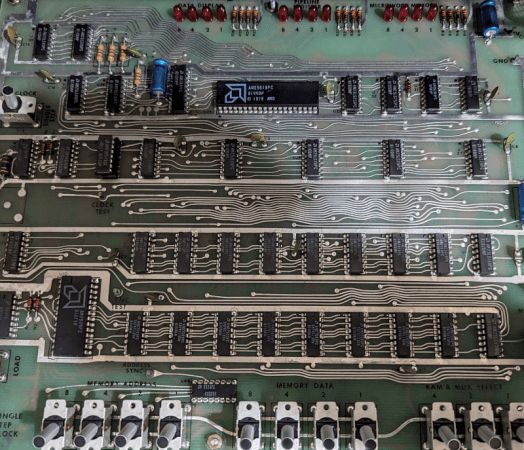
The board hardly looks at least 40 years old.
The board is a bit larger than a letter-sized sheet of paper. Along the top, there are three banks of four LEDs. The bottom edge has three banks of switches. One bank has three switches, and the other two each have four switches. Two more switches control the board’s operation, and two momentary pushbutton switches.
The heart of the device, though, is the AM2901, a 4-bit “slice.” It isn’t quite a CPU but more just the ALU for a CPU. There’s also an AM2909, which controls the microcode memory. In addition, there’s a small amount of memory spread out over several chips.
A real computer would probably have many slices that work together. It would also have a lot more microprogram memory and then more memory to store the actual program. Microcode is a very simple program that knows how to execute instructions for the CPU. Continue reading “Slicing And Dicing The Bits: CPU Design The Old Fashioned Way”→
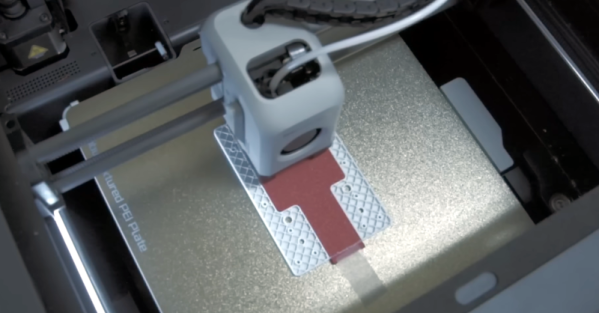
[MakerSpace] wanted to 3D print an RFID card holder. On one side is a slot for a card and on the other side has recesses for the RFID antenna. They used these to control access to machines and were milling them out using a CNC machine. Since there were no flat surfaces, he had to turn on supports in the slicer, right? No. He does use supports, but not in the way you might imagine.
Inspired by creating cast iron using sand casting, he decided to first 3D print a reusable “core” using PETG. This core will support future prints that use PLA. When printing the actual item, the printer lays down the first few layers and pauses. This allows you to stick the core in and resume the print. After the print completes, you can remove the core, and the results look great, as you can see in the video below.
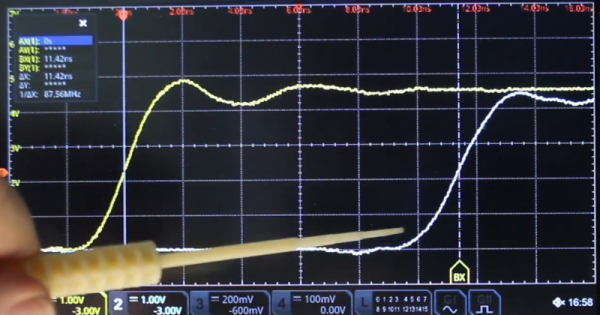
When is the speed of light not the speed of light? Of course, that’s a trick question. The speed of light may be constant, but just as sound travels at different speeds in different media, electronic signals move through transmission lines at a reduced speed. When you have a known cable, you can look up the velocity factor and use it to approximate the length of cable to have a given effective length. But what if you don’t know what kind of cable you have? [More Than Electronics] used a scope to measure it. You can see what he did in the video below.
For example, RG-8/U has a factor of 0.77. Even air isn’t exactly a factor of 1, although it is close enough that, in practice, we pretend that it is. If you wonder why it matters, consider stubs. Suppose you have a 300 MHz signal (handy because that’s 1 meter in wavelength; well, OK, pick 299.792 MHz if you prefer). If you have a quarter wavelength piece of coax shorted at one end, it will attenuate signals at 300 MHz. To understand why, picture the wave on the stub. If the close end of the stub is at 0 volts, then the other end — because it is a quarter wavelength away — must be at the maximum positive voltage or the minimum negative voltage. If either of the extremes is at the close end, then the far end must be at zero volts. That means the maximum current flows only when the signal is at 300 MHz.
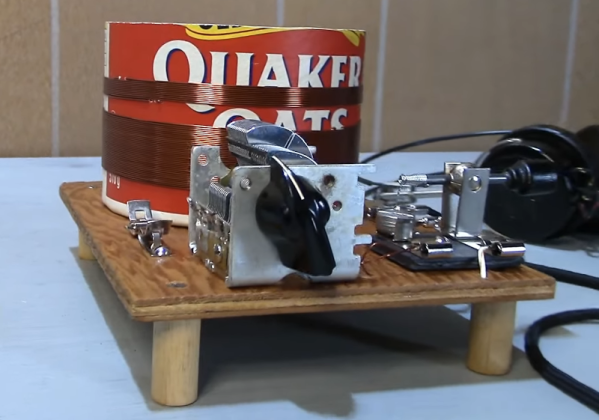
If you read the December 1970 issue of Mechanix Illustrated, you’d be treated to [Len Buckwalter]’s crystal radio build. He called out Modern Radio Labs as the supplier for parts. That company, run by [Elmer Osterhoudt], got so many inquiries that he produced a kit, the #74 crystal set. [Michael Simpson] found an unopened kit on eBay and — after a bidding war, took possession of the kit. The kit looked totally untouched. The crystal detector was still in the box, and there were period-appropriate newspaper wrappings.
The kit itself isn’t that remarkable, but it is a classic. An oatmeal box serves as a coil form. There’s a capacitor, a crystal detector, and headphones. The original cost of the parts was $7, but we imagine the eBay auction exceeded that by a large amount.
If the name [Len Buckwalter] sounds familiar, he was quite prolific in magazines like Electronics Illustrated and also wrote several books about transistors. [Michael] also shows off his innovative coil winder made from plastic cups and a coat hanger.
We’d love to find some old kits like this, although, from one way of thinking, it is almost a shame to build them after all these years. With an added audio amplifier and fiddling with the cat whisker, it sounded just fine.