Something’s Rotating In The State Of Denmark: A Clock

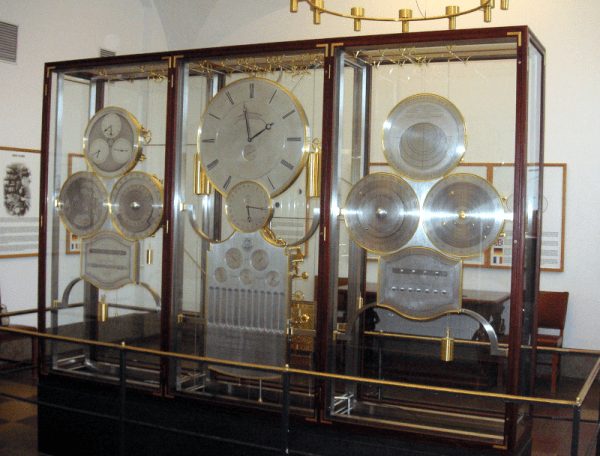
If you visit the Copenhagen City Hall, you’ll see an ornate mechanical clock. By itself, this is unremarkable, of course. There are plenty of ornate clocks in city halls around the world, but this one has a fascinating backstory that starts with a locksmith named Jan Jens Olsen. Unfortunately, Jens didn’t actually complete the clock before his death. It would take 12 years to put together the 15,448 individual parts. However, he did manage to see most of the clock that he had been designing for 50 years put together.

Jens was 60 when he started constructing the clock, but the story starts when he was only 25. In Strasbourg, the young locksmith saw an astronomical clock with a perpetual calendar in a cathedral. He was fascinated and returned several times to study the mechanism. Around the age of 30, Jens had moved to watchmaking and had a keen interest in astronomy — he was a founding member of the Danish Astronomical Society. Perhaps it was the combination of these two interests that made it inevitable that he would want to build a precise astronomically-correct clock.

Continue reading “Something’s Rotating In The State Of Denmark: A Clock”
A Homebrew SMD Vise Built From Scrap Wood

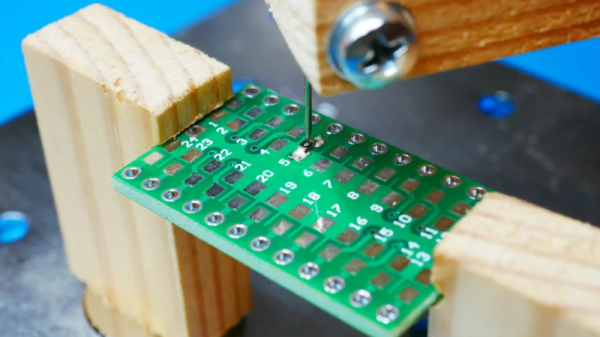
We don’t see too many wooden projects around these parts, but when [olikraus] turned a few pieces of scrap lumber into a functional SMD vise, how could we not take notice? The idea is simple. Two pieces of wood with slots in them hold the PCB. Two other pieces form an arm with an adjustable needle that can hold down tiny parts while you solder. Magnets hold each piece to a metal working surface. Simple and elegant.

We might have 3D printed some of the pieces, but then again, you have to be careful where your soldering iron goes if you go that route. The other advantage to using wood is that you can easily grab a few pieces of scrap and have a different-sized vice in just a few minutes.

There are a few improvements we might suggest. For example, a thumbscrew to fix the needle would be welcome. It seems like you could make the part that holds the needle smaller, too, to help you get your soldering iron into the same area. But it looks workable with no changes at all.

Working with scrap wood isn’t glamorous, but it does make for quick and easy functional builds. A number of the holes and bolts here could even be replaced with glue if you don’t mind the time for it to set.

Of course, you could mix and match this with other designs. We like the “dollar store PCB holder,” but it would work well with the arm from this project. We couldn’t help but think of the SMD beak when we saw this project.

Near Field EMI Probes: Any Good?

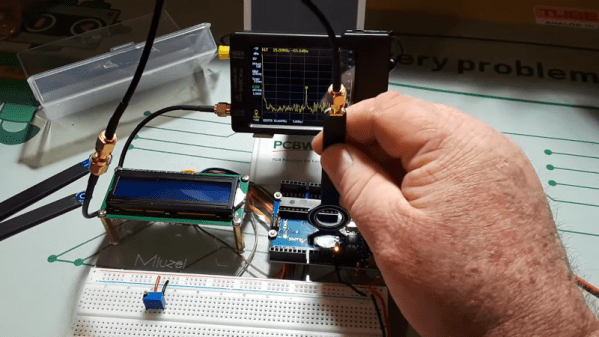
[Learnelectronics] purchased some near-field EMI probes for his tiny spectrum analyzer for about $5 on sale. Could they be any good at that price? Watch the video below and find out.

The probes arrived as a kit with four probes: three circular ones for sensing the H field and a stubby probe for sensing E fields (although the video gets this backward, by the way). There’s not much to them, but for the price, it probably isn’t worth making them yourself if your concern is the cost. Now, if you just want to make your own, we get that, too, but don’t expect to save much money.

Continue reading “Near Field EMI Probes: Any Good?”

Holographic Cellphones Coming Thanks To AI

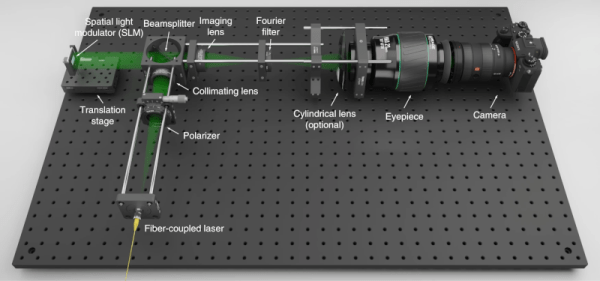
Issac Asimov foresaw 3D virtual meetings but gave them the awkward name “tridimensional personification.” While you could almost do this now with VR headsets and 3D cameras, it would be awkward at best. It is easy to envision conference rooms full of computer equipment and scanners, but an MIT student has a method that may do away with all that by using machine learning to simplify hologram generation.

As usual, though, the popular press may be carried away a little bit. The key breakthrough here is that you can use TensorFlow to generate real-time holograms at a few frames per second using consumer-grade processing power found in a high-end phone from images with depth information, which is also available on some phones. There’s still the problem of displaying the hologram on the other side, which your phone can’t do. So any implication that you’ll download an app that enables holograms phone calls is hyperbole and images of this are in the realm of photoshop.

Continue reading “Holographic Cellphones Coming Thanks To AI”

Linux Fu: Miller The Killer Makes CSV No Pest

Historically, one of the nice things about Unix and Linux is that everything is a file, and files are just sequences of characters. Of course, modern practice is that everything is not a file, and there is a proliferation of files with some imposed structure. However, if you’ve ever worked on old systems where your file access was by the block, you’ll appreciate the Unix-like files. Classic tools like awk, sed, and grep work with this idea. Files are just characters. But this sometimes has its problems. That’s the motivation behind a tool called Miller, and I think it deserves more attention because, for certain tasks, it is a lifesaver.

The Problem

Consider trying to process a comma-delimited file, known as a CSV file. There are a lot of variations to this type of file. Here’s one that defines two “columns.” I’ve deliberately used different line formats as a test, but most often, you get one format for the entire file:

Slot,String 
A,"Hello" 
"B",Howdy 
"C","Hello Hackaday" 
"D","""Madam, I'm Adam,"" he said." 
E 100,With some spaces!
X,"With a comma, or two, even"

Continue reading “Linux Fu: Miller The Killer Makes CSV No Pest”

3D Modelling In English With AI

By now, you’ve surely seen the AI tools that can chat with you or draw pictures from prompts. OpenAI now has Point-E, which takes text or an image and produces a 3D model. You can find a few runnable demos online, but good luck having them not too busy to work.

We were not always impressed with the output. Asking for “3d printable starship Enterprise,” for example, produced a point cloud that looked like a pregnant Klingon battle cruiser. Like most of these tools, the trick is finding a good prompt. Simple things like “a chair” seemed to work somewhat better.

Continue reading “3D Modelling In English With AI”

Virtualizing IPhoneOS 1.0

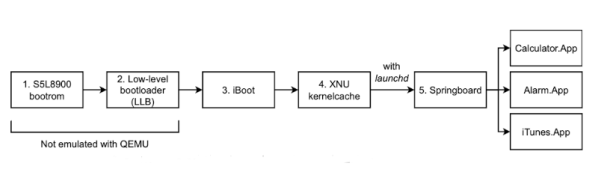
Virtualizing computers is nothing new. However, Apple devices always present challenges. Just ask anyone who has built a Hackintosh. At least computer hardware is usually exposed, but on phones, the challenge is even harder due to mysterious devices. [Martijn] managed to reverse engineer the iPod Touch 1G enough to run iPhoneOS 1.0 on it and has several blog posts explaining how he did it.

The emulator is the ubiquitous QEMU. He has emulation for the critical hardware, including the cryptographic modules, the hardware clock, and the timer, along with memory and display and interface hardware. However, Wifi, some USB, audio, the light sensor, and some graphics hardware are still absent. That doesn’t stop the OS from booting, however.

Continue reading “Virtualizing IPhoneOS 1.0”