Understanding Wavelets

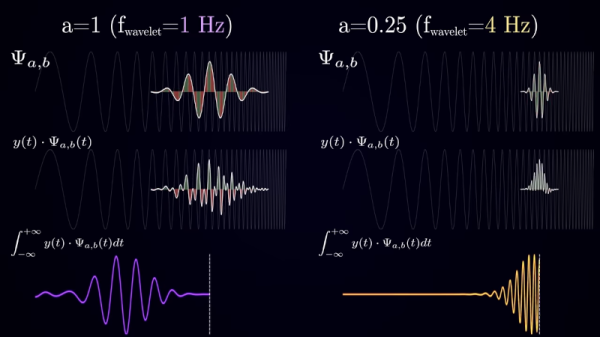
Mathematical transforms can be a great help in understanding signals. Imaging trying to look at a complex waveform and figuring out the frequency components without the Fourier transform. [Artem Kirsanov] calls the wavelet transform a “mathematical microscope” and his video gives you a great introduction to the topic. You can see the video below.

The video starts with a discussion about how the time domain and frequency domain have a dual relationship — not big news if you’ve dealt with Fourier transforms and — in fact — that’s the next topic in the video. However, there are limitations to the transformation — you lose time domain information in the process.

Continue reading “Understanding Wavelets”

Diff Tool Knows What You Mean

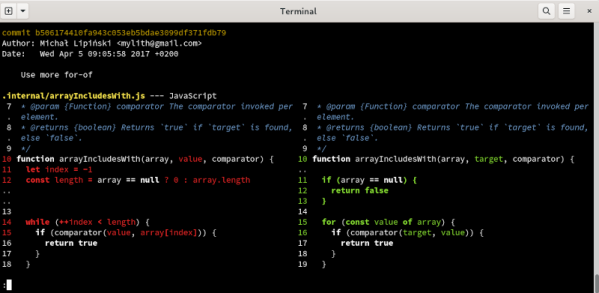
We will admit to not being particularly artistic, but we do remember an art teacher telling us that sometimes it is better to draw what isn’t there instead of what’s there — a concept known as negative space. [Wilfred] makes a similar point when explaining his “fantastic diff” tool called, appropriately, difftastic. He points out that when comparing two programs, the goal isn’t so much to determine what changed, but rather what stayed the same. The more you can identify as the same, the less you have to show as a change.

The tool compares source code in a smart way, assisted by tree-sitter which has many different languages already parsed, at least well enough for this purpose. According to [Wilfred’s] post the tool supports 44 different languages ranging from bash and YAML, Verilog to VHDL, and C++ to Rust, among others.

Continue reading “Diff Tool Knows What You Mean”

The Internet Without The Computer: 1990s Style

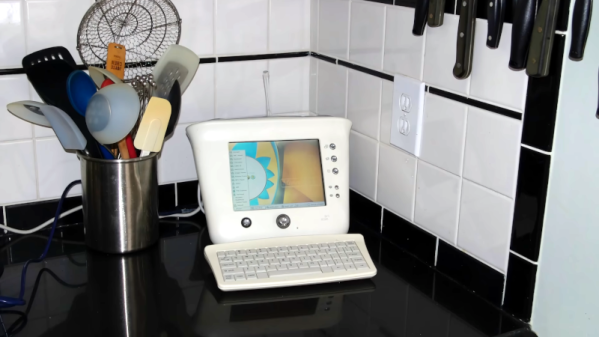
We think of the Internet extending to small devices as a modern trend, but it actually is a good example of how everything makes a circle. Today, we want the network to connect to our thermostat and our toaster. But somewhere between the year 1990 and the year 2010, there was a push to make the Internet accessible to the majority of people who didn’t own a computer. The prototypical device, in our mind, was Microsoft’s ill-fated WebTV, but a recent video from [This Does Not Compute] reminded us of another entry in that race: The Audrey from 3COM. Check out the video, below.

Many devices, like the WebTV, wanted to take over your TV set to save on a display. That doesn’t sound bad today, but you have to remember, the typical TV set in those days was not the high-resolution digital monster you have today, so the experience of surfing the Web on one was suboptimal. The Audrey actually had a cute little screen and a compact keyboard.

Continue reading “The Internet Without The Computer: 1990s Style”

Upcycling Flat Scraps With Open Source Tools

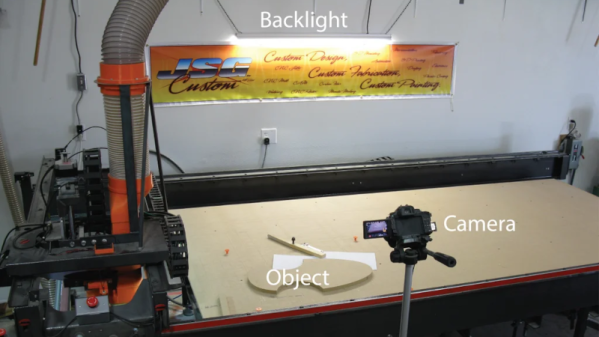
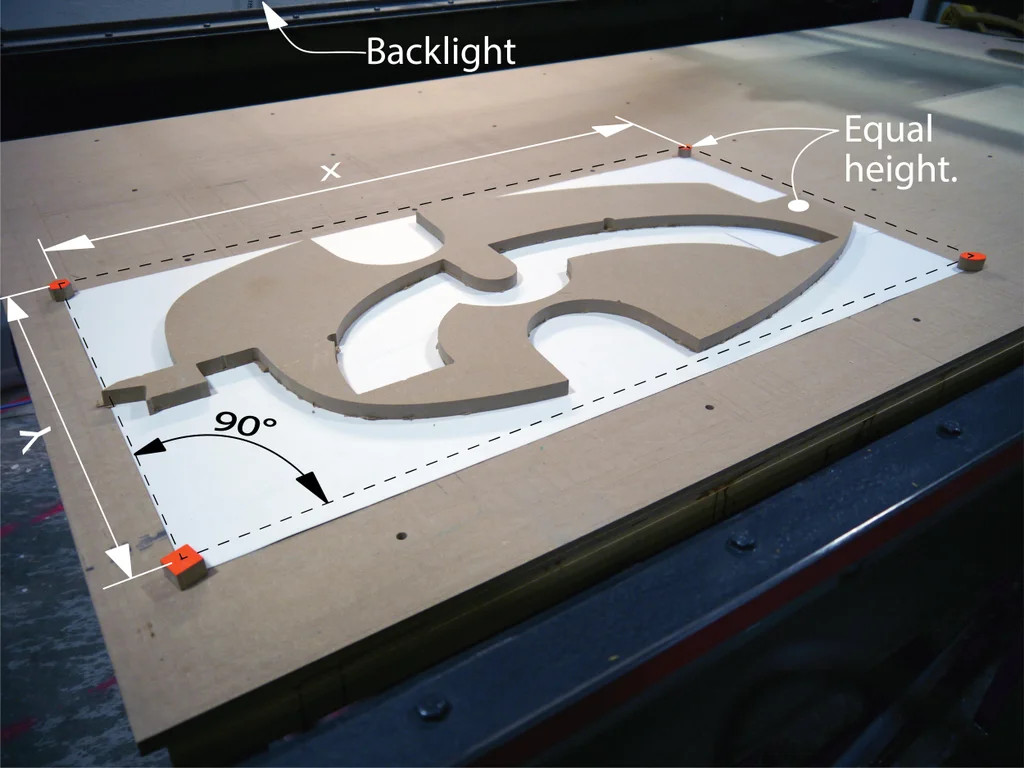
If you have any sort of device that cuts like a CNC mill or a laser cutter, you probably generate a lot of strange-looking scrap material. Most of us hate to throw anything away, but how do you plan to use all these odd shapes? [Caddzeus] has an answer.  Using a camera and some software he digitizes the shapes accurately into a form usable in his CAD package of choice.

The process involves setting up some targets with known dimensions that will appear in the photograph. This allows the picture to be taken without being overly concerned about the distance to the camera or the angle.

Using GIMP, he adjusts the images to remove the perspective. He then brings the image into Inkscape where he can accurately scale and trace the shape.

There are detailed instructions — including videos — but if you know how to use these tools, you can probably figure it out for yourself. This technique would be useful, too, if you wanted to get an outline of something you intend to mill or cut into your CAD program as a reference. We like to do this with a laser cutter so you can burn the outline of something you are engraving or cutting on a piece of paper before you start and easily align the workpiece to the laser.

Of course, a small part could surrender its image to a conventional scanner and you can use a similar technique to adjust the scale. If you start using Inkscape a lot, you’ll want more plugins. You never know what you might build from some scrap odds and ends.

Continue reading “Upcycling Flat Scraps With Open Source Tools”

Tracking Weather Balloons With SDR

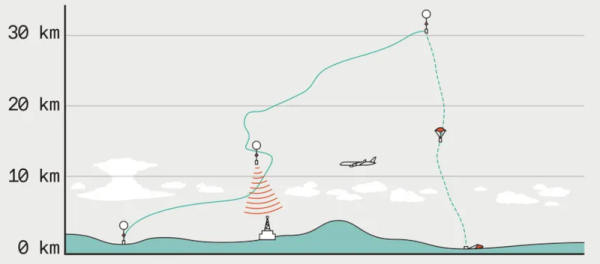
The advent of cheap software-defined radio hardware means that what would have once been an exotic expensive undertaking can now be relatively cheap. [David] notes that using some pretty simple gear, he could track down weather balloons.

The U.S. National Weather Service sends up a large number of radiosondes attached to balloons twice a day. Their job is to measure conditions at high altitudes up to about 30km. Once the balloon gets too high, the pressure inside bursts the balloon, and a small parachute slows the instrument package’s descent back to Earth. [David] wanted to track these down and return them to the NWS for reuse.

Continue reading “Tracking Weather Balloons With SDR”

Troubleshooting Barcodes: A Lesson In Critical Thinking

We’ve all been there. Something that is known to work doesn’t work out in the field. But back at home base, it works fine. How do you fix it? Of course, there’s no one right answer to that question, but [Benji York] had a particularly satisfying round of troubleshooting some errant barcodes and even came up with a very creative solution.

Here’s the setup: a customer couldn’t read some barcodes sent from [Benji’s] company. Yet when the bad barcodes returned, they were fine. They looked fine, too. In a Twitter post, [Benji] challenges you to see if you can tell what’s wrong.

Continue reading “Troubleshooting Barcodes: A Lesson In Critical Thinking”

Ask Hackaday: Stripping Wires With Lasers

Most of us strip the insulation off wires using some form of metal blade or blades. You can get many tools that do that, but you can also get by with skillfully using a pair of cutters, a razor blade or — in a pinch — a steak knife. However, modern assembly lines have another option: laser stripping. Now that many people have reasonable laser cutters, we wonder if anyone is using laser strippers either from the surplus market or of the do-it-yourself variety?

We are always surprised that thermal strippers are so uncommon since they are decidedly low-tech. Two hot blades and a spring make up the heart of them. Sure, they are usually expensive new, but you can usually pick them up used for a song. The technology for lasers doesn’t seem very difficult, although using the blue lasers most people use in cutters may not be optimal for the purpose. This commercial product, for example, uses infrared, but if you have a CO2 laser, that might be a possibility.

The technique has found use in large-scale production for a while. Of course, if you don’t care about potential mechanical damage, you can get automated stripping equipment with a big motor for a few hundred bucks.

We did find an old video about using a CO2 laser to strip ribbon cable, but nothing lately. Of course, zapping insulation creates fumes, but so does lasering everything, so we don’t think that’s what’s stopping people from this approach.

Continue reading “Ask Hackaday: Stripping Wires With Lasers”