I3C — No Typo — Wants To Be Your Serial Bus

Remember old hard drives with their giant ribbon cables? They went serial and now the power cables are way thicker than the data cables. We’ve seen the same thing in embedded devices. Talking between chips these days tends to use I2C or SPI or some variation of these to send and receive data over a handful of pins. But now there is I3C, a relatively new industry standard that is getting a bit of traction.

I2C and SPI are mature but they do have problems. I2C can be relatively slow and SPI usually requires extra pins for each device. Besides that, there is poor support for adding and removing devices dynamically or discovering devices automatically.

I3C, created by the MIPI Alliance, aims to fix these problems. It does use the usual two wires, SCL for the clock and SDA for data.  One device acts as a controller. Other devices can be targets or secondary controllers. It is also backward compatible with I2C target devices. Depending on how you implement it, speeds can be quite fast with a raw speed of 12.5 Mbps and using line coding techniques can go to around 33 Mbps.

Continue reading “I3C — No Typo — Wants To Be Your Serial Bus”
Skarper E-Bike Conversion Kit Simplifies Electrifying Your Bike

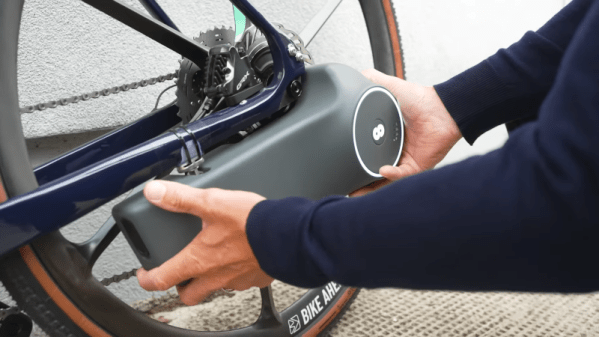
If you’re a Hackaday reader, it’s a good bet you could figure out how to convert your bike to use an electric motor. But you might have more important things to do, so a start up company, Skarper, wants to help you with a conversion kit and the folks over at [autoevolution] took a closer look at how it works. The interesting part is that it transfers power from the motor to your wheels through a disc that substitutes for the bike’s disc brake. You can see a promotional video about the product from the company below.

Unlike some conversions, it looks like with this kit you can easily snap the assembly on the bike when you want it powered and take it off when you want it to function normally or if you want to take the electronic part inside with you.

The company claims that the 250-watt motor can to propel a bike to nearly 20 miles per hour. But we’re willing to bet you can’t go that fast and get the claimed 37-mile range. On the plus side, a 30-minute charge will net you another 12 miles and a full charge only takes 2.5 hours. The battery and motor weigh a bit more than 7 pounds. Obviously, you’ll need a bike that has disc brakes.

Cost? About $1,200, so it isn’t quite an impulse buy. Especially if you have the time and wherewithal to roll your own solution. For example, try a skateboard motor. Makes it easier, too, if you have a 3D printer.

Continue reading “Skarper E-Bike Conversion Kit Simplifies Electrifying Your Bike”

Frequency Counter Restoration Impeded By Kittens

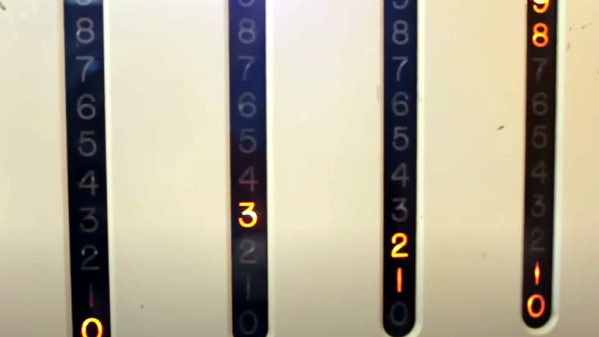
We think of digital displays as something you see on relatively modern gear. But some old gear had things like nixies or numitrons to get cool-looking retro digital displays. The HP 521A frequency counter, though, uses four columns of ten discrete neon bulbs to make a decidedly low-tech but effective digital display. [Usagi Electric] has been restoring one of these for some time, but there was a gap between the second and third videos as his workshop became a kitten nursery. You can see the last video below.

In previous videos, he had most of the device working, but there were still some odd behavior. This video shows the final steps to success. One thing that was interesting  is that since each of the four columns are identical, it was possible to compare readings from one decade to another.

However, in the end, it turned out that the neon bulbs were highly corroded, and replacing all the neon bulbs made things work better. However, the self-check that should read the 60 Hz line frequency was reading 72 Hz, so it needed a realignment. But that was relatively easy with a pot accessible from the back panel. If you want to see more details about the repair, be sure to check out the earlier videos.

We love this old gear and how clever designers did so much with what we consider so little. We hate to encourage your potential addiction, but we’ve given advice on how to acquire old gear before. If you want to see what was possible before WS2812 panels, you could build this neon bulb contraption.

Continue reading “Frequency Counter Restoration Impeded By Kittens”

There’s Gold In That There Graphene

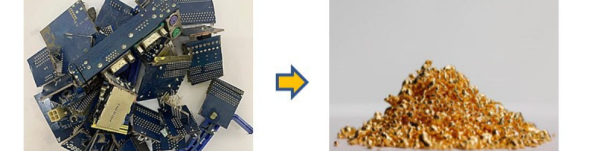
There’s gold all around us, embedded in our electronics. There are people who collect e-waste and use various methods to extract gold from them. However, it is hard to qualify it as a “get rich quick” scheme because the amount of gold recovered is usually minute. Still, if you can do volume, you can make some money and recycling is always a good idea. At the University of Manchester, they have a better way to extract gold from e-waste using graphene. You can see a brief video about the process below, or read the full paper.

The process is relatively simple. You dissolve the e-waste in a solvent, add some graphene oxide, and the gold appears bound to the graphene. You pull out the graphene and burn it off to result in the gold you want. A gram of graphene can grab 2 grams of gold and graphene is relatively cheap per gram compared to gold.

Graphene oxide nanosheets are processed using ascorbic acid into a colloid suspension. The chemical process converts gold bound with chlorine into elemental gold. After diving into why the process works, they were able to increase the selectivity of the process by manipulating the pH so that the majority of the residue is actually gold.

The team believes they can build a continuous process that takes liquefied e-waste and extracts gold as it flows through the system. If you’d rather go with the traditional method, here’s a start for you. Then again, there are other metals to recover besides gold.

Continue reading “There’s Gold In That There Graphene”

IBM’s Early PC Attracts Time Travelers

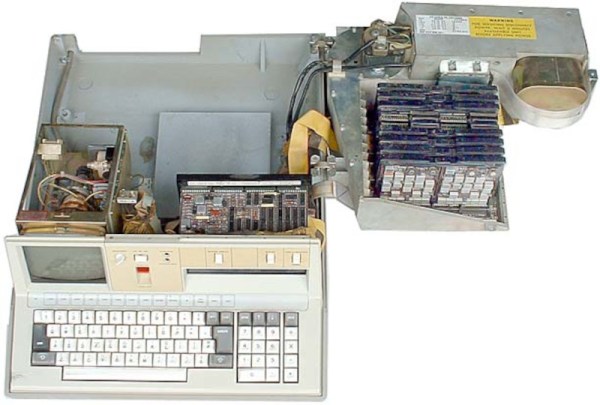
It wasn’t long ago I was nostalgic about an old computer I saw back in the 1980s from HP. It was sort of an early attempt at a PC, although price-wise it was only in reach for professionals. HP wasn’t the only one to try such a thing, and one of the more famous attempts was the company that arguably did get the PC world rolling: IBM. Sure, there were other companies that made PCs before the IBM PC, but that was the computer that cemented the idea of a computer on an office desk or at your home more than any computer before it. Even now, our giant supercomputer desktop machines boot as though they were a vintage 1981 PC for a few minutes on each startup. But the PC wasn’t the first personal machine from IBM and, in fact, the IBM 5100 was not only personal, but it was also portable. Well, portable by 1970s standards that also had very heavy video cameras and luggable computers like the Osborne 1.

The IBM 5100 had a brief three-year life from 1975 to 1978. A blistering 1.9 MHz 16-bit CPU drove a 5-inch CRT monitor and you could have between 16K and 64K of RAM along with a fair amount of ROM. In fact, the ROMs were the key feature and a giant switch on the front let you pick between an APL ROM and a BASIC ROM (assuming you had bought both).

Continue reading “IBM’s Early PC Attracts Time Travelers”

Soviet-Era Test Gear Defects To YouTube

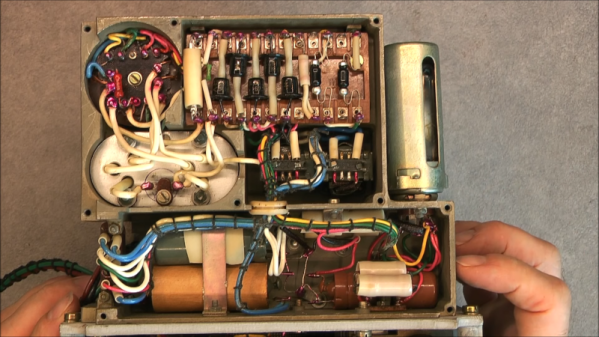
If you want to work on communication gear — especially in the 1960s — you probably wanted a VTVM (a vacuum tube voltmeter), a way to generate frequencies, and a way to measure frequencies and power. The Soviet military had a piece of portable gear that could do all of this, the IK-2, and [msylvain59] shows up how one looked on the outside and the inside in the video below. Be warned, though. The video is hard to stop watching and it runs for over an hour, so plan accordingly.

We don’t read Russian, but based on the video, it looks like the lefthand piece of gear is a frequency generator that runs from 20 to 52 MHz and a power meter. The right-hand instrument is a VTVM that has some way to measure frequency and the center section is a quartz crystal frequency standard.

Continue reading “Soviet-Era Test Gear Defects To YouTube”

Magic Mirror Isn’t Transparent Metal

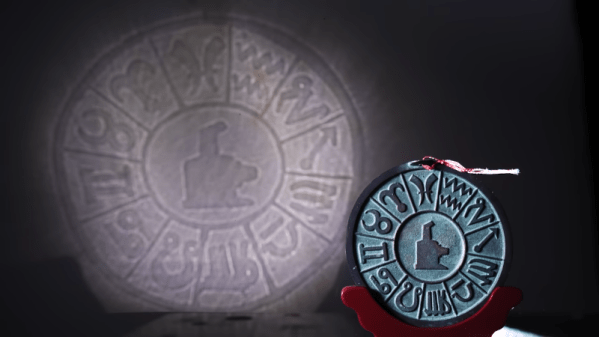
One of the Star Trek movies has a McGuffin called “transparent aluminum.” While magic mirrors aren’t really transparent, it appears that way to a casual observer. If you haven’t seen one of these, they are polished metal mirrors with a pattern embossed on the back. When you shine a point source of light on the mirror, however, the reflection matches what is on the back of the mirror. Is it transparent? No, and the video by [Steve Mould] below explains what’s really going on.

The reality is that very subtle variations of the surface produce the image. You need some understanding of optics and calculus to fully understand what’s going on.

Continue reading “Magic Mirror Isn’t Transparent Metal”