Smart Contact Lenses Put You Up Close To The Screen

Google Glass didn’t take off as expected, but — be honest — do you really want to walk around with that hardware on your head? The BBC recently covered Mojo, a company developing smart contact lenses that not only correct vision but can show a display. You can see a video from CNET on the technology below.

The lenses have microLED displays, smart sensors, and solid-state batteries similar to those found in pacemakers. The company claims to have a “feature-complete prototype” and are going to start testing, according to the BBC article. We imagine you can’t get much of a battery crammed into a contact lens, but presumably, that’s one of the things that makes it so difficult to develop this sort of tech.

The article mentions other smart contacts under development, too, including a University of Surrey lens that can monitor eye health using various sensors integrated into the lens. You have to wonder how this would be in real life. Presumably, the display turns off and you see nothing, but it is annoying enough having your phone beep constantly without getting messages across your field of vision all the time.

It seems like this is a technology that will come, of course. If not this time, then sometime in the future. While we usually think the hacker community should lead the way, we aren’t sure we want to hack on something that touches people’s eyeballs. Not everyone can say that, though. For us, we’ll stick with headsets.

Continue reading “Smart Contact Lenses Put You Up Close To The Screen”

VR Spectrum Analyzer

At one point or another, we’ve probably all wished we had a VR headset that would allow us to fly around our designs. While not quite the same, thing, [manahiyo831] has something that might even be better: a VR spectrum analyzer. You can get an idea of what it looks like in the video below, although that is actually from an earlier version.

The video shows a remote PC using an RTL dongle to pick up signals. The newer version runs on the Quest 2 headset, so you can simply attach the dongle to the headset. Sure, you’d look like a space cadet with this on, but — honestly — if you are willing to be seen in the headset, it isn’t that much more hardware.

What we’d really like to see, though, is a directional antenna so you could see the signals in the direction you were looking. Now that would be something. As it is, this is undeniably cool, but we aren’t sure what its real utility is.

What other VR test gear would you like to see? A Tron-like logic analyzer? A function generator that lets you draw waveforms in the air? A headset oscilloscope? Or maybe just a giant workbench in VR?

A spectrum analyzer is a natural project for an SDR. Or things that have SDRs in them.

Continue reading “VR Spectrum Analyzer”

Building Your Own 8088 XT Motherboard

There was a time when an XT-class motherboard — like the old IBM PC with an 8088 CPU — was a high-tech accomplishment. Now, something like that is easily within reach of the average hobby lab. [Homebrew8088] did it, and it looks surprisingly simple, especially compared to what passes for a motherboard these days.

The board will take an 8088 or one of the NEC chips and by default sports 512 K of RAM, a few ISA slots, a PC speaker, a USB hard drive, and a PS/2 keyboard connector. The board will fit in an ATX case. Not bad. You can see a video of the board below.

In fact, the channel has a lot of related videos and the main site has many interesting topics, like driving an 8088 or 8086 from a Raspberry Pi. The GitHub site has design files for KiCad along with a lot of other information. Some of this will be interesting even if you are just trying to repair an old motherboard or would like to design a new ISA card.

If you want to know why the PC used an 8088 instead of an 8086, we just covered that. What are you going to do with an old XT computer? How about IRC?

Continue reading “Building Your Own 8088 XT Motherboard”

Sound Generation Board Makes The Tunes

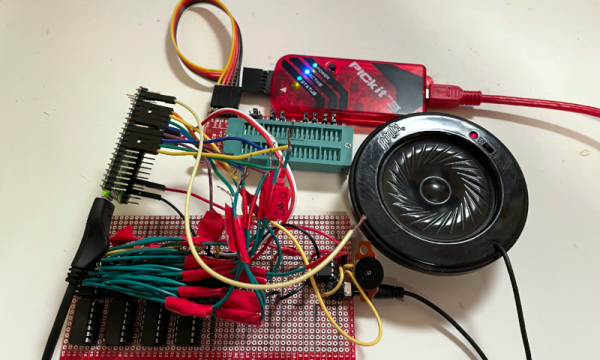
[Mcjack123] has been getting into chiptunes lately and realized that his original interest started in 2018 when he used an Arduino to turn a TI-84 calculator into a sound machine. His latest iteration is a custom-designed soundboard and he takes us through the design and construction of it in a recent post.

The work models classic sound generators like the 2A03 or the Commodore 64 SID. You have a bunch of simple waveform generators along with filters and modulators to make various effects. These boards eventually gave way to FM synthesis devices like the Yamaha OPL2 and OPL3 chips. All of these cards accepted commands and generated audio on their own. More modern boards are more likely to simply convert digital data from the computer into audio.

Continue reading “Sound Generation Board Makes The Tunes”

Scott’s CPU From The Bottom Up

It isn’t for everyone, but if you work much with computers at a low level, you’ll probably sooner or later entertain the idea of creating your own CPU. There was a time when that was a giant undertaking, but with today’s tools and FPGAs it is… well, not easy, but certainly easier. If you have the urge to try your own, you might have a look at [Simply Explained’s] video series called “Building Scott’s CPU.

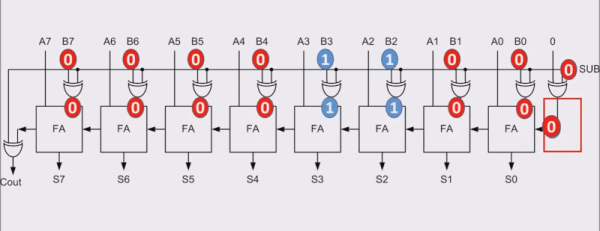
The 11 videos cover everything from basic transistor logic to sequential circuits and moves on to things like ALUs, clock units, and how jump instructions work.

Continue reading “Scott’s CPU From The Bottom Up”

Put A New Spin On Your 3D Printed Parts

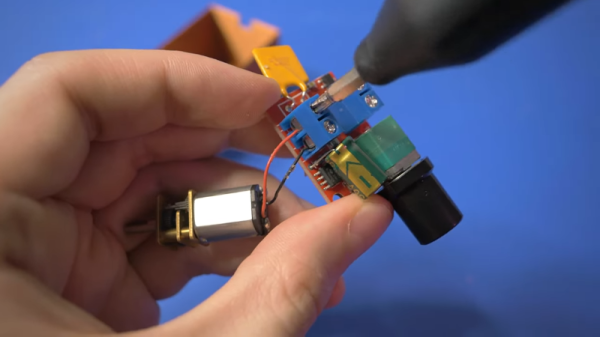
Once you get tired of printing keychains and earbud holders with your 3D printer, you’ll want to design things a bit more sophisticated. How about things that rotate? [3DSage] has a good how-to about how to integrate a simple motor and controller into a few different size boxes. Combined with some 3D printed linkages, these boxes can turn your project — printed or otherwise — into something that spins.

To demonstrate, he created a few cat toys, played with an idea for a magic trick, and refit a selfie light into… something. We have no doubt you can find something to do with these little motor modules. The boxes vary mostly in how big the battery packs are. There are also several interesting side pieces like a 3D holder for rechargeable button cells and their charger.

In addition, he also demonstrates how to use the motor as a (rather poor) generator. Attaching a water wheel wasn’t a success until he used compressed air to run the wheel. You would have thought water would have done the trick.

The video stresses that you should solder connections, but you don’t have to. Honestly, we think if you are building moving stuff with a 3D printer, you should probably just go ahead and learn to solder. It isn’t that hard and there are plenty of reasons to learn.

Of course, you could 3D print the motor itself. Adapting motor modules for different uses isn’t a new idea, of course, but it is always great to see more ways to apply basic components.

Continue reading “Put A New Spin On Your 3D Printed Parts”

Engineering Vs Pigeons

We’ve all been there. Pigeons are generally pretty innocuous, but they do leave a mess. If you have a convertible or a bicycle or even just a clean car, you probably don’t want them hanging around. [Max] was tired of a messy balcony, so like you might approach any engineering problem, he worked his way through several possible solutions. Starting with plastic crows, and naturally ending with an automated water gun.

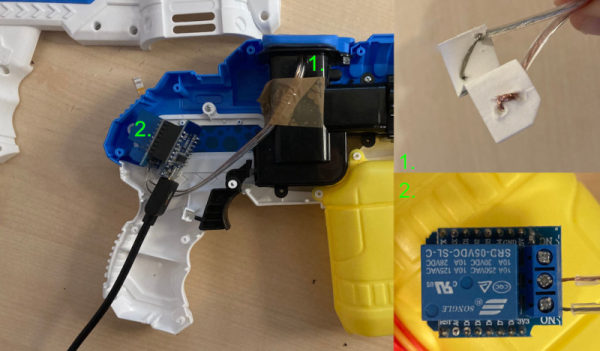
The resulting robotic water gun that targets pigeons with openCV is a dandy project and while we don’t usually advocate shooting at neighborhood animals, we don’t think a little water will be any worse than the rain for the pigeons. The build started with a cheap electric water pistol. A Wemos D1 Mini ESP8266 development board provides the brainpower. The water pistol wouldn’t easily take rechargeable batteries, plus it is a good idea to separate the logic supply and the pump motors, so the D1 gets power from a USB power bank separate from the gun’s batteries.

That leaves the camera. An old iPhone 6S with a 3D printed bracket feeds video to a Python script that uses openCV. If looks for changes using a very particular algorithm to detect that something is moving and fires the gun. It doesn’t appear that it actually tracks the pigeons, so maybe that’s a thought for version 2.

Was it successful? Maybe, but it does seem like the pigeons learned to avoid it. We still think azimuth and elevation on the gun would help.

Most of the time when we see pigeon hacking it is to use them for nefarious purposes. [Max] should be glad he doesn’t have to deal with lions.